I believe that love does not fear questions. A heart rooted in god does not have to listen with fear, because truth does not need to be defended with anger or hostility.
I strongly believe we can enter into conversations with humility and compassion, seeking to understand the person before us without fear of it shaking or erasing our own conviction in our belief. We can listen, learn, and engage with traditions, beliefs, and ideas that challenge us, while still remaining faithful to the path that we have been called to walk.
For me personally, faith is not about closing myself off from questions that challenge my belief it is about allowing God to deepen my understanding through love, wisdom, and humility
One thing I’ve learned since leaving Islam and rediscovering Christianity—particularly Orthodox Christianity, which preserves the ancient faith of the early Church—is that the idea of Islam simply continuing the biblical story isn’t as straightforward as I once believed.
I wasn’t always a Muslim. I was born and raised Roman Catholic and spent over 48 years exploring different faiths and spiritual traditions. Looking back, many seemed to contain echoes of similar questions and longings, each reflecting humanity’s search for God.
When I embraced Islam, I genuinely believed it completed what had come before. But as I continued to study while I was still a Muslim, I came to a different conclusion. In fact, that growing conviction became one of the reasons I eventually left Islam.
While the Qur’an speaks respectfully of the Torah and the Gospel as revelations from God, Muhammad did not simply continue the biblical story as Christians understand it. The Qur’an rejects some of the New Testament’s central claims: Christ’s crucifixion, His resurrection, His divinity, His identity as the Son of God, and the Holy Trinity.
As a Muslim, I believed the Bible had been corrupted. Yet when I began examining the historical evidence, the early manuscripts, and the writings of the first Christians, I found myself confronted with something I could no longer ignore. The earliest Christians proclaimed the death and resurrection of Jesus centuries before Islam, and that message has remained at the heart of the Christian faith.
For me, I haven’t found a new story. I’ve come home to the oldest one—the Gospel of Jesus Christ, faithfully preserved in the Orthodox Church.
This isn’t written to attack anyone’s faith or to win an argument. It’s simply an honest account of where my search for truth has led me, and why I could no longer believe that Islam was the continuation of the Gospel as claimed, it was the attempt to change it.
This isnt a question that can be answered simply and I dont intend to claim to be a scholar simply a sinner that follows Christ.
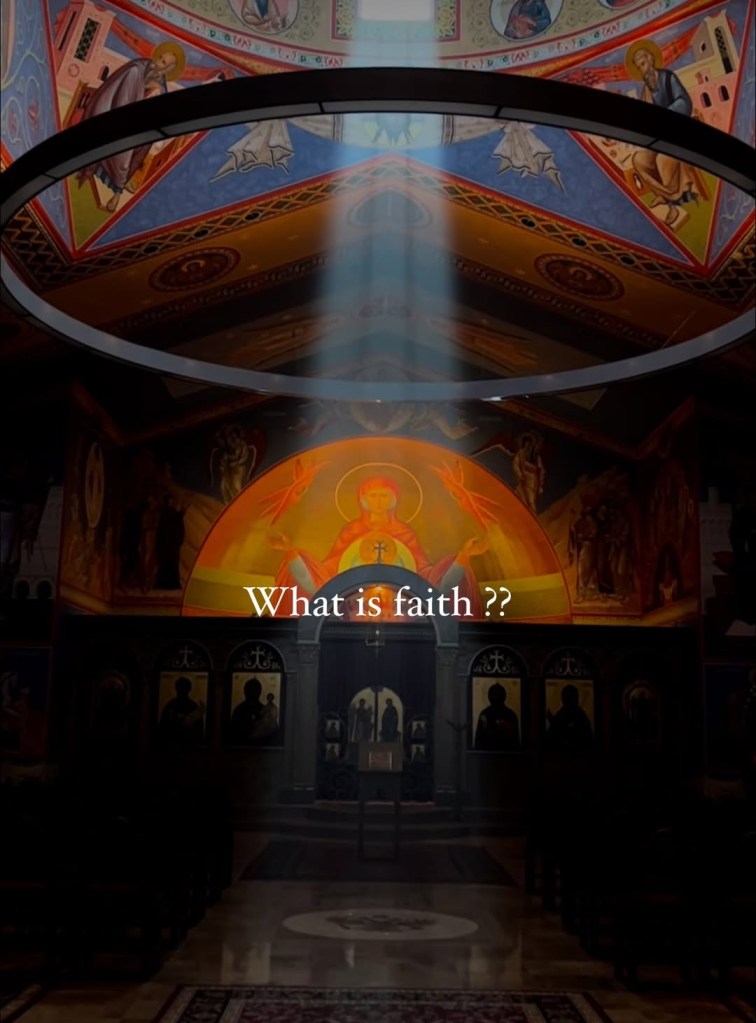
For me faith in God is not like solving a maths problem where you reach a point of absolute proof and there is nothing left to question. God is not simply an answer we arrive at through logic — He is Someone we come to know, trust, and love.
Faith is not just believing that God might exist; it is the assurance that He is there and that we can place our trust in Him.
Because faith is a relationship, it can exist alongside doubt. Having questions or moments of uncertainty does not mean we have no faith. In fact, doubt can sometimes be part of a living faith because it shows we are searching, growing, and engaging with God rather than simply accepting things without thought.
Faith is not about being comfortable and never questioning; it is about taking the courage to step forward, to seek, and to discover more of God.
In this way, faith is an ongoing conversation with our doubts — choosing to continue trusting while we keep growing.


You must be logged in to post a comment.