One of the things I am beginning to understand more deeply about Christianity is the profound distinction it makes between the Creator and creation. God is the Creator; we are His creation. The world, nature, the universe and everything within it are creation, not God. Yet everything that exists is dependent upon Him and ultimately points back to Him.
I think there is something incredibly humbling about recognising that we can know God without ever being able to fully comprehend Him. We can seek Him, love Him, worship Him and experience His presence, but we cannot contain Him within our understanding. God is not simply an idea or a feeling that we can define according to our own experience. There is a difference between knowing God and knowing everything about God.
Christianity leaves room for that mystery. We can genuinely know God while accepting that our knowledge is incomplete. We can have faith without having every answer. We can ask questions without losing faith. We can stand in awe of something that is greater than our ability to explain.
And I think the distinction between Creator and creation is important because it stops us from making ourselves, nature or the universe into something they are not. A sunrise isn’t God, the sea isn’t God, the stars aren’t God, and we aren’t God. But creation can still reveal something of its Creator. It can point beyond itself towards the One from whom everything comes.
Then Christianity states that the Creator entered His creation. In Jesus Christ, Christians believe that God came into the world He made, taking on human nature and coming near to humanity. The Creator did not remain distant from His creation; He entered into it.
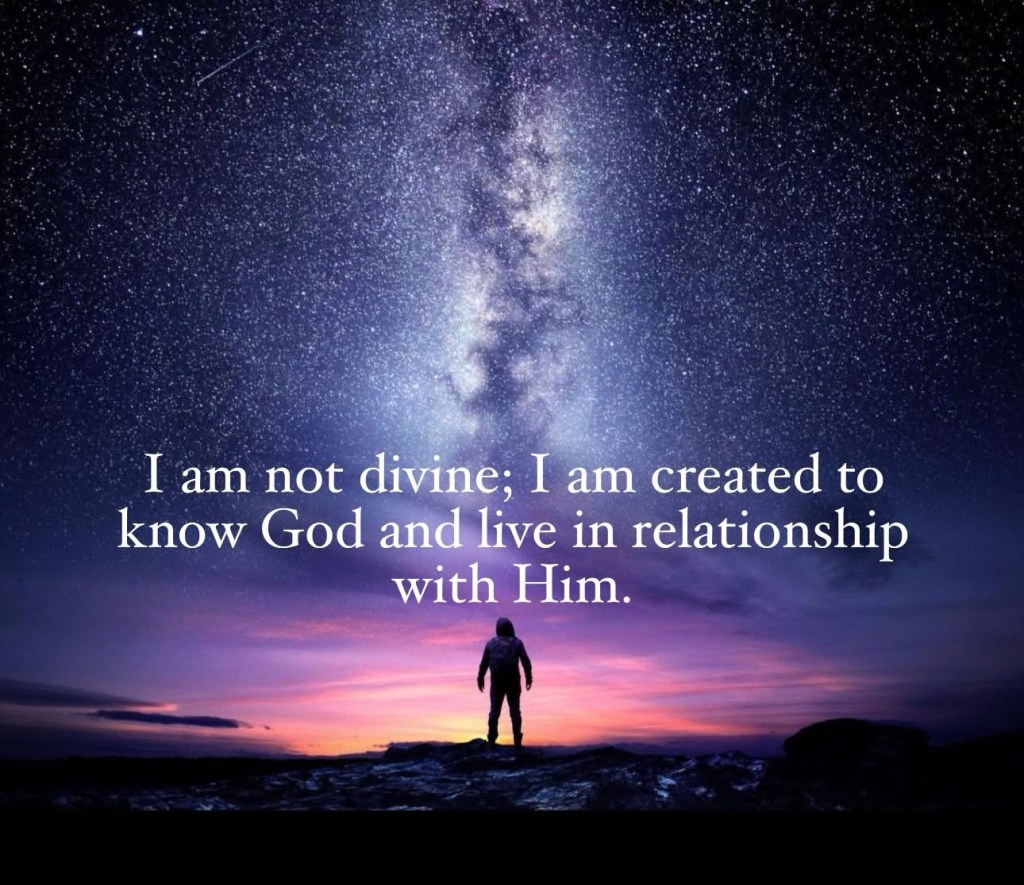
For me, that makes Christianity fundamentally relational. It isn’t about discovering that I am divine or trying to escape my humanity. It is about coming to know the God who created me and learning to live in relationship with Him.
There is actually something deeply freeing in recognising that I am not God. I don’t have to understand everything, control everything or carry the weight of everything. I am allowed to be human: finite, limited, learning and still searching. My limitations don’t make me worthless. They simply remind me that I am creation, not the Creator.
Perhaps faith isn’t about possessing complete certainty. Perhaps it is about being willing to keep seeking, keep learning and keep asking, while remaining humble enough to recognise that God will always be greater than my understanding of Him.
I don’t need to become God. I don’t need to contain God within my own ideas. I simply want to know God.
And perhaps there is a quiet peace in that distinction: God is God, and I don’t have to be.
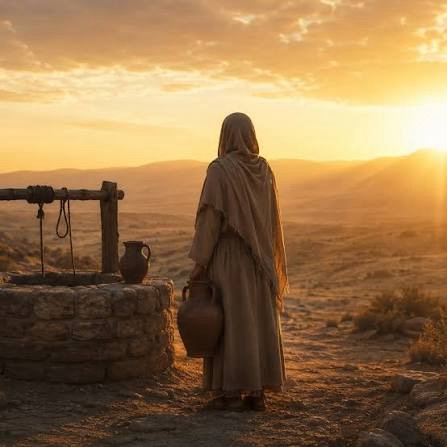
One of the names of God I’ve been discovering is El Roi, a Hebrew name meaning “The God Who Sees Me.”
It comes from Genesis 16:13, when Hagar encounters God in the wilderness. Hagar is alone, distressed and vulnerable, and after her encounter with God she gives Him this name: El Roi — the God who sees me.
The name itself comes from Hebrew. “El” (אֵל) means God, while “Roi” (רֳאִי) is connected with the Hebrew idea of seeing, looking upon or perceiving. So the name carries the beautiful sense of God who sees me — not merely seeing me physically, but seeing and knowing me completely.
There’s something incredibly powerful about that.
God sees what I’m going through. He sees the things I don’t say out loud. He sees my struggles, my fears, my hopes and the parts of me that other people might never see. He sees me when I feel invisible, and He hasn’t forgotten me.
And I think that’s what makes this name so personal. It reminds me that I don’t have to explain everything to God for Him to understand me. He already sees me.
You can pray the name El Roi whenever you need to remind yourself of that.
You might simply say:
“El Roi, You are the God who sees me. You know me completely. You see where I am, what I’m carrying and what I need. Help me to remember that I am never unseen or forgotten. Amen.”
You don’t need a special time or place to pray it. You could pray it in the morning, before going to sleep, while walking, when you’re overwhelmed, or simply whenever you need to feel close to God.
For me, there’s something deeply comforting about knowing that the God who sees everything also sees me personally.
I’ve been thinking a lot about religious syncretism, particularly the way it has become increasingly common within Western spirituality.
And I want to make something clear: I am not opposed to people exploring different religions. I am not opposed to people finding wisdom in different traditions, questioning what they have inherited, or even constructing a personal spiritual philosophy from the things that speak to them.
What I do question is the point at which that personal philosophy is presented as though it is an established religion.
Because there is a fundamental difference between saying:
“I have constructed my own spiritual path, drawing inspiration from Christianity, Hinduism, Islam, Buddhism and other traditions.”
and saying:
“I am a Christian,” “I am a Muslim,” or “I am Jewish,” while simultaneously rejecting or substantially redefining the fundamental theological claims of those traditions.
Those are not necessarily the same thing.
A religion is not simply a collection of practices, symbols, scriptures and ideas that we can select from according to personal preference. Religious traditions have developed particular understandings of God, humanity, morality, revelation, salvation, worship and ultimate reality. Those beliefs form interconnected theological systems.
You cannot necessarily remove the pieces you don’t like, add ideas from another tradition, and still claim that what you have constructed represents the original religion.
And I say this partly from experience.
There were periods in my own spiritual journey when I found it incredibly easy to cherry-pick.
I could take something from one tradition because I found it beautiful, something from another because it resonated philosophically, and something else because it gave me a practice that felt meaningful. I could place it all under the broad umbrella of spirituality or paganism and tell myself that I was creating something expansive, open-minded and uniquely my own.
At the time, that felt liberating.
Eventually, though, I had to confront something much more uncomfortable.
I wasn’t discovering a truth. I was constructing a belief system.
And because I was constructing it myself, I could continually alter it. I could remove whatever challenged me, retain whatever resonated with me, borrow whatever I found beautiful and discard whatever no longer served me.
I eventually recognised that what I had built was, in a very real sense, empty.
Not because every individual thing I had taken from those traditions was meaningless. Many of those things had genuinely moved me.
It was empty because there was no foundation outside of myself.
I was searching for something greater than myself while simultaneously making myself the final authority over what that something was allowed to be.
And the more I combined, borrowed, altered and diluted, the more fragmented it became.
A little of this.
A little of that.
A fragment of one tradition, a symbol from another, a philosophy from somewhere else.
Eventually, the whole thing became fractured.
And perhaps that is the paradox of syncretism.
It can look incredibly rich from the outside because it contains elements of so many traditions.
But sometimes, when you keep taking pieces away from their original context and combining them according to your own preferences, you don’t end up with something richer.
You end up with something thinner.
Something fragmented.
Something that contains many influences but no real centre.
And I think that is what I eventually came to understand about myself:
I wasn’t necessarily looking for truth anymore. I was looking for pieces of truth that I could make comfortable enough to live with.
There is a profound difference.
Truth, if we genuinely believe it to be truth, has the capacity to confront us.
It can tell us that we are wrong.
It can demand something from us.
It can challenge our assumptions.
It can require us to surrender our own preferences rather than constantly adapting itself to them.
And perhaps that is why an established religious tradition can be so uncomfortable.
It isn’t ours to redesign.
It existed before us.
It has its own claims, its own history, its own scriptures, its own practices and its own understanding of what is true.
We can reject it.
We can question it.
We can leave it.
We can embrace it.
But we cannot simply reconstruct it according to our own preferences and then insist that what we have created is the same thing.
This becomes particularly important when we consider the Abrahamic religions.
There is an increasing tendency within Western spiritual culture to treat Christianity, Judaism and Islam almost as spiritual toolboxes. A little mysticism here. A little scripture there. A prayer from one tradition. A symbol from another. A philosophy borrowed from somewhere else.
Everything becomes interchangeable.
And perhaps the intention is beautiful: unity, tolerance, universalism, the belief that all religions are ultimately pointing towards the same truth.
But there is another consequence that we don’t talk about enough.
It changes how the religion itself is perceived.
I know this from my own experience of Islam.
Whatever disagreements I may have had with Islam, I developed a genuine respect for the seriousness with which many Muslims approach the preservation of their tradition. Islam is not monolithic—there are profound differences between traditions, schools and interpretations—but there is nevertheless a strong emphasis on remaining anchored to scripture, prophetic tradition and established scholarship.
Someone cannot simply remove doctrines they dislike, introduce an entirely different metaphysical framework and then expect Muslims to accept that as an equally valid expression of Islam.
They will quite reasonably say:
“That isn’t what Islam teaches.”
And I think Christians have every right to say the same thing about Christianity.
And this matters because religion is not merely an individual matter.
Religions have histories.
They have communities.
They have sacred texts.
They have inherited traditions.
They have people who have spent centuries preserving, defending, interpreting and living according to their beliefs.
When we take those traditions and continually reshape them until they fit our own worldview, we aren’t simply exercising personal freedom.
We are also changing how those traditions are perceived by everyone else.
That, to me, is where dilution becomes a serious problem.
Someone who has never seriously studied Christianity may encounter a person presenting themselves as Christian while simultaneously holding a radically different theological framework—and assume that this is what Christianity actually is.
It isn’t.
The same principle applies to Islam, Judaism, Hinduism and every other established religious tradition.
You don’t have to agree with a religion.
You don’t even have to respect its theological claims.
But if you are going to represent it, there is an intellectual responsibility to understand what it actually claims to be.
Otherwise, we end up with a Westernised reconstruction of ancient traditions being presented back to the world as though nothing has changed.
Christianity becomes reduced to vague spirituality, universal consciousness and inspirational teachings.
Islam becomes simply “peace and spirituality.”
Hinduism becomes a collection of detached philosophical concepts and practices.
Judaism becomes mysticism and symbolism.
And the actual religions—with their scriptures, histories, doctrines, communities and sometimes very uncomfortable truth claims—disappear beneath the aesthetic.
That is where I think we need to be careful.
I don’t think we should be afraid of people exploring.
Nor do I think religious pluralism requires hostility towards people who practise differently.
But I do think we should be intellectually honest about what we’re doing.
There is a difference between saying:
“I have taken inspiration from several religious traditions and created my own spiritual path.”
And saying:
“All of these traditions are essentially saying the same thing.”
The first is an honest description of personal spirituality.
The second makes an enormous theological claim—and one that the religions themselves do not necessarily make.
Perhaps the real danger of modern Western syncretism isn’t that people are exploring.
Perhaps it is that, in our determination to make everything compatible, we gradually erase the boundaries, doctrines, histories and distinctive claims that made those traditions what they were in the first place.
And perhaps this is the part that matters most to me now:
You are free to construct your own spiritual philosophy.
You are free to explore Christianity, Hinduism, Islam, Judaism, Buddhism or Paganism.
You are free to find beauty in all of them.
You are free to reject all of them.
But you don’t get to construct your own theology, give it the name of an established religion and then expect that religion to accept your reconstruction as though nothing has changed.
You can create your own spiritual house.
But you don’t get to knock down the foundations of an ancient one and then insist that you are simply redecorating it.
Perhaps the greatest respect we can show a religious tradition is to allow it to speak for itself.
Not the version that makes us comfortable.
Not the version that fits neatly into modern Western spirituality.
Not the version we have reconstructed from the pieces we personally like.
But the version its own adherents have inherited, argued over, preserved and lived for generations.
Because once every religion becomes a collection of interchangeable ideas, we may think we have created harmony.
But we may actually have created something else entirely:
I heard something recently that really stayed with me. I can’t remember the exact words or who originally said it, but the message was essentially this:
Stop reading about Christ. You don’t need another book. You don’t need another icon. You need to live the teachings of Christ.
And honestly, that hit me.
Because I think this is another reason why Orthodox Christianity has begun to make so much sense to me.
I’ve spent years searching through different spiritual traditions, and so much of spirituality can become about acquiring things — another book, another object, another symbol, another ritual, another altar, another thing that supposedly brings you closer to whatever you’re seeking.
And Christianity can become that too, if we’re not careful.
You can have an entire bookshelf about Christ.
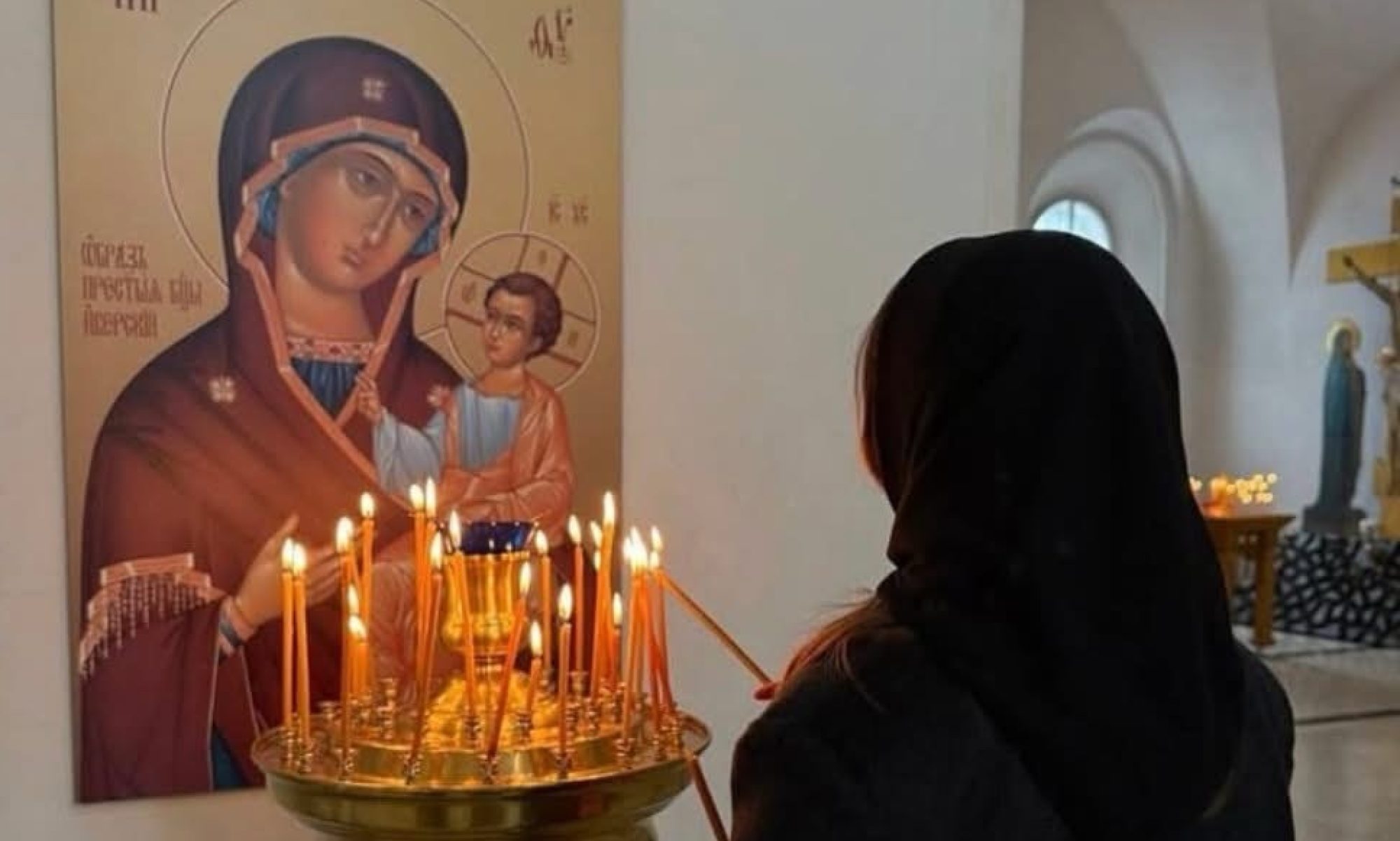
You can have beautiful icons on your walls.
You can have the perfect prayer corner.
You can know the prayers.
You can know the theology.
You can know the history.
You can talk endlessly about Christ.
And yet still not actually live like Christ.
That’s the bit that really gets me.
Because what good is knowing everything about Christ if I’m not trying to live what He taught?
What good is having an icon of Christ if I’m not trying to see Christ in the person standing in front of me?
What good is reading His words every day if I don’t allow those words to change the way I behave?
And this brings me back to something I’ve been discovering about myself.
I don’t need another thing.
I don’t need to keep accumulating objects in order to prove my spirituality.
I don’t need my entire home to become a visual representation of my faith.
Yes, I have a prayer corner. I love the icons. I love the beauty, the incense, the prayers and the ancient traditions of Orthodoxy.
But those things aren’t the destination.
They point me towards Christ.
And then, at some point, I have to put the book down.
I have to step away from the icon.
I have to leave the prayer corner.
And live it.
Love people.
Forgive.
Show mercy.
Be humble.
Serve.
Don’t judge.
Care for the stranger.
Love your enemy.
Feed the hungry.
Visit the lonely.
Give without expecting anything back.
Because perhaps the greatest expression of my faith isn’t how many books about Christ I own, how many icons I have, or how beautifully I can arrange my prayer corner.
Perhaps it’s what happens when I walk out of my front door.
That’s where I have to live the Gospel.
And maybe that’s the simplest thing Christianity has taught me so far:
I don’t need to keep collecting things that point me towards Christ. I need to actually turn towards Christ — and then live as He taught me to live.


You must be logged in to post a comment.