
The Quiet gift of being a revert

There is a particular strength that comes with finding faith rather than inheriting it.

To come to Islam as a revert is to arrive without the weight of sect, tribe, or cultural ownership. It is to meet the Qur’an as it speaks, not as it has been filtered, weaponised, or narrowed by wounded egos and power struggles. Many of us come bruised, questioning, and alert — not empty-headed, not submissive in the unhealthy sense, but awake.

And because we were not carried into belief by habit, our faith is not easily shaken by noise.

When someone hurls labels like kāfir as an insult, or tries to weaponise Islam to assert dominance, it does not undo us. We recognise that behaviour for what it is: human injury dressed up as piety. Islam does not need such defenders, and Allah does not require cruelty spoken in His name. The Qur’an itself warns us that oppression and arrogance are not signs of closeness to God, no matter how loudly someone speaks about Him.

What anchors reverts is that our relationship with Allah is direct.

Allah says in the Qur’an:

“And when My servants ask you concerning Me — indeed, I am near. I respond to the call of the caller when they call upon Me.”

(Qur’an 2:186)

Near. Not mediated. Not guarded by gatekeepers. Not owned by scholars, sects, or loud men with microphones.

This is why the faith of a revert often feels unshakeable. We did not arrive because we were told to believe — we arrived because we answered a call. We searched, resisted, doubted, circled back, and then recognised truth when it stood before us. When belief comes that way, it settles deeper in the bones.

Many reverts naturally gravitate to the Qur’an first — not out of rebellion, but out of instinct. The Qur’an is Allah’s own speech, unambiguous in its call to tawḥīd, justice, humility, and mercy. It repeatedly corrects the very human tendency to elevate messengers beyond their station. The Prophet Muhammad ﷺ is honoured, loved, and followed — but never worshipped. He, like Jesus before him, called people away from himself and toward God.

The Qur’an reminds us:

“Say: I am only a human being like you, to whom it has been revealed that your God is One God.”

(Qur’an 18:110)

To honour the Prophet is to follow his message — not to replace Allah with reverence so intense that it slips into something else.

Reverts often sense this intuitively because nothing in us is inherited. There is no fear of “betraying tradition,” no reflexive loyalty to hadith over Qur’an, culture over conscience. This doesn’t make reverts superior — but it does make the faith cleaner at the point of contact. Fresh water at the source.

And yes, among reverts there are disagreements, half-formed ideas, unpolished theology. That’s natural. But what binds us is a shared understanding: the Qur’an is the criterion. Opinions may exist, but they bow to revelation. Hadith may inform, but they never outrank Allah’s words. This hierarchy matters — especially in an age where Islam is often reduced to rules, outrage, and identity warfare.

There is also something quietly powerful in knowing that we were not “chosen” in the way people sometimes romanticise.

We chose.

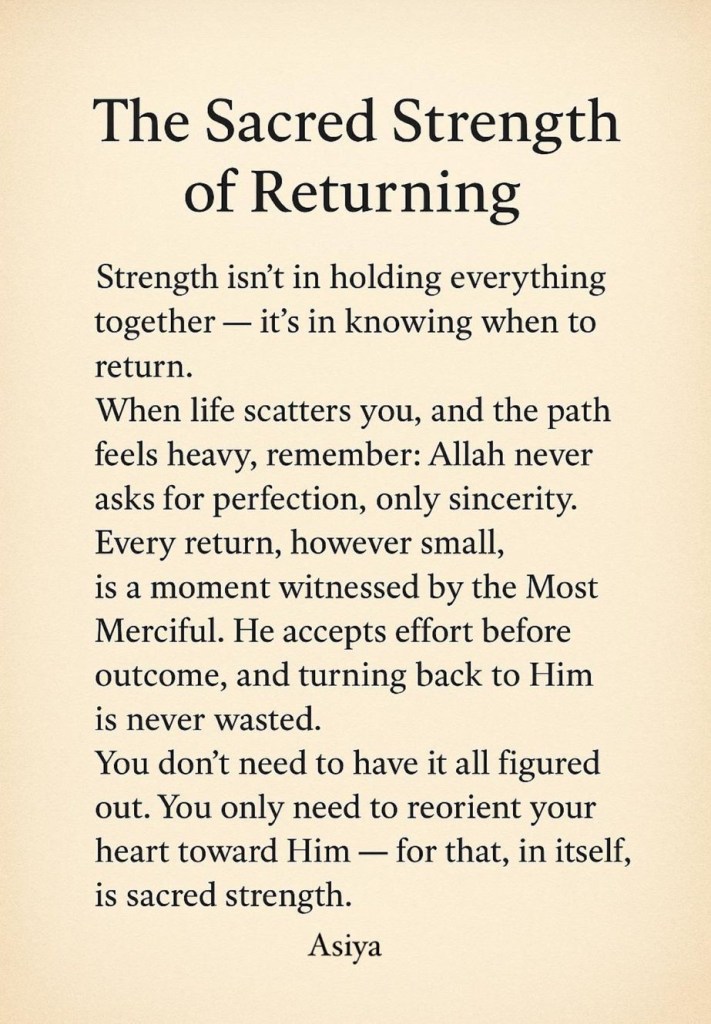
We stepped toward Allah — and He drew near.

The Prophet ﷺ narrated (in meaning) that Allah says: “Whoever comes to Me walking, I come to them running.” While this wording comes through hadith, its spirit is already alive in the Qur’an’s promise of nearness, response, and mercy. It captures something many reverts feel in their chest: the sense that when we turned, even hesitantly, we were met with overwhelming gentleness.

This is why external hostility does not undo us.

This is why insults do not hollow us out.

This is why wounded voices cannot steal our peace.

Our Islam is not borrowed.

Our faith is not second-hand.

Our conviction was earned through seeking.

And perhaps that is the quiet gift of being a revert:

to love Allah not because we were raised to —

but because, after everything, we recognised Him.
How Can Men Lead Their Wives If They Don’t Even Know Their Deen?

I have my best thoughts at the beach and I have to ask: how on earth do men think they can lead their wives when they can barely lead themselves? Every day on TikTok and other platforms, I see men spouting what they think is “religious authority”—hypocritical, borderline Salafi statements about women’s rights, secret second wives, and taking on marriages they can’t even uphold openly. And they justify it all because they “can’t control their desires.”

Let’s be real: if your nafs is running the show, if your actions are dictated by lust or ego rather than taqwa, you are not qualified to speak about leadership, guidance, or marital responsibility. Secret marriages, coercion, online arguments with women you don’t even know—all of it screams the same thing: you don’t know your deen, bro.

And yet these men feel emboldened to reply to women in comments sections as if they are paragons of virtue. They lecture about obedience, rights, and morality while their own hearts and actions are untethered from any real accountability. They think power and knowledge are interchangeable, but they are not. Knowledge without humility is poison. Leadership without self-discipline is a farce.

Here’s the part these men don’t understand: this is exactly why the loneliness epidemic among men is exploding. Women are becoming more educated—more educated in their rights, more educated in their deen—and many know more about true faith than these TikTok “scholars” do. Women see through the patriarchal nonsense instantly. We are no longer falling for the empty, hypocritical sermons or secretive lust-driven marriages. When a man comes with that kind of bullshit, it doesn’t impress us—it repels us. And then he wonders why he can’t find a meaningful, faithful, lasting connection.

If you can’t discipline your own desires, if your faith doesn’t guide your actions, how can you possibly guide anyone else? TikTok clout doesn’t replace taqwa. Viral opinions don’t make you a scholar. Secret marriages don’t make you righteous.

Here’s the harsh truth these men refuse to hear: your hypocrisy is proof enough. Every comment you make, every unsolicited lecture to women, every justification for sin—you’re demonstrating exactly why you cannot lead. Until men learn their deen, until they confront their own nafs and cultivate genuine taqwa, they have no authority, no moral high ground, and no right to dictate the lives of women.

Leadership starts with self-mastery. It starts with knowledge. It starts with integrity. And clearly, most of these men are failing on all counts—so it’s no surprise they are lonely, frustrated, and left wondering why women won’t follow them. Maybe, just maybe, the solution isn’t in controlling others or flexing “authority,” but in humility, soul-searching, and real self-reflection. Maybe if men looked inward before looking outward, things would finally start to change.

Xmas, Culture, and the Quiet Confidence of Faith

One of the most beautiful things about being a revert to Islam within an interfaith family is the freedom to see clearly — to separate culture from religion, and to honour both without fear.

In the UK, Xmas has never been a deeply religious event for many families. For the past 53 years of my life, it certainly hasn’t been for mine. It has always been cultural: a time of gathering, of tradition, of shared meals, familiar rituals, and collective pause. There were no theological declarations, no sermons, no acts of worship — just family, warmth, and continuity.

Reverting to Islam did not take that away from me. If anything, it added a new layer of meaning.

Now, as a Muslim with non Muslim children, I still get to enjoy this time with them — but with an added depth that feels quietly sacred. Xmas becomes an opportunity for conversation, not conversion. In schools, children are taught that Jesus is born at this time of year, and rather than shutting that down, Islam invites me to lean into it.

Because Jesus — ʿĪsā ibn Maryam — is our Prophet too.

Through this cultural moment, I get to introduce my children to the Islamic understanding of Jesus: his miraculous birth, his deep connection to God, his compassion, his prophetic role. Islam doesn’t erase him; it honours him. And that brings a new, unexpected beauty to the season — one rooted not in dogma, but in shared reverence.

This time of year matters to us as a family not because of theology, but because of tradition. Cultural tradition. Human tradition. The simple act of coming together. And that has absolutely nothing to do with religious allegiance.

Interestingly, the loudest voices insisting that Muslims “should not celebrate Christmas” are almost always those who have only ever experienced it through a religious lens. Hardline interpretations exist in every faith — Islam included — and they often come from people who have never known Xmas as a purely cultural event. They speak from theory, not lived reality.

And no — Christmas was never a pagan festival.

I say this as someone who practised paganism for over 35 years. The winter solstice and Christmas are not the same thing. The solstice occurs days earlier and has its own meaning entirely. What did happen historically is that Christianity — like many dominant religions before and after it — absorbed, rebranded, and re-dated existing cultural moments in order to make conversion more palatable. This pattern is not unique, nor is it surprising.

And yet, this is precisely why I love Islam in its truest form.

Islam does not require coercion. It does not demand cultural erasure. It does not fear exposure to other paths. The Qur’an is explicit:

“There is no compulsion in religion.”
(Qur’an 2:256)

This verse alone reshapes how faith is meant to live in the world — especially within families. It gives me the freedom not to force Islam onto my children, not to coerce belief, not to instil fear. Instead, I can show them beauty. I can let them witness faith as something lived with integrity, not imposed with anxiety.

The Qur’an also reminds us why diversity exists at all:

“O humanity, We created you from a single male and female, and made you into nations and tribes so that you may know one another.”
(Qur’an 49:13)

Not to dominate one another.
Not to erase one another.
But to know one another.

This is the heart of Islam — the place where ego falls away, where the need to be “the only true path” dissolves, and where connection replaces control. When people drop the fear, they begin to see how deeply connected all spiritual paths really are.

So yes — Xmas is for everyone.

If your faith is strong, participating in a cultural celebration should not threaten it. If it does, then perhaps the issue isn’t the celebration, but the fragility of the belief itself. A faith rooted in truth does not tremble at a shared meal, a decorated tree, or a moment of collective joy.

For me, Xmas has become richer — not because I believe in it religiously, but because Islam has taught me not to be afraid of it.

It has given me the confidence to stand fully in my faith while remaining open-hearted, grounded, and deeply human.

And that, to me, is one of the quiet miracles of this season.

Blessed to Witness: From Earth to Its Maker

How blessed I am to have been alone long enough to meet myself.

And in meeting myself, to understand why my soul always leaned toward the land.

I came from an earth-based way of knowing—one rooted in soil and season, in sunrise and frost, in reverence for the living world. I learned to bow my head to the land, to listen to the wind, to mark the turning of the year. There was beauty in it. There was depth. There was care.

But there was also a quiet ache.

Something unnamed.

Something just beyond reach.

I loved creation deeply, yet I did not know Whom I was loving through it.

And then Islam entered my life—not as a rejection of that reverence, but as its unveiling.

The Qur’an did not ask me to stop looking at the world.

It asked me to look more clearly.

“In the creation of the heavens and the earth, and the alternation of night and day, are signs for people of understanding.”

“We will show them Our signs on the horizons and within themselves.”

What I once experienced as sacred moments—sunrise after the longest night, the hush of winter, the breath of the earth waking again—I now experience as āyāt, signs pointing beyond themselves.

Not objects of devotion, but messengers.

I am blessed to have known the world without its Creator, and then to know the Creator through the world.

To stand at dawn and watch the sun rise—not as something divine in itself, but as a servant in perfect obedience.

To witness the solstice and feel not mystery alone, but command.

Not worship, but recognition.

This is what was missing before.

Not meaning—but origin.

The yearning I carried in my bones was not for the earth alone. It was for the One who shaped it, sustained it, and entrusted it to us. Islam did not take my reverence away; it gave it direction.

Now, when I walk the land, I walk it as a witness.

When I observe the seasons, I observe His mercy in cycles.

When I feel small beneath the sky, I know exactly before Whom I am small.

Faith, I have learned, is not inherited noise or borrowed certainty. It is not found in endless commentary or polished voices competing to speak for God. Faith is encountered—in stillness, in honesty, in lived awareness.

“Do they not reflect within themselves?”

I reflect because I have been allowed to experience both absence and presence.

To know reverence without tawḥīd—and then to know tawḥīd filling every hollow place reverence could not reach.

How blessed I am to experience creation as creation.

And how infinitely more blessed to know its Creator.

Finding My Peace with Islam

For a long time, Islam stopped feeling aligned with who I am.i felt like I had a daily struggle internally and externally and it affected my mental health to breaking point.

Not Allah — Islam as it was being presented to me by other Muslims.

So much so that I stepped away from most of my social media spaces that had anything to do with Islam. Not out of rebellion, not out of arrogance, but out of self-preservation. Because what I was experiencing was not faith — it was pressure, policing, and judgment dressed up as religious duty.

It often felt as though Islam was no longer about my relationship with God, but about other Muslims telling me how to live my Islam. As if belief itself came with a checklist authored by strangers. And unless you lived it exactly as they believed it should be lived, you were suddenly outside the fold — branded a kāfir, dismissed, silenced.

But that isn’t Islam.

Islam, at its core, is about accountability to Allah.

My obedience, my disobedience, my sincerity, my struggle — all of it belongs between me and God. No one else carries that weight. No one else answers for it.

Yet so many people take it upon themselves to act as moral enforcers, often claiming it is their responsibility to “keep other Muslims in line.” And that raises a question no one ever seems willing to answer honestly:

Where is that line?

Is it where Sunni doctrine says it is?

Shia interpretation?

Salafi literalism?

Madkhali authoritarianism?

Who exactly was given the authority to decide which interpretation is “Islam” and which is deviation?

There are Qur’an-focused Muslims.

There are hadith rejectors.

There are multiple schools, methodologies, cultures, histories.

And yet, again and again, anyone who doesn’t conform to a specific narrative is thrown into the same pot — labelled kāfir, told they are no longer Muslim — simply because they don’t mirror someone else’s belief system.

And nine times out of ten, that judgment isn’t even purely theological.

It’s cultural, inherited, enforced, and defended out of habit rather than understanding.

For reverts especially, this landscape is a minefield. Confusing. Overwhelming. Isolating.

I can’t speak for all reverts — only for myself — but what this environment created in me was turmoil. Something close to religious trauma. I began questioning myself, doubting my place, struggling internally, while finding very little genuine support.

And when I asked questions — sincere questions — I was treated as if questioning itself were disbelief.

Yet the Qur’an tells us to seek knowledge.

Still, questioning is often framed as:

questioning Allah, questioning the Prophet, questioning the validity of Islam itself.

It isn’t.

It’s honesty.

It’s saying: I believe in One God. I believe in the Prophet Muhammad. But I am thinking. I am reflecting. I have questions.

And somehow, that becomes unacceptable.

I have to say this plainly, even if it makes people uncomfortable:

The worst of this behavior, in my experience, has come from Sunni Muslims.

Not all Sunnis — but overwhelmingly, the bullying, the superiority, the dismissal of others as “not real Muslims” has come from that space. Even other denominations within Islam are targeted, despite the Qur’an itself warning against declaring fellow believers outside the fold.

That constant invalidation pushed me to a breaking point.

I questioned everything — to the point where I genuinely wanted to leave Islam altogether. I’ll own that. I couldn’t imagine anything worse than remaining Muslim if it meant being surrounded by people so narrow-minded that they couldn’t see beyond their own inherited narratives, whether religiously or culturally ingrained.

And then something shifted.

I spent hours — long, quiet hours — thinking. Not emotionally reacting, but critically reflecting. Using logic, insight, and honesty. I spoke, I listened, I examined.

And what I discovered was this:

Islam wasn’t the problem.

The way it was being weaponized was.

I finally understood where I fit.

I am a progressive, liberal Muslim.

And for the first time, that didn’t feel like compromise — it felt like truth.

The Qur’an, to me, is guidance, not a weapon.

It emerged in 7th-century Arabia, yes — but it was never meant to be frozen there or hurled at others to prop up ego and authority.

Today, I see too many Muslims throwing surah numbers and ayah references at one another like ammunition — not to seek understanding, but to win arguments. To dominate. To feel superior.

That isn’t faith. That’s insecurity wearing religious language.

The essence of the Qur’an — the heart of it — is about becoming better:

better individuals, better neighbors, better members of community.

It is about justice, mercy, compassion, responsibility, and love.

Allah describes Himself as Most Merciful, Most Compassionate — yet so many people reduce faith to fear.

“Fear Allah,” they say, as if God is something to cower from.

I don’t live my faith in terror.

I am not “unafraid” in a careless way — but fear is not my driving force. Hope is. Compassion is. The desire to please Allah through integrity, not panic.

Fear without mercy is distortion.

I believe Allah forgives — not because He must, but because He chooses to. And that belief doesn’t make me reckless; it makes me responsible. I don’t want to live in ways that require constant repentance — not because I’m afraid of punishment, but because I want to live with intention.

Yes, I sin. I’m human. I seek forgiveness because I fall short — not because I’m coerced into submission.

And now, finally, I feel peace.

I believe progressive Islam reflects the true message of the Qur’an:

that guidance is meant to illuminate the path, not beat people into walking it.

Islam, for me, is no longer noise, judgment, or fear.

It is quiet.

It is grounded.

It is between me and Allah.

And that is where it belongs.

Learning to Rest in What Is Written

This week has felt like a series of quiet but decisive curveballs, the kind that don’t arrive loudly but still manage to change the shape of things. My perception of certain people shifted almost overnight. It wasn’t dramatic, and it wasn’t fuelled by anger or hurt; it was simply clarity. I started to see people as they are, not as I hoped they might be, not as I had framed them through patience or loyalty or benefit of the doubt. And once that shift happened, there was no struggle in stepping back. It only took one moment of seeing clearly for something I had been holding to loosen its grip entirely.

People talk about 2025 as a year of shedding, of veils lifting, of cycles closing—the year of the snake, the year of truth surfacing. I remember reading those things with disbelief, dismissing them as pattern-seeking or spiritual trend language. There was one line in particular about relationships being revealed for what they truly were, about a long cycle ending, and I remember thinking, no, not this one, not now. But clarity doesn’t ask for permission. It arrives when it arrives, and once it does, there is no unseeing it. At the same time, there was another situation I had written off entirely, assuming it belonged to some distant “next year,” only to realise that timing, like everything else, has never belonged to me.

What surprises me most is not the events themselves, but where I am internally despite them. In the midst of disappointments, reversals, and uncomfortable truths, I have reached a place I used to dream about but never quite believed I’d inhabit. It isn’t enlightenment, and it isn’t numbness. It’s peace. A deep, anchored peace where what happens around me no longer disturbs my inner core. Not because I don’t care, but because I trust. Trust not in fate as randomness, not in “what will be, will be,” but in God—Allah—being fully in control. Trust that the outcome was never mine to orchestrate, only mine to walk through.

I may want things to unfold a certain way. I may believe an ending should look different, or that someone should choose differently. But everything happens for a reason, and more often than not, that reason is hidden from us. And that is where the beauty lies—not in knowing, but in trusting without knowing. In Islam, the word that comes close to this state is taqwa—not fear in the simplistic sense, but a deep God-consciousness, a reverent awareness that shapes how you move through the world. When you reach that state of trust, something else happens quietly alongside it: you begin to see people clearly. You recognise intentions before they are acted upon. You sense agendas without needing to confront them. And instead of trying to manage, correct, or save anyone, you let them walk their path.

Because it isn’t my role to guide people. The Qur’an is clear about this. “Indeed, you do not guide whom you love, but Allah guides whom He wills” (Surah Al-Qasas, 28:56). And elsewhere: “Allah guides whom He wills and misguides whom He wills” (Surah Ibrahim, 14:4). That truth removes such a heavy burden from the heart. People are not lost or found because of me. Their journeys unfold by divine decree. If someone is guided away from my life, that too is by the will of Allah. Everyone learns in their own time, and no amount of love, logic, or patience can force a lesson that isn’t ready to be received.

There’s a modern saying that people come into your life for a reason, a season, or a lesson—and while it sounds simplistic, it holds truth. Not everyone is meant to stay. Not every ending requires blame. Sometimes nothing “went wrong” at all. Sometimes it simply reached its appointed conclusion. And when you truly accept that, life becomes gentler. Loss no longer feels like failure. Distance no longer feels like rejection. It feels like alignment.

The greatest beauty is not just understanding this, but trusting it. Trusting that whatever enters your life and whatever leaves it was always meant to. Trusting that even when struggle returns—and it will, because struggle is part of being human—you now know how to find your way back to stillness. The lesson is never to avoid hardship, but to learn how not to live inside it.

Salmon do not question why they must swim upstream, struggle against the current, fulfil their purpose, and then die. They do not resist their nature or argue with their design. It is written into their very being. And yet humans, gifted with awareness and faith, spend so much time questioning their own journey. Perhaps the question itself is the struggle. Perhaps peace begins when the questioning softens into acceptance.

Acceptance does not mean passivity. It means trust. And trust, I am learning, is the foundation of a peaceful life. A faithful life. A life that moves forward without needing to control every outcome. And I am deeply grateful to be standing in that place now, even knowing I may stumble out of it again, because I finally know the way back.

Rethinking the Sunnah: Qur’anic Guidance vs. Popular Understanding

Today, many Muslims understand the Sunnah as a set of precise rituals and practices reported in Hadith collections. Following it often means replicating specific numbers of rakʿah, performing ablution in exact detail, or imitating minute aspects of the Prophet Muhammad’s ﷺ daily life. For many, failure to observe these practices is feared as deviation or even as risking punishment in the Hereafter. This focus on outward conformity and ritual correctness often overshadows the deeper purpose of worship: sincerity, reflection, and connection with God.

Yet the Qur’an presents a fundamentally different understanding. It frames the Sunnah not as posthumously recorded rituals, but as the Prophet’s example in conveying God’s message and embodying moral and spiritual guidance. In Qur’an 33:21, we are told: “Indeed, in the Messenger of Allah you have a good example for anyone whose hope is in Allah and the Last Day and who remembers Allah often.” The emphasis here is on ethical and spiritual conduct, character, and the remembrance of God, not on replicating actions from centuries-later reports. Similarly, Qur’an 3:164 highlights the Prophet’s role: “Indeed, Allah conferred a favor upon the believers when He sent among them a Messenger from themselves, reciting to them His verses and purifying them and teaching them the Book and wisdom.” His mission was to teach, convey, and embody the Qur’an, not to codify rigid rituals.

The Qur’an also emphasizes reflection and knowledge-seeking. “Do they not reflect upon the Qur’an, or are there locks upon [their] hearts?” (Q 47:24) and “My Lord, increase me in knowledge” (Q 20:114) encourage believers to think critically, engage with scripture, and seek understanding. Applying this principle to ritual practice means questioning inherited customs when they are not clearly grounded in the Qur’an. Reflection and understanding, not blind imitation, are at the heart of true worship.

Prayer itself exemplifies this. The Qur’an specifies times to pray—Fajr at dawn (Q 24:58, 17:78), the middle of the day (Q 2:238), and night prayers (Q 11:114, 17:78)—and describes the actions involved: standing (qiyām, Q 3:39, 73:1–2), bowing (rukūʿ, Q 3:43, 22:26), prostrating (sujūd, Q 96:19), and reciting what is manageable (tilāwah, Q 73:20). Ablution includes washing the face and arms, wiping the head, and wiping the feet (Q 5:6). Nowhere does the Qur’an mandate specific numbers of rakʿah. The Prophet ﷺ, whose mission was to convey this guidance, did not dictate rigid cycles or posthumous rituals. His example shows that heart, intention, and sincerity matter far more than mechanical imitation; when companions attempted to follow him in his private night prayers, he told them to pray at home instead, prioritizing devotion over replication.

Despite this clarity, Hadith collections, compiled 200–300 years after the Prophet, record various numbers of rakʿah and specific procedural details. While historically interesting, these reports are not definitive proof of divine command. Differences in transmission, memory, and regional practices make them unreliable as absolute law. Yet today, many treat them as binding, believing that repeating these numbers guarantees correctness and reward, and that failure to follow them risks punishment in the Hereafter, including burning in Jahannam. This focus on rote performance shifts the essence of worship from sincerity, reflection, and connection with God to fear and ritual compliance.

The contrast is clear: popular understanding equates Sunnah with Hadith-derived rituals and legalistic forms, whereas the Qur’an presents the Sunnah as the Prophet’s ethical, moral, and spiritual guidance. Respecting the Prophet ﷺ, in the Qur’anic sense, means following the guidance he was sent to deliver, embodying his character, and living by the Qur’an, not mechanically imitating centuries-later reports. This approach does not disrespect the Prophet; on the contrary, it honors his mission, aligns with divine instruction, and ensures worship remains living, meaningful, and spiritually grounded.

Ultimately, the Qur’an provides all that is necessary: knowledge of when to pray, how to stand, bow, prostrate, purify, and recite, combined with sincere focus on God. Anything beyond this—fixed numbers of rakʿah, formalized sequences, or strict reliance on Hadith for guidance in matters the Qur’an already addresses—is human interpretation, not divine prescription. True adherence to the Sunnah is found in following the Qur’an fully while embodying the Prophet’s moral and spiritual example, seeking knowledge, reflecting, and maintaining presence in all acts of worship.

People Have Reduced a Living Spiritual Act to a Ritualistic Motion

Oh this seems to be a hot topic of late and a question I’ve found myself asking over the last few months I’ve been absent but with more enquiry as to why as after all Qur’an 47:24 – “Do they not reflect upon the Qur’an, or are there locks upon [their] hearts?”

Therefore I shall begin: Bismillah

Many Muslims today ask, “How many rakʿah should I pray?” This question, repeated so often, points to a deeper issue: a failure to read and understand the Qur’an in its entirety. The Qur’an itself provides guidance on prayer, detailing when to pray, how to pray, and how to purify oneself, without ever specifying a fixed number of rakʿah for any prayer.

The Qur’an clearly identifies prayer times:

   •   Fajr (dawn) – Q 24:58, Q 17:78

   •   The middle of the day – Q 2:238

   •   Night prayer – Q 11:114, Q 17:78

It describes the movements: standing (qiyām, Q 3:39, 73:1–2), bowing (rukūʿ, Q 3:43, 22:26), prostrating (sujūd, Q 96:19), and reciting what is manageable (tilāwah, Q 73:20). Ablution is prescribed: wash the face and arms, wipe the head, and wipe the feet (Q 5:6). Everything necessary for worship is there.

Nowhere does the Qur’an mandate a fixed number of rakʿah. And the Prophet ﷺ, whose role the Qur’an makes clear was to convey and exemplify the message of God, never instructed a specific number of cycles. His purpose was to deliver the Qur’an, to live its ethical guidance, and to show mercy and humility—not to invent or codify rigid ritual forms. Following the Qur’an fully is therefore not contrary to following the Prophet; it is precisely what his mission was about.

Some argue that to disregard hadith is to disrespect the Sunnah of the Prophet. However, the Qur’an itself defines his Sunnah as his example in transmitting the revelation and embodying its moral and spiritual teachings (Q 33:21). Honoring him means following this example, living his teachings, and acting with humility, patience, and sincerity. It does not require uncritical adherence to posthumously compiled reports, particularly when they prescribe details absent from the Qur’an.

The hadith literature, compiled 200–300 years after the Prophet, records various numbers of rakʿah for different prayers. While these narrations reflect historical practices, they are not definitive proof that the Prophet mandated specific ritual units. Differences in transmission, memory, and regional practice make them unreliable as absolute law. Yet today, many treat them as binding, believing that repeating these numbers guarantees correctness and reward, and that failing to follow these prescribed numbers—or ignoring hadith guidance—puts them at risk of punishment in the Hereafter, of burning in Jahannam. In doing so, the focus shifts from sincerity, presence, and reflection—the very essence of prayer according to the Qur’an—to rote performance.

The Prophet’s guidance further illustrates this. When companions tried to follow him in his private night prayer, he told them to pray in their homes, showing that external imitation was not required; sincere, conscious devotion mattered most. This example aligns with the Qur’anic principle that true worship is about the heart and intention, not ritual repetition.

Ultimately, the obsession with counting rakʿah reflects a misunderstanding of worship. The Qur’an provides all the instructions needed: know the times, stand, bow, prostrate, purify, recite what is manageable, and focus your heart. Sincerity, reflection, and presence are the core. Everything beyond this—the fixed numbers, the formalized sequences, the reliance on later narrations—is human interpretation, not divine prescription. Respecting the Prophet means returning to the guidance he was sent to deliver—the Qur’an itself—while embodying his ethical and spiritual example.