
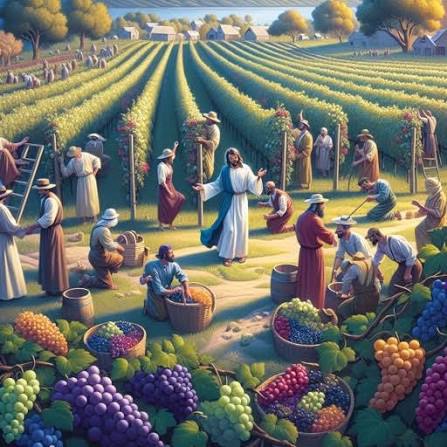
Matthew 20:1–16 — The Workers in the Vineyard
Today’s Gospel is one of those passages that can initially make us uncomfortable. Jesus tells us about workers who are hired at different times throughout the day. Some work from early morning, enduring the heat and long hours, while others arrive only at the very end of the day. Yet when it is time to be paid, they all receive the same amount.
It doesn’t seem fair.
Those who had worked all day naturally felt that they deserved more than those who had worked for only an hour. And perhaps that is exactly where Jesus wants us to begin — with our very human understanding of fairness.
But the landowner had not been unjust to anyone. Those who worked from the beginning received exactly what they had agreed to receive. What offended them was not injustice, but generosity.
And that is where the deeper message lies.
God’s grace is not something we can measure, calculate or earn through comparison with someone else. We can spend so much of our lives looking at what another person has received and wondering why they have been given the same love, mercy or opportunity when perhaps we feel they have done less to deserve it.
But God does not work according to our calculations.
Whether we have followed Christ for our entire lives or have only just turned towards Him, we are equally loved. His mercy is not a limited resource, and someone else receiving His grace does not mean there is less available for us.
Perhaps this is one of the hardest lessons of faith: learning to stop comparing.
We can become so focused on what others have been given, what they have achieved, or what we believe they deserve, that we forget to recognise the gifts God has already placed in our own lives.
The Gospel reminds us that God’s generosity is not something we need to compete for. His love is not earned by being first, working the longest or proving ourselves worthy.
The workers who arrived at the eleventh hour were not loved less.
And neither are we.
God’s grace is freely given, not because we have earned it, but because He is generous.
“So the last will be first, and the first last.”
✝️


 Seeking him
You must be logged in to post a comment.