Not a religious blog just a revert and her struggles
Author: Talia Noa
I write about faith, growth, and navigating both struggle and guidance on this journey—sharing my personal experiences, not as a scholar, but as someone learning and growing along the way
How do we come together — as families, as communities, as an ummah — when our versions of the truth are different?
Not just different in interpretation, but in acknowledgment.
Not just different in emotion, but in fact.
It’s a question that haunts me — especially when the truths we disagree on are not abstract, but blood-stained.
Like the killing of the Prophet’s ﷺ family.
Like the battles waged against Ahl al-Bayt.
Like the silencing of their grief and the rewriting of their sacrifice.
How can unity be built on truth, when even the truth is contested?
And it is. Deeply. Painfully.
Ask a Sunni Muslim about the Battle of Jamal, and most will hesitate. Ask about the killing of Imam Hussain (رضي الله عنه), and they will mourn the tragedy — but avoid the names. The questions. The accountability.
We’re told not to look too deeply. Not to “cause division.”
Not to “speak ill” of companions.
But at what cost?
The truth is: we can’t rewrite history just to make it easier to live with ourselves.
We can’t erase the blood of the Prophet’s grandsons and still claim to love him fully.
We can’t selectively honour Ahl al-Bayt while ignoring the pain they bore at the hands of our own ummah.
This is not a sectarian issue. This is a moral one.
So why the denial?
Part of it is fear — fear of being “divisive,” fear of being called Shia, fear of questioning what we’ve been taught.
Part of it is inherited bias — an unwillingness to hold revered figures to account.
And part of it is simply spiritual dissonance — because to admit the truth would demand a reckoning.
It would mean acknowledging that our ummah has wounds we’ve never healed — because we’ve never even admitted they exist.
It would mean accepting that not all companions were infallible. That power corrupted some. That women — even beloved wives of the Prophet ﷺ — were capable of grave misjudgment.
That political ambition, jealousy, and tribalism tore through our early history, just as it tears through our present.
And yet — here is the tension:
If we want true unity, it cannot be built on silence.
It cannot be built on the erasure of sacred suffering.
It must begin with truth — even if that truth is uncomfortable.
So where do we go from here?
We begin with honesty.
We allow space for multiple voices — and we listen, not just to scholars of one tradition, but to the descendants of the Prophet ﷺ themselves.
We read. We research. We ask. We sit in the discomfort.
Because the killing of the Prophet’s family should be something that unites every Muslim — not divides us.
If we truly love the Prophet ﷺ, then our hearts should break for the injustice faced by Ali, Fatima, Hassan, and Hussain.
If we claim to follow the Sunnah, then we must follow it all the way to Karbala — and stand with the oppressed, even if it means questioning those in power.
And no, unity doesn’t mean we’ll all agree on every detail.
But unity can mean we agree on what is sacred.
We don’t need to have identical opinions to have collective compassion.
But we cannot have selective truth and expect collective healing.
Families fall apart over these same tensions. Some members hold truth in their bones; others hold fear in their silence. But even here, the path forward is the same: truth, with compassion. Justice, with gentleness. The courage to speak — and the humility to listen.
And most of all, the refusal to call betrayal unity.
Because if we unite by ignoring injustice, then we are not united — we are just avoiding each other.
The Prophet ﷺ warned us of this. He left behind two things: the Qur’an and his Ahl al-Bayt. Not one. But both. If our love for him does not extend to defending their honour, mourning their pain, and amplifying their legacy — then what kind of love is it?
So I return to the question I began with:
If the price of unity is betrayal, then what are we uniting upon?
“If the price of unity is betrayal, then what are we uniting upon?”
It’s a question that came to me like a quiet interruption — the kind that doesn’t just echo in your mind but settles in your chest. We speak so often about unity in our communities, our ummah, our families. We are taught that unity is sacred, that it is a strength, a mercy, a protection. And it is. But like anything, when misunderstood, unity can become a shield that hides deep fractures — and sometimes even justifies them.
Because what are we calling unity when it demands silence in the face of oppression? What are we defending when “getting along” requires that we ignore harm, abandon truth, or betray the very values that are meant to hold us together?
Unity is a noble goal. But unity built on fear, coercion, or denial is not unity — it is conformity. And conformity at the expense of integrity will always collapse. Eventually.
Sometimes, we are asked to “not make waves,” to “keep the peace,” to “let it go — for the sake of unity.” But peace that demands injustice is not peace. It’s just a quieter form of violence. A betrayal dressed up as harmony.
Whether it’s within the ummah, within families, or within ourselves — the call to unity must never override the call to truth.
Because real unity is not built on erasing difference, or tolerating injustice, or pretending harm hasn’t been done. Real unity is built on accountability. On shared values. On a commitment to something higher than ego, reputation, or comfort. It is built when we can say: this was wrong — and still remain in each other’s lives. When we can hold each other to account — and still hold each other in compassion. When we can look one another in the eye and know we are standing together on the side of what is right, not what is easy.
Our faith teaches us this. Islam is not a religion of empty consensus. The Prophet ﷺ did not unite his people by appeasing every party. He did not say “let’s just get along” when Quraysh asked him to compromise on tawheed. He did not sacrifice truth for togetherness. He stood in truth — even when it meant standing alone.
So we have to ask ourselves:
If the price of unity is betrayal, then what exactly are we uniting upon?
Are we standing on shared conviction? Or shared denial? Are we avoiding conflict because it’s unnecessary — or because it’s uncomfortable? Are we keeping peace — or just keeping secrets?
There is no honour in a unity that protects the powerful and silences the oppressed. There is no barakah in peace that buries truth.
So perhaps the real work is not to strive for unity at all costs — but to strive for integrity within our unity. To know that it is not disloyal to speak the truth. It is not divisive to challenge harm. And it is not betrayal to refuse to betray your own conscience.
Real unity is not the absence of tension.
It is the presence of truth, held with love.
And that is a price worth paying.
Posted on
Trying to Hold It All Together in a World That Was Never Meant to Hold Us
There are days — many days — when it feels like I’m juggling fifteen things at once. Appointments. Forms. Operations. Children. Responsibilities. Bills. Tasks that never seem to end. And all the while, trying to hold on. Trying to hold it all together.
But the truth is… it’s already out of my hands.
We often move through life with this illusion of control. We plan, we push, we organise, we chase. But the outcomes? They were never ours to begin with. Yes, we do our part. Islam teaches us to act — to take the means — but the results belong only to Allah. QaddarAllahu wa maa shaa’a fa’al — Allah has already measured it, and whatever He wills, happens.
And yet, despite knowing that, we struggle. We feel overwhelmed. Disconnected. Like we’re running a race in a world that was never designed to be the destination.
Sometimes I wake up and feel like I’m carrying more than one person should. I’ve even been told by my own medical professionals that I’m doing the equivalent of two of their professional roles, stress-wise. And still, somehow, I carry on. But it’s not without cost. I’ve worked in high-pressure jobs — I was once a PA to four directors, I even ran a nightclub abroad — but somehow, this life, this stage I’m in now, feels even heavier. And I wonder why.
Maybe it’s because the burdens of dunya aren’t just physical. They’re spiritual. They weigh on our hearts. They pull at our souls. They distract us from the One we’re meant to be turning to — and preparing to return to.
And that’s the test, isn’t it? That’s the real fitnah of this life. Not just the big tragedies, but the daily demands. The mundanity. The relentlessness. The endless cycle of doing, and fixing, and managing, and coping. The tension between what must be done to survive here — and what we yearn to do to thrive in the next life.
I often find myself longing for a different rhythm. One where I could just be — immersed in dhikr, in salah, in stillness. Where my days revolve around prayer, reflection, maybe even sacred places. Medina, Makkah, Al-Aqsa… not school runs, hospital corridors, and urgent deadlines.
But for most of us, that isn’t our reality. Our test is here. Our worship is in the struggle.
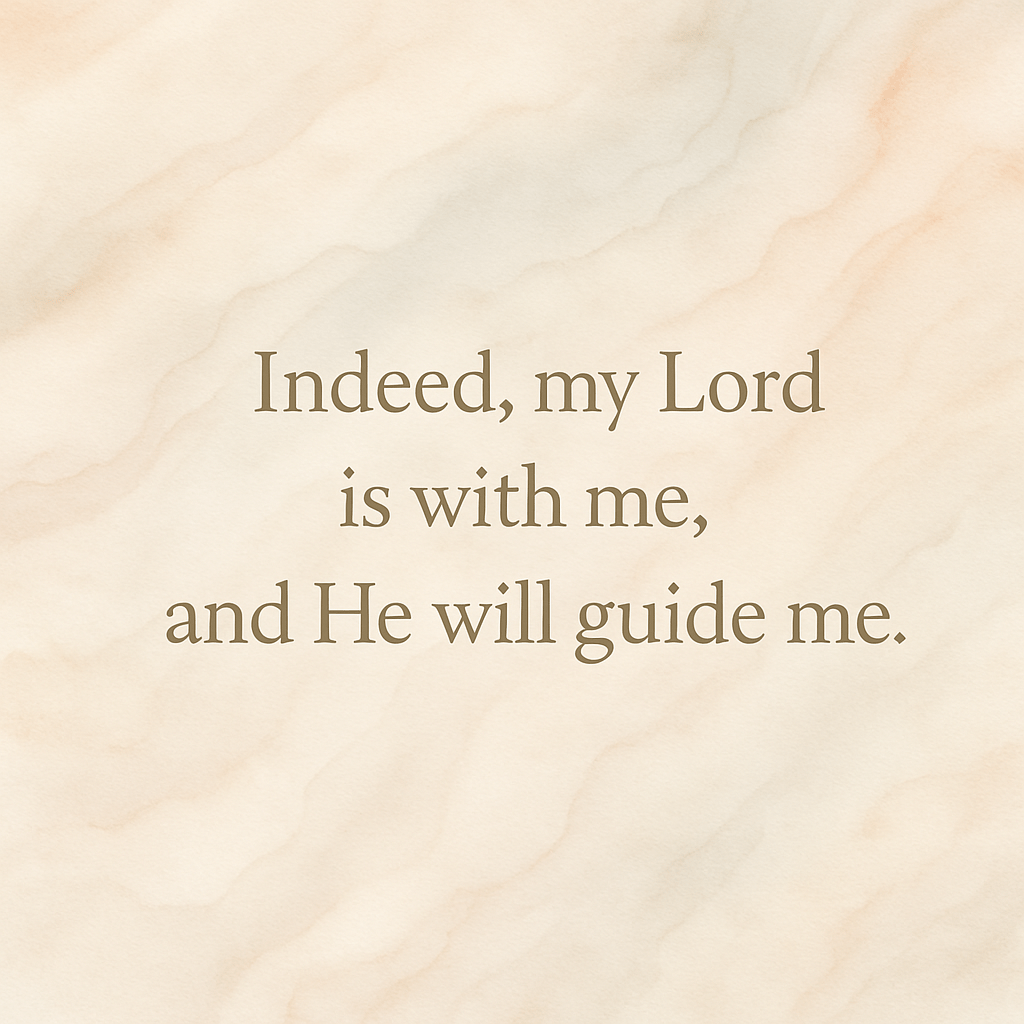
When I reach that state of overwhelm — when everything feels too heavy and nothing makes sense — I often whisper to myself: Inna ma’iya Rabbi sayahdeen — Indeed, my Lord is with me, and He will guide me. It’s not just a verse. It’s an anchor. A reminder that I’m not alone in this.
And that, right there, is tawakkul.
It’s trust. Not a passive giving up, but an active surrender. Trusting that Allah sees, knows, and cares. Trusting that even when everything feels like chaos, He is still in control. Tawakkul means doing what I can, with the strength He’s given me, and then handing the rest back to Him — completely.
Because if I try to carry it all alone, I fall. But when I remember that He’s already holding it for me — that’s when the burden starts to lighten.
This dunya can feel like a trap. Constraining. Demanding. Loud. We live lives where we are constantly switched on, constantly responsible — for ourselves, for others, for tasks we didn’t choose. But maybe this is why we feel so disconnected. Because we were never meant to live for this world. We were meant to live through it — for Allah.
That’s the real challenge, I think. That’s what I woke up with on my heart this morning. Balancing the life we’ve been given to live, with the life we are preparing for after this one ends. Walking that line between surviving here and striving for what comes next.
I don’t have the answers. I’m just a soul trying to breathe beneath the weight of too many things. But maybe that’s the whole point: not to carry everything alone, but to keep returning it to the One who never asked us to do this life without Him.
So if you’re in that place too — tired, overwhelmed, aching — remember this:
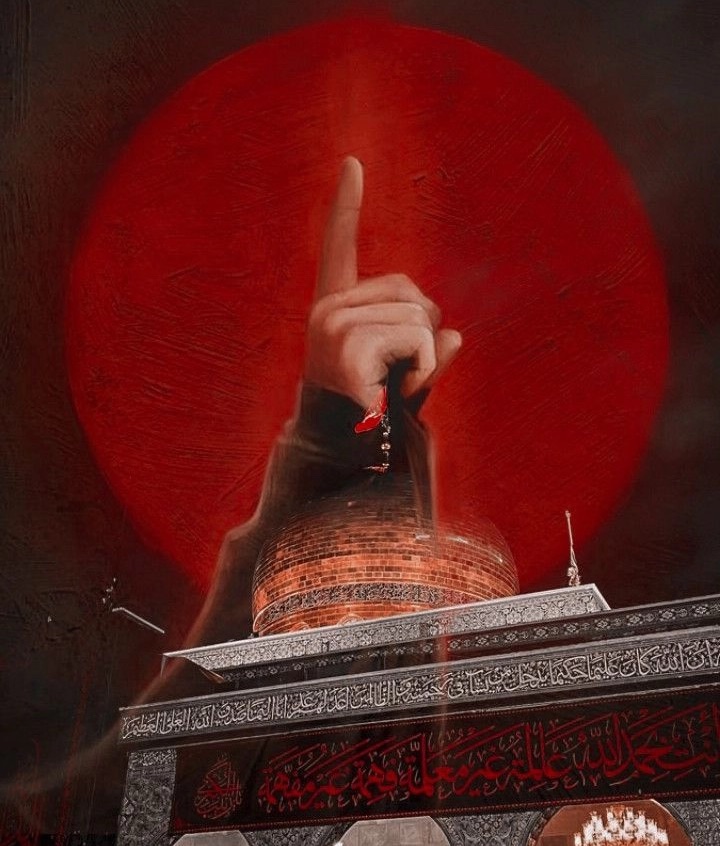
I remember seeing this canvas way before October 2023 and falling in love with it instantly.
Little did I know at the time that since first seeing the dome of the rock as a child in a history book and being totally fascinated with it how deep that fascination would run and eventually turn into a deep love and respect for its land and her people.
As I lay here gazing at the canvas on the wall opposite my bed I am struck with a multitude of thoughts and emotions and fear of its erasure. It’s a dream I’ve been having for a while now and I know many others feel the same way but with this fear runs something deeper and it’s the realisation that even if the zionists were to seize and destroy it,as is their plan for a third temple, that this still wouldn’t be enough to get a rise, a stand ANYTHING from the Arab world the so called ummah,for Palestine, her people or her land. Yet we all know if this was the kabba it would be different
But why. ???
Does one matter less than the other ? Simply because one generates an income that exceeds billions every year justified by its religious purpose and one doesn’t ?
Follow the money and the truth appears.
But for for now I will put down in words what my heart spoke:
In a land called Palestine,
beneath a sky bruised with storm and silence,
the Golden Dome glows —
a quiet fire at the centre of shadow.
Even the clouds seem to hold their breath around it.
And above, a crescent moon hangs like a prayer not yet spoken.
but with the voice inside me that says, “You’re fine. Just hold it together.”
Yesterday, I was sitting in the dental waiting room, waiting.
The smell hung in the air — sharp, sterile, suffocating.
My chest tightened. I felt sick.
My instinct was to run, or pretend I was okay.
They told me fourteen teeth must be removed.
That the infections in my jaw —
years in the making from Crohn’s and chronic illness —
are serious enough to need partial dentures.
That some of the work might have to be done in hospital.
That because of my past sepsis,
and how likely it is to return,
the risk of dental sepsis is high —
and if it happens, survival is only fifty-fifty.
My world cracked open.
And still, I was expected to nod. To cope.
To thank the dentist and walk out strong.
But inside, I was breaking —
quietly, invisibly, again.
The sharp clinical tang still lingers in my memory, fueling panic. I’m unraveling inside, still on the outside.
Like a girl with her sock slipping halfway off in her shoe —unseen, uncomfortable, fidgeting for peace.
And yet, I remind myself:
I’ve walked through fire with steady steps.
So why does this feel like too much?
People see me as strong —the one who holds it together, no matter what.
Do I tell them I’m spiraling?
Or do I keep the mask in place, again?
This “strong one” persona —
it’s a trauma response, I know.I learned early that needing no one was the safest way to exist.
But this Muharram, I promised myself something different: to live with more honesty. To let go of performance. To stop hiding behind strength that costs my peace.
This is one of my first tests.
To sit in my discomfort. To name it. To not shrink away from it —not even here, in this small, anxious moment with slipping socks, shaky breath, and quiet vulnerability.
There’s something I’ve been sitting with lately — a quiet shift in how I understand the role of men, especially within the home. It came from a tafsir I listened to recently. Not a dramatic revelation, just one of those verses you’ve heard a dozen times before… until it suddenly lands differently.
The verse was about Adam عليه السلام in Jannah.
But what struck me wasn’t the story — it was the structure.
Allah addresses Adam directly. He tells him to reside in Paradise, with his wife.
Not the two of them together.
Not a joint command.
The instruction is to him alone.
And the word used — uskun — isn’t just about living.
It’s rooted in stillness. In serenity. In sukoon.
It made me pause.
Because even in a place like Paradise — where peace is already a given — Allah still places the emotional tone of the home on the man.
It’s subtle, but it’s massive.
Before leadership, before provision, before family or tests or legacy — the first responsibility given to the man was to bring calm. Not to rule. Not to fix. Not to control. Just to be a presence of peace.
I keep coming back to that.
Because in this world we live in — full of noise, demands, overstimulation, emotional exhaustion — that responsibility becomes even more sacred.
But somewhere along the way, the definition of manhood shifted.
Now it’s often about dominance, performance, withholding.
Presence is rare. Peace, even more so.
And what I’m realising is: emotional maturity in a man isn’t something you “build together.”
It’s something you either witness in him — or you don’t.
He either brings sukoon into the space… or he brings disturbance.
There is no in-between.
And when he brings chaos? When you find yourself constantly managing, soothing, shrinking just to keep things together — that’s not your role. It was never meant to be.
We, as women, weren’t created to carry the emotional climate of the home alone.
We shift, we soften, we unravel and rebuild. That’s how Allah made us — in cycles.
But peace in the home? That isn’t our burden to bear.
Not entirely. Not always.
I’ve seen too many women asked to become the stillness and the structure — while the men around them remain emotionally unavailable, unaware, or even volatile.
And that tafsir reminded me:
That’s not how it’s supposed to be.
Peace is a man’s responsibility too — from the very beginning.
And if he hasn’t cultivated it within himself first, he has no business expecting partnership.
Because the kind of peace I want in my life isn’t performative. It isn’t external.
It’s something a man carries.
Something that shows in how he speaks. How he listens. How he responds in silence.
Something that cannot be faked.
And if he doesn’t bring sukoon, he doesn’t belong in that role.
This Muharram, I am not just making a promise — I am taking a stand.
A stand to live more authentically.
To walk with integrity.
To align my life with the Haqq — the Truth of Allah.
Authenticity, in its truest form, is not self-indulgence or rebellion. It’s submission. It’s aligning your soul with Divine truth, even when it hurts. Even when it costs you people, comfort, or belonging.
I’ve never really “fit in.” I’ve always stood out — but more importantly, I’ve always stood up.
I don’t turn a blind eye, not even to those closest to me.
Right is right. Wrong is wrong.
That’s something my parents instilled in me — a clear moral compass, no sugar-coating, no excuses, no loyalty to wrongdoing.
Just truth. Just justice.
And yes, it’s cost me friendships. People don’t always want truth — they want allegiance.
But you can’t be loyal to people and to truth when those two paths divide.
You have to choose.
This Muharram, I am choosing.
I am choosing to live like the Prophet’s family — the Ahl al-Bayt — who stood for truth even when they stood alone.
Who were not afraid to confront injustice, even when it came from within the ummah.
Who bore the weight of truth with grace and unshakeable resolve.
There’s a quote I carry in my heart:
“Stand for what is right, even if you’re standing alone.”
It has defined me for as long as I can remember.
And this year, it defines my path forward.
I no longer want to be around gossip, or people who thrive on low-vibrational energy.
If someone is comfortable gossiping to you, don’t think for a second they won’t gossip about you.
Authenticity requires discernment. And discipline.
So this Muharram, I walk forward.
Toward Allah.
Toward truth.
Toward a version of myself that fears no one but Him, and seeks no validation but His.
This Muharram, I am choosing to live upon the Haqq.
And I pray, by the end of this sacred month, I come out of it closer to Allah,
closer to Ahl al-Bayt,
and closer to who I was always meant to be:
authentic.
Unapologetically, faithfully, sincerely — for Him alone.
A sacred month. A time when the air itself feels heavy with remembrance. For me, it’s never just about history. It’s personal. It’s raw. It’s a mirror held to the soul, a moment to ask: who do I stand with? And who do I stand as?
This year, I’ve stepped away from the noise—from social media, from performance, from the shallow conversations that scrape at the surface but never dare to go deeper. I’ve chosen silence. Reflection. I’ve chosen to retreat into my Deen—not for show, not even for healing, but for truth. Because truth is what Hussain stood for. And if we can’t find that in ourselves during this month… what are we really mourning?
Hussain (peace be upon him) was not a political figure. He was the beating heart of the Prophet’s legacy.
He was the grandson who the Prophet ﷺ used to cradle in his arms during prayer. The one he called Sayyid shabab ahl al-jannah—the leader of the youth of Paradise. He was known for his love, his generosity, his uprightness, and above all, his unwavering refusal to surrender to tyranny.
At Karbala, he stood with barely 70 followers against an army of thousands. No water. No mercy. No compromise. Because to him, truth was not negotiable. And to surrender to falsehood—even if it bought safety—was not an option.
He and his companions were butchered under the sun. Children murdered. Women taken prisoner. And all of this was done by people who claimed Islam. Who wore the cloak of religion. Who prayed, fasted, and recited Qur’an, all while slaughtering the bloodline of the Messenger of God ﷺ.
That truth alone should have shaken the ummah. But instead?
We forgot.
We forgot who the oppressors were. We erased the pain of the Ahl al-Bayt. We buried the truth beneath centuries of silence and scholarly revision. And we turned the very villains of our history into saints.
We praise those who betrayed the Prophet’s family. We quote those who stood at the Prophet’s door and crushed his daughter behind it.
Abu Bakr stole Fadak from Fatimah. Umar broke down her door and caused her to miscarry. Aisha raised an army against Ali, the rightful successor to the Prophet, in the Battle of Jamal. These are not fringe accounts—they are history. But we’ve been taught not to question them. We’ve been taught that “unity” means silence. That truth is divisive. That grief is sectarian.
But I ask you: If the price of unity is betrayal, then what are we uniting upon?
Today, I see Muslims around the world grieving the genocide in Gaza—and rightfully so. The suffering of the Palestinian people is unbearable. The bombs. The blood. The body bags. The lies.
And yet, some of these same Muslims glorify the very figures who laid the foundation for Karbala—the spiritual Gaza of our history.
They speak out against Israeli apartheid while quoting hadiths narrated by those who tore the house of Zahra apart.
They share du’as for the oppressed while venerating those who oppressed the Prophet’s own family.
They cry for martyrs today while silencing the ones whose blood built this ummah.
There is a deep, unspoken hypocrisy in our outrage.
We are willing to cry—but not willing to confront.
We are willing to mourn—but not to question.
We are willing to say “Free Palestine”—but not “Follow Hussain.”
So this Muharram, I ask myself again: what am I really grieving?
Because if I mourn Karbala, I must also mourn Saqifah.
If I cry for Gaza, I must ask who I glorify in my religion.
If I claim to love the Prophet ﷺ, then I must love his family not just in name—but in allegiance.
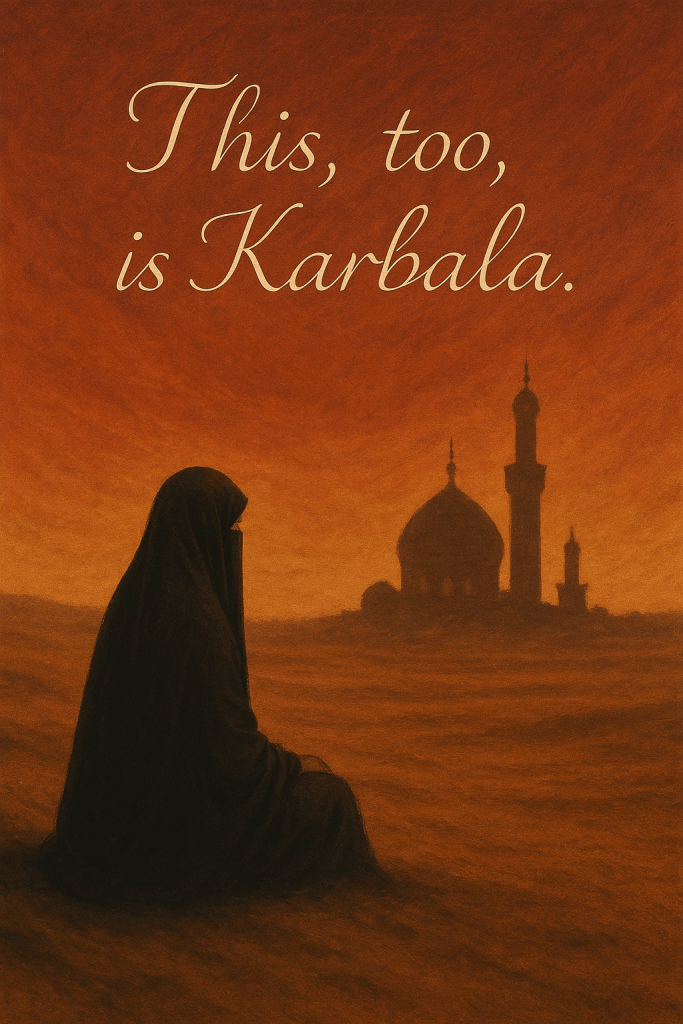
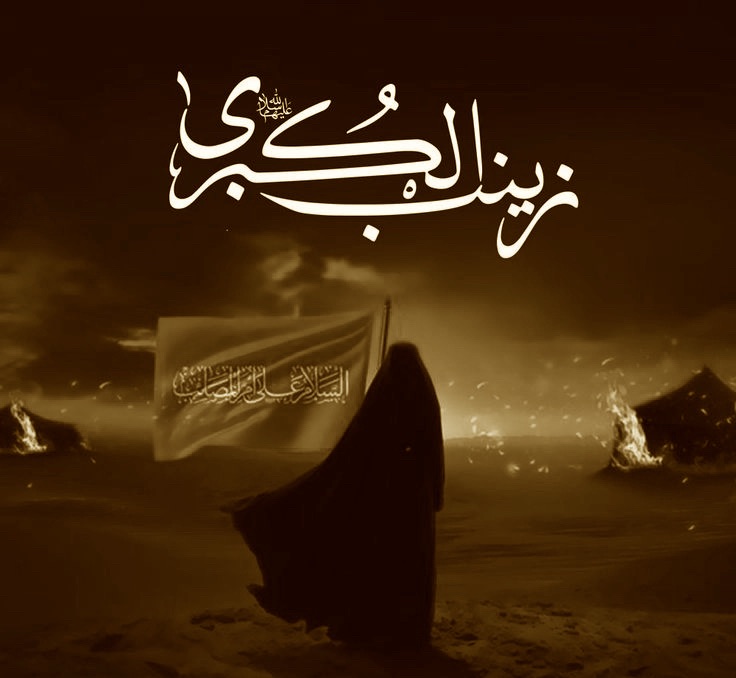
This grief I carry—this truth I refuse to abandon—it isolates me. It costs me. It makes me an outsider to many. But I think of Zaynab. I think of the women who walked in chains from Karbala to Kufa to Sham. I think of the courage it takes to speak truth not when it’s popular—but when it’s condemned.
Like Zaynab, I will not cry for sympathy. I will cry as a witness.
Like Hussain, I will not die for victory. I will live for loyalty.
And like Fatimah, I will guard my silence until it becomes louder than every lie.
This Muharram, I withdraw not out of weakness—but out of love. Love for the Ahl al-Bayt. Love for truth. Love for a God who sees every buried injustice and promises its resurrection.
From Karbala to Gaza, truth still bleeds. And I refuse to look away.





 Seeking Sakina