Not a religious blog just a revert and her struggles
Author: Talia Noa
I write about faith, growth, and navigating both struggle and guidance on this journey—sharing my personal experiences, not as a scholar, but as someone learning and growing along the way
Tonight, after a day where everything seemed to fall apart — when every door closed, and every thread of patience unravelled — I lay in bed, empty and aching. Just hours before, I had written about Karbala, about Gaza, about grief — and yet, what washed over me next wasn’t the grief of history, or of others. It was my own.
A heavy, unbearable sadness began to rise in me. Not for Hussain, not for the martyrs, but for me. For how far I felt from Allah. From my Deen. From the steadiness I once had. I felt it in every part of me — the distance, the disconnection, the doubt.
And in that moment of complete vulnerability, I broke.
The tears came hard and fast, and all I could do was say it — “Ya Allah, Ya Allah.”
Over and over again. Not with eloquence. Not with hope. Just desperation.
“Ya Allah.”
I didn’t know if He would respond.
I wasn’t expecting a response.
I just needed to cry out — to say His name.
And then… something came.
Not a sign. Not a voice.
Just a whisper from within:
La ilaha illallah.
There is no god but Allah.
Again, and again, my lips moved with it.
La ilaha illallah.
And the crying softened.
And then, almost like a breath rising from the depths of me:
Inna ma‘iya Rabbi sayahdeen.
“Indeed, my Lord is with me, and He will guide me.”
I don’t know what happens next.
I don’t know what tomorrow will bring, or what path lies ahead.
But I know this: He never left me.
Even when I felt furthest from Him, He was there.
Even in the dark, even in the silence — He was always there.
And sometimes, you only remember that at rock bottom.
Because it’s from rock bottom that you finally stop looking in every direction except up.
And when you finally do — you realise you’re not lost.
As the sacred month of Muharram approaches, I feel a weight in my chest — a lump in my throat I can’t quite swallow. This is the month of mourning. The month in which Imam Hussain, the beloved grandson of our Prophet Muhammad (peace be upon him and his family), was brutally martyred on the plains of Karbala.
This year, I feel it differently. I feel it deeply.
Last year, I had just embraced the path of the Ahl al-Bayt. I was still learning, still finding my footing as a Shia. But this year… this year, the grief feels alive. My soul recognises what is coming, even before the crescent appears.
Islam is a journey — and my journey into Shia Islam has transformed me on every level. Spiritually, emotionally, intellectually. And in this transformation, I’ve found myself drawn to the Ahl al-Bayt: to Fatima al-Zahra, to Ali, and above all, to Hussain — all through the luminous heart of our Prophet.
Knowing their stories, feeling their pain, honouring their sacrifices — it overwhelms me. My chest tightens with emotion. My eyes well with tears. And in this month of Muharram, everything is intensified. The pain is sharper, the sorrow heavier, the love stronger.
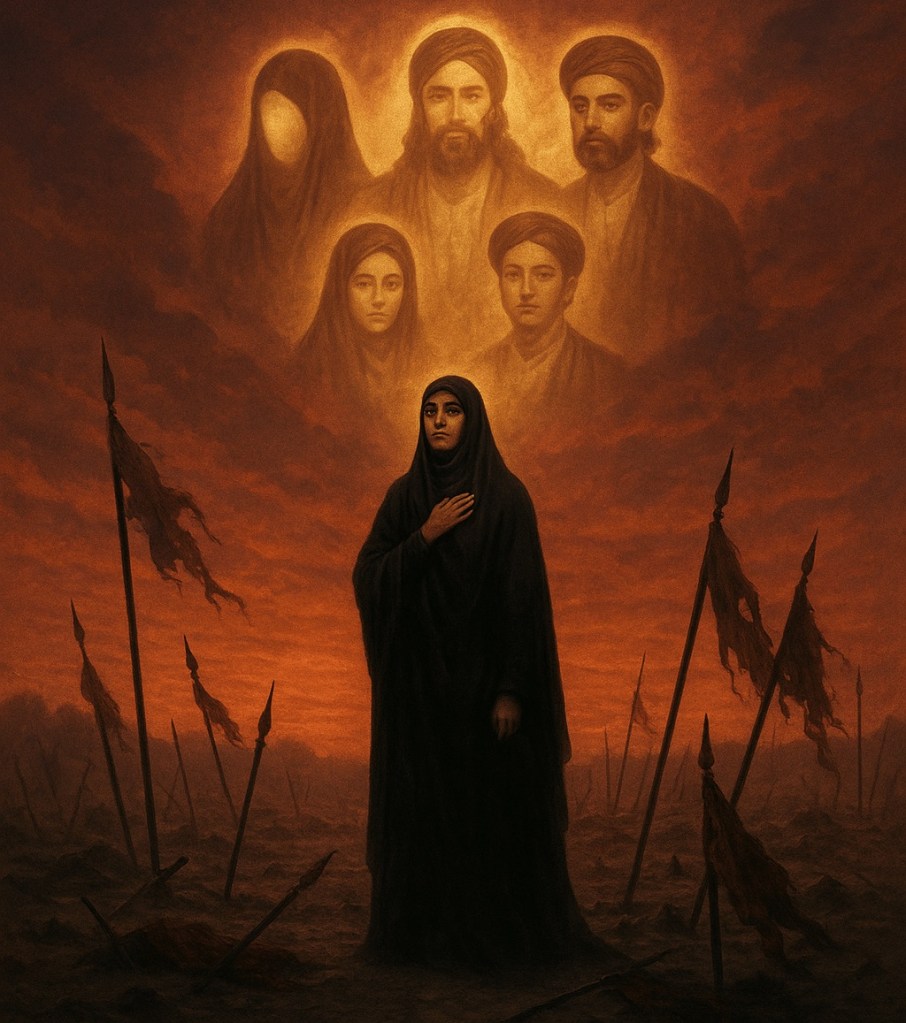
At Karbala, alongside Hussain, stood the most loyal and courageous souls: Abbas, his lion-hearted brother; Ali al-Akbar, his radiant son; Qasim, the brave young nephew; and so many others who gave their lives not for power, but for truth (Haqq).
And then there was Lady Zaynab.
Zaynab, the mountain of patience.
Zaynab, who stood amidst devastation — her family slaughtered, her brother’s head raised on a spear — and still said, “I saw nothing but beauty.”
How can one soul endure such loss, such horror, and still speak with that kind of strength, that unwavering dignity?
Her courage leaves me breathless.
This year, more than ever, I feel her words echo within me. I feel the pain of Karbala mirrored in the suffering of Gaza, where once again the innocent are slaughtered, where children die in the arms of their mothers, and the world looks away. The parallels are haunting. The injustice is unbearable.
And I wonder — how many in our Ummah have lost their hearts? How many have become so indoctrinated, so desensitised, that they cannot see the truth? How many dismiss what happened to the family of the Prophet as mere politics, when it was oppression, pure and simple? When it was the silencing of Haqq.
The pain of seeing people glorify those who stood against Ahl al-Bayt, or justify their crimes, is almost as heavy as the grief itself. It feels like betrayal. A betrayal of love. A betrayal of truth.
So this Muharram, I will withdraw into myself. I will sit with the sorrow. I will connect more deeply with Karbala. With the stories. With the legacy. With the heartbreak.
And like Lady Zaynab, I will strive to see beauty in it all.
Not because the pain is beautiful. But because the resistance, the courage, the unwavering stand for truth — that is beauty. That is love. That is Islam.
Ya Hussain.
Ya Zaynab.
Peace and blessings be upon all those who gave everything for truth
There are moments in life when the pain is too deep for words. When you feel buried under depression, weighed down by addiction, abandoned by family, or haunted by your past. You may wonder: Is there any light left for me?
If you’re in that place right now — silent, struggling, or barely holding on — this post is for you.
And these words are not mine. They’re from the Qur’an — words that never grow old, never expire, and were sent by the One who knows every wound you carry.
🌧️ When Life Feels Too Heavy
You might be tired of hearing “just be patient” or “it’ll get better.” Sometimes, those words sound empty — especially when your heart is breaking.
But Allah sees you. He knows what you’ve been through. And He doesn’t dismiss pain — He meets it with mercy:
“Verily, with hardship comes ease.”
Surah Ash-Sharh (94:6)
“Do not despair of the mercy of Allah.”
Surah Az-Zumar (39:53)
“Indeed, after difficulty, there is ease.”
Surah Ash-Sharh (94:5)
These are not promises from people — these are promises from the One who created your soul. Ease will come. Not in spite of your pain, but through it.
🕊 When You Feel Unworthy or Alone
Addiction. Shame. Repeated mistakes. Distance from faith. For many, these things become chains — making you feel like Allah has turned away from you.
But the Qur’an reminds us:
“Your Lord has not forsaken you, nor has He hated [you].”
Surah Ad-Duhaa (93:3)
“And He found you lost and guided [you].”
Surah Ad-Duhaa (93:7)
“He is with you wherever you are.”
Surah Al-Hadid (57:4)
Even if everyone walks away — even if you walked away from Allah — He is still near. Still listening. Still waiting to receive you with open mercy.
🌙 For Those Haunted by the Past
Maybe your past follows you like a shadow — family trauma, abuse, guilt, mistakes, betrayal. You wonder if you’ll ever be free. The Qur’an answers with both gentleness and power:
“Say, ‘O My servants who have transgressed against themselves, do not despair of the mercy of Allah.’”
Surah Az-Zumar (39:53)
“My mercy encompasses all things.”
Surah Al-A’raf (7:156)
Your story doesn’t end with your pain. Your story continues with His mercy.
🌿 For the Tired Soul
You may feel spiritually exhausted — disconnected from prayer, unable to focus, weighed down by your own sadness. You’re not alone in that either.
“Truly it is in the remembrance of Allah that hearts find rest.”
Surah Ar-Ra’d (13:28)
“And We are closer to him than [his] jugular vein.”
Surah Qaf (50:16)
“And your Lord is going to give you, and you will be satisfied.”
Surah Ad-Duhaa (93:5)
You don’t have to be perfect to be loved by Allah. You just have to keep reaching, even if all you can do is whisper.
✨ You Are Seen. You Are Heard. You Are Loved.
If no one has told you lately: you matter. You are not broken beyond repair. You are not unloved. You are not too far gone.
Your sadness is not a sign of weak faith. Your struggle is not a punishment.
It may just be the doorway to Allah’s closeness — one that opens in the dark, when no one else is around to see.
So hold on. One verse. One breath. One prayer at a time.
Lately, I feel like I’m breaking in ways I can’t explain.
I’m carrying so much — in silence. The weight of it all presses down so hard some days that I can’t breathe. And the hardest part is feeling like no one really sees it. No one sees how much I’m holding together — the house, the responsibilities, the faith, the exhaustion. No one sees what it takes just to keep showing up.
And the truth is, I feel like I’m slipping. I’m struggling with my deen. Struggling with my iman. Struggling with my trust in Allah and in myself. I’m struggling to wear my hijab. Struggling to pray. Struggling to do the most basic things that used to feel like second nature.
Except for the Qur’an.
The Qur’an is the only thing I can hold onto right now. It’s the only thing that reaches me where I am. I find myself climbing into bed at night, utterly drained, but my hands reach instinctively for it. It’s become my anchor. The only thing that helps me sleep.
When the nightmares come — and they do, again and again — when anxiety floods my chest and threatens to drown me, it’s the Qur’an that quiets the storm. Its words calm something deep inside me. And more often than not, I fall asleep with tears in my eyes. Not because I’m broken… but because I feel this overwhelming peace, this mercy that I can’t put into words.
It’s like every ayah is speaking only to me. Like Allah is responding to the parts of me I’ve never spoken aloud.
And still, part of me keeps whispering, “You’re behind. You should be doing more. You’re not enough.”
But somewhere deep in my soul, I know those thoughts aren’t from Him.
Allah doesn’t measure me by how perfectly I perform.
He sees what no one else sees — the private battles, the quiet tears, the way I keep trying.
He saw the moments I wanted to ask for help, but didn’t, because I didn’t want to be a burden.
He saw me shrink myself, question myself, overextend just to feel worthy.
He saw the effort it took just to stay standing.
And maybe I’ve been asking for scraps — acceptance, peace, a sense of belonging — from places that were never meant to feed me.
But Allah… Allah is preparing something better. A place where I won’t have to fight to be seen.
Where I won’t have to earn love by exhausting myself.
I’m not falling behind.
I’m falling into the space He’s clearing just for me.
A place of stillness. Of truth. Of divine overflow.
This isn’t about becoming something new.
It’s about remembering who He already created me to be.
I don’t have to hustle to be worthy.
I don’t have to force anything to be loved.
I don’t have to figure it all out. He already has.
And maybe… just maybe…
It’s time I stop abandoning myself.
It’s time I choose me — the way He’s already chosen me.
Alhamdulillah for the Qur’an. For the peace it brings. For the way it finds me when I’m most lost.
Alhamdulillah for a Lord who sees me, hears me, holds me — even when I feel unseen.
I’m lying in bed, eyes wide open, scrolling endlessly through every scrap of news I can find about my beloved Iran. The thunder outside crashes again, shaking the windows, and for a moment I can’t tell where the storm ends and where the war begins.
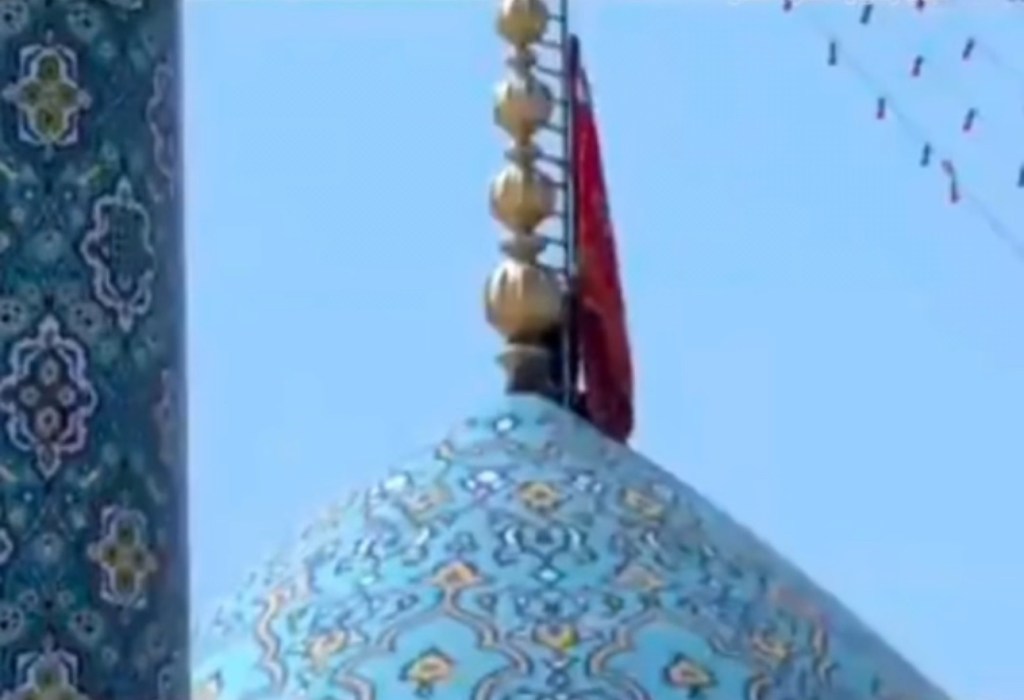
It’s that kind of night. The kind where the sky roars with the same rage that’s stirring across the region. A red flag has been hoisted over Karbala — a signal the world barely understands. But we do. It’s a symbol of revenge. Not petty vengeance, but righteous reckoning. The kind that calls back to the plains of Karbala, to the blood of Hussein, spilled but never silenced. That flag says we are not done yet. That flag says there is more to come.
And the ground beneath me — I can feel it humming, vibrating with something ancient and alive. We are standing on the edge of the sword. Between what was and what’s coming. Between memory and fire. There is a current running through everything right now — not just urgency, but inevitability. Something is shifting. The air knows it. The thunder knows it.
Iran has struck back. A quiet storm gathering for years now lashes out with lightning precision. Israel, so used to impunity, now finds itself touched by the storm it helped provoke. And while the world watches, unsure whether this is the beginning of World War III or just another long chapter in an already blood-soaked book, those of us with roots in the soil of resistance feel something else: clarity.
If Palestine has taught us anything, it’s this: sometimes, we are forced to sit and watch while the wheels of power turn over the bodies of the innocent. No matter how loudly we scream. No matter how often we protest. The world spins on.
And yet — just like the storm that rolls across the sky — maybe we, too, must roll with it. That doesn’t mean passivity. It means endurance. It means faith. It means that with thunder comes rain. And with rain comes cleansing. Something new is coming, even if it emerges from the ash of everything we know.
Tonight, my heart is with Iran. With her courage, that ancient Shiite courage that burns as fiercely as it did when Hussein stood, alone but unshaken, on the battlefield of Karbala. That kind of courage sounds like thunder — relentless, pure, echoing across generations. It doesn’t ask for approval. It doesn’t ask for survival. It stands for what is right. It stands for truth. It stands with integrity.
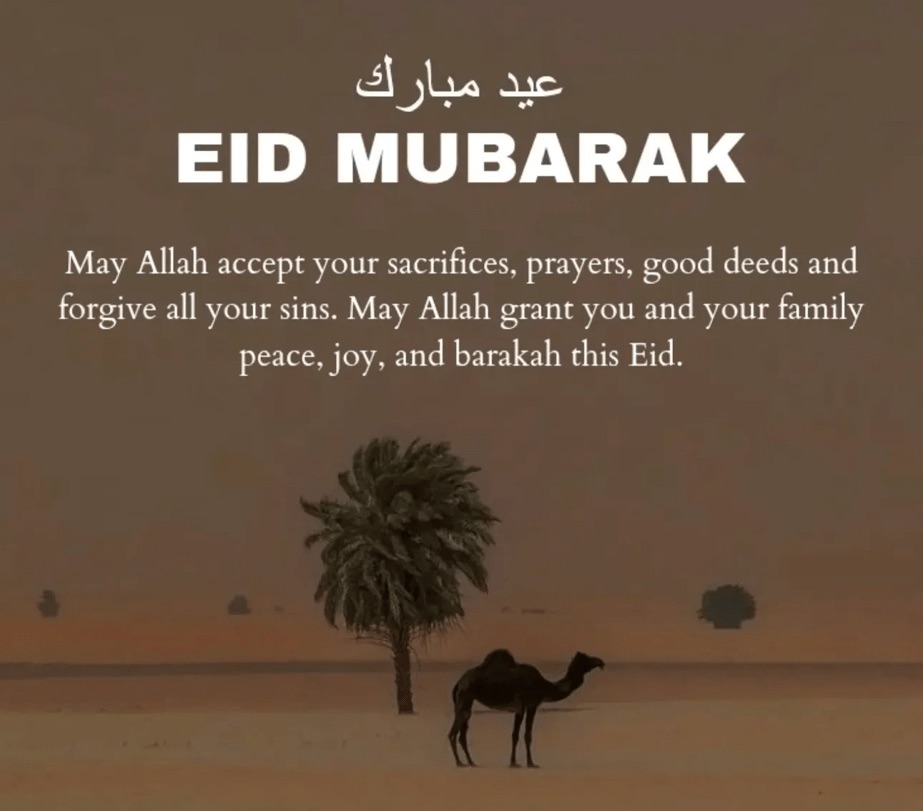
Today is Eid al-Adha. And today marks the fifth year I’ve spent Eid alone. No family to gather with. No invitations to accept. No dresses picked out for the day, no colourful gatherings, no plates shared, no henna drying overnight. And for many of us who came to Islam later in life, this story is far too familiar.
We are the Muslims practicing in private.
The Muslims who are the only ones in our households.
The Muslims who whisper “Allahu Akbar” alone at fajr, and break our fasts alone during Ramadan.
The Muslims who remember Eid… but don’t celebrate it.
And while the Ummah sends messages of “Eid Mubarak,” and asks kindly, “So what are you wearing today?” or “How are you celebrating?”—we often smile, we reply politely. But deep down, we feel the ache of absence. Because Islam may be for everyone, but the Ummah… it doesn’t always feel like it is.
I’ve lost count of how many Eids I’ve seen reverts post online about being alone. No plans. No invitations. Just a quiet day, and sometimes, quiet tears. And I’ve also lost count of how often I’ve seen the same well-meaning phrases shared:
“Come and spend it with my family!”
“You’re welcome anytime!”
“You don’t have to be alone!”
But these words often stay just that—words. Lip service for likes and spiritual currency online. Because the truth is, very few people actually follow through. And even fewer reverts feel comfortable enough, or safe enough, or mentally well enough, to say yes.
So no, telling someone to “just go to the masjid” isn’t always helpful. Some of us can’t. Some of us are still hiding our Islam. Some of us are caring for children, or elderly parents, or have chronic anxiety, depression, financial barriers, or broken ties. Some of us carry layers of life that make stepping into public Muslim spaces incredibly hard.
And no, I don’t need to get married just so I can have someone to celebrate Eid with. I need community. Real, welcoming, grounded community. One that sees me beyond my marital status or my “convert story.” One that sits beside me, not just preaches to me.
So maybe today, instead of celebrating, I reflect.
Because this is Eid al-Adha. The Eid of sacrifice.
The remembrance of Prophet Ibrahim (AS) and the son he was willing to give up in obedience to Allah. And of how, at the final moment, Allah spared him. Replaced sorrow with mercy. Delivered provision in place of pain.
As reverts, we know something about sacrifice.
We’ve lost family ties. Friendships. Acceptance.
We’ve given up traditions. Changed our wardrobes. Adjusted how we speak, eat, pray, think, live.
We’ve let go of who we were to become who Allah called us to be.
But just as Allah intervened for Ibrahim, we believe—He sees us too. He hears us. He knows our loneliness. And He is enough. Always enough.
So today, this message is for the reverts.
For those spending Eid in silence.
For those holding their faith close like a secret.
For those scrolling through photos of Eid gatherings, wondering when it will be their turn.
You are not forgotten. You are not less than.
You are not outside of the Ummah, even if it feels like the Ummah has forgotten you.
Your Eid may be quiet, but it is not empty. It is filled with every silent du’a you make. Every tear you cry in prostration. Every sacrifice you’ve made for the sake of Allah.
And maybe it’s time we build something real.
Not just passing words on a timeline, but actual gatherings, actual spaces, where reverts can meet, eat, talk, reflect—even if it’s just a small room in a library, or a pot of tea in someone’s flat. Because the Ummah isn’t always forthcoming. But maybe we can be, for each other.
If this is your Eid alone, know that I see you.
And if you have space in your life for a revert this Eid—or next Eid—don’t just say it. Mean it. Follow through. Open your door. Make room at your table.
Because hospitality is a Sunnah. And so is sincerity.
Eid doesn’t have to be about celebration. Sometimes, it’s about reflection.
And maybe, just maybe, that’s the most meaningful Eid of all.
Eid Mubarak. From one revert to another. May Allah never leave us lonely.
There are moments in life when we feel so far from Allah, we wonder if we even know how to come back. We hear the Adhan we hit it like a snooze button and turn over in bed.
We carry the heaviness of this dunya, the exhaustion, the grief, the guilt—and prayer becomes distant. Like something for someone stronger. Someone better.
But the truth is, Salah isn’t for the perfect. It’s for the broken. It’s for the weary. It’s for the hearts that ache with longing, even when they’ve been silent for too long.
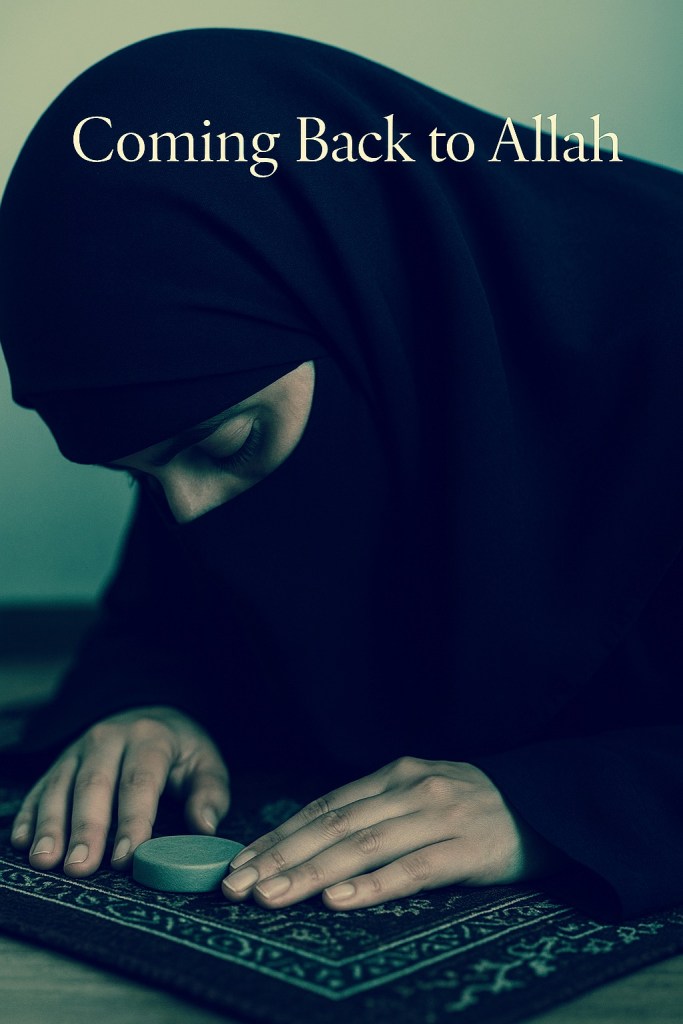
Today, on the Day of Arafah, I returned.
In pain, physically and spiritually, I laid my prayer mat on the ground I placed my turbah on top and I stood before Allah—no grand gestures, no eloquence. Just a heart cracked open. Before I could even finish reciting Al-Fatiha, the tears began to fall. Not just one or two—waves of them.
And in each tear was a door.
A door to forgiveness.
A door to mercy.
A door to coming home.
It was as if the heavens opened in that moment—not because I was worthy—but because I was willing. Willing to turn back. Willing to say, “I need You, Ya Allah.”
There’s a sacred truth that lives in our faith:
“Whoever comes to Me walking, I will come to him running.”
— (Hadith Qudsi, Sahih Muslim)
And today, I saw that truth unfold with my own soul. I had taken only a step—but Allah met me with overwhelming mercy.
When we abandon Salah, we do not punish Allah—we punish ourselves. We carry the weight of disconnection and call it depression. We feel the ache of loneliness and call it failure. But the ache is simply the soul longing for its Creator.
Allah never moves away from us. We move away from Him. And yet, the instant we turn—even half a turn—He is already near. Closer than the pain, closer than the tears.
So if you are struggling… if your prayer mat has been untouched for days or weeks or even years—know this: it only takes one moment. One whisper. One tear.
Let your tears fall. Let them carry your pleas for forgiveness. Let each one become a door to something sacred. Allah is not waiting to punish you. He is waiting to embrace you.
Come back.
Come back to the One who has never turned away from you.
They wept when he wept, they shouted Allahu Akbar when he stood among them. And yet, before his blessed body was buried in the ground, they gathered without his family, without his cousin, his son-in-law, his appointed one, my father Ali — and they chose a successor.
Without consultation of those closest to him. Without the ones purified by Allah Himself.
“Indeed, Allah only intends to remove from you impurity, O people of the household, and to purify you with [extensive] purification.”
— Qur’an, Surah Al-Ahzab (33:33)
We, the purified ones — Ahl al-Bayt — were left behind. Forgotten in the shadow of politics dressed as unity.
What unity is this that was built on exclusion? What brotherhood chooses expedience over revelation?
My grand father had spoken at Ghadir Khumm, under the blazing sun, before thousands:
“Of whomsoever I am the Mawla, Ali is his Mawla.”
They heard it. Omar heard it. He was among the first to congratulate Ali. Yet days later, it was he who stood to give allegiance to Abu Bakr — swiftly, without Ali or Abbas, without my family present. It was he who declared, “The Prophet has died, and this affair must not be left leaderless.” And so a decision was made — one not guided by divine revelation, but by haste, by fear, by politics.
Do not tell me this was Shura. Do not tell me this was divine. If Allah had revealed that leaders should be elected, show me where. Show me where in the Qur’an the successor of a Prophet is chosen by men rather than appointed by God. Every Prophet left behind a successor — so why would the Seal of Prophets, my father, do otherwise?
They crowned Abu Bakr, but at what cost?
My mother, Fatima, the radiant one, came to claim what was hers — the land of Fadak, gifted to her by the Prophet in his lifetime. She brought testimony, evidence, her word — the word of the most truthful woman, of the leader of all women of Paradise.
And they denied her.
She who the Prophet stood for when she entered the room. She who he called part of himself:
“Fatima is a part of me. Whoever hurts her, hurts me.”
— [Sahih al-Bukhari]
But they hurt her. They rejected her. They broke her door.
They say this was unity. But it was unity built on silencing.
And then there was Aisha.
Yes, I will speak her name. I will not call her what they call her, for those titles demand respect earned through loyalty — and she, she rose an army against Ali.
She, the wife of my grand father, took up arms against his cousin, his chosen, his successor. Against my family. Against her own stepdaughter’s husband. My father. Against the very man who slept in the Prophet’s bed when he faced death. Against the one the Prophet declared the gate to knowledge.
What loyalty is this?
What love for the Prophet is this, when one disrespects his blood?
She rode into battle at Jamal, raising a standard not of faith, but of rebellion — and history remembers that day with sorrow. Blood was shed between Muslims, and the sword first rose against the rightful Imam.
She claimed it was ijtihad, a matter of conscience. But conscience does not rise against the one who was entrusted with the banner at Khaybar. Conscience does not ignore the command of the Prophet at Ghadir.
I say this now because I have seen the aftermath.
I watched my brother Hussain fall at Karbala. I saw the heads of my kin raised on spears. I carried the burden of silence and the pain of memory. And I will not let history forget what they did.
This was not just a political disagreement. This was betrayal. This was the hijacking of my father’s legacy.
They crowned Abu Bakr. They praised Omar. They empowered Uthman. But it was Ali who was left behind, Ali whose door they ignored, Ali who waited in patience while truth was turned into fable.
But history has witnesses. And I am one of them.
Do not ask me to forget. Do not ask me to soften truth for the sake of comfort.
I am Zaynab bint Ali. My blood is Hussain’s blood. My voice is the echo of Zahra’s cry.
In recent online conversations — especially among young reverts — I’ve seen a worrying trend: people declaring that forcing someone to accept or practice Islam takes you out of the fold of Islam. That doing so makes you a disbeliever.
That’s not just a critique. It’s takfir — the act of calling another Muslim a non-Muslim.
That’s a heavy, serious claim in our deen. And it requires us to slow down, step back, and assess with deep care.
⸻
Islam Prohibits Compulsion — But That’s Not the Same as Takfir
Yes — Islam clearly prohibits compulsion. Allah says:
“There is no compulsion in religion.”
(Qur’an 2:256)
No Muslim denies this. The Prophet ﷺ never forced faith on anyone. Our religion is built on conviction, not coercion. But what’s happening today is something else entirely.
Here’s where things get dangerous: when someone takes that principle — “no compulsion in religion” — and stretches it to say that anyone who encourages, pressures, or pushes someone into Islam, or even reminds them to pray, is no longer Muslim themselves.
Let’s be clear: what’s being described as “force” here often isn’t force at all. It’s a simple reminder — “Don’t forget to pray,” or “It’s Maghrib time.” That’s not coercion. That’s love. That’s community. That’s the Sunnah.
We need to be very clear about the lines we are crossing when sincere encouragement gets twisted into an accusation of disbelief. Because this is no small matter. It’s spiritual harm.
⸻
What Actually Removes Someone from Islam?
Scholars from every school of thought — throughout Islamic history — have agreed that only specific, well-defined actions or beliefs remove a person from Islam. These include:
• Associating partners with Allah (shirk)
• Denying what is ma‘lum min al-din bid-darurah (known necessarily in the religion)
• Believing in false deities
• Rejecting clear verses of the Qur’an or an obligation such as prayer or fasting
• Mocking Allah, His Messenger ﷺ, or any fundamental element of the deen
These rulings are grounded in texts, not opinion. Not emotion. Not trauma. And they apply equally — regardless of background, sect, or level of knowledge.
⸻
Not Every Sin Is Kufr
This is a foundational principle in Islam, emphasized by scholars such as:
• Ibn Taymiyyah
• Imam Nawawi
• Al-Ghazali
• Ibn Abidin
• and many more.
“Not every sin is kufr, and not every incorrect interpretation removes someone from the fold of Islam.”
Someone may be doing wrong. They might be overstepping. They might even be acting unjustly. But that does not mean they’ve left Islam — unless their actions or beliefs directly contradict the fundamentals of the deen.
⸻
Where This Misunderstanding Comes From
And here’s the key: a lot of people making these claims are sincere. Especially among reverts, many of us come from backgrounds where religion was used as control. We carry trauma — and that can create sensitivity around any kind of pressure.
That reaction is valid. But when our response is to overstate the problem — to call a reminder “oppression” or label someone a “disbeliever” for encouraging prayer — we’re moving from sincerity into misguidance.
The Prophet ﷺ warned:
“Whoever interprets the Qur’an without knowledge, let him take his seat in the Fire.”
(Tirmidhi)
This isn’t about arrogance. It’s about the immense weight of this Book.
We can’t quote a verse without understanding its context, the legal reasoning (usul al-fiqh), and how scholars have applied it for centuries. The Qur’an isn’t meant to be a weapon. It’s meant to be guidance.
And just because someone brings in another verse that sounds similar or appears to support their position, that doesn’t make their argument correct.
Without proper grounding in tafsir and legal principles, quoting more verses doesn’t strengthen a flawed interpretation — it often just compounds the error.
Quantity doesn’t replace accuracy.
⸻
When Ego Enters, Learning Stops
This is where things take another turn.
In discussions, when correction is offered gently, what sometimes comes back is defensiveness. It becomes about credentials:
“Well, I’m doing a Sunni diploma…”
As if that makes one immune to error.
But Islam is not about labels. It’s about humility. It’s about sincerity. It’s about being willing to say, “I might be wrong.”
Let me say this clearly:
It doesn’t matter whether you’re studying from a Sunni diploma or a Shia background — the Qur’an is the same.
The rules of kufr, iman, and valid interpretation don’t change based on sect. They are rooted in our shared foundations.
If you’re using sectarian identity to shut people down or elevate yourself, you’ve already missed the point.
That’s not ‘ilm. That’s ego.
⸻
The Real Danger
Here’s the irony:
Those claiming that “forcing Islam on others makes you a disbeliever” are themselves engaging in a harmful act — because they are forcing their own misinterpretation on others, backed by the threat of kufr.
That’s not da’wah.
That’s not correction.
That’s not compassion.
That’s spiritual harm dressed up as piety.
⸻
Final Thoughts
We all need to tread carefully. Because when ego enters, learning stops. When we elevate our feelings over the scholars, we cut ourselves off from the tradition. When we use verses to wound instead of heal, we’re misusing the very light we were given.
Let’s return to balance.
Let’s return to humility.
Let’s correct wrongs — yes — but let’s do so with adab, with precision, and with the understanding that none of us are beyond learning.
May Allah guide us, correct us, and protect us from ever thinking we hold the truth so tightly that we forget how to carry it with mercy.
Lately, I’ve felt completely overwhelmed. Like I’m stuck in a fog I can’t quite name.
There’s been this pressure building behind my eyes, And a quiet, desperate wish that someone—anyone—would just take over for a while. That maybe I could stop being “strong” for everyone else.
And then yesterday… I witnessed something awful. Something I can’t unsee.
But in the middle of that shock and sorrow, i caught a glimpse—just a flicker—Of the woman I used to be. Or maybe the one I was always meant to be.
And I realized…
I’ve drifted so far from her. This rage I’ve been carrying, This grief that swells in silence, It’s not weakness.
It’s my nervous system finally saying:
“I wasn’t made to carry this much alone.”
And I believe now—God was listening. Not with judgment. Not with disappointment. But with this fierce, tender kind of mercy that whispered:
“You’ve done enough. Let Me take what was never yours to hold.”
Even the anger I’ve felt—At the world, At the pain, Sometimes even at Him—
It wasn’t rebellion. It was me waking up. Coming out of survival mode. Starting to feel again.
This isn’t a punishment. This is a return.
To softness.
To surrender.
To the truth I keep forgetting:
I was never meant to be the source for everyone else. I was meant to be held too.
And now I can feel it—
Everything that was built on over-functioning, On people-pleasing, On abandoning myself just to cope— It’s all being shaken loose.
It hurts. It feels like grief. Like rage.
Like I’m coming apart. Like someone’s holding me in place,
And I’m fighting to get away—
But gently, firmly, they won’t let go. It’s like being pinned by love that refuses to let me escape the truth I’ve been avoiding.
And maybe that’s exactly what it is. Maybe this is what it looks like
When God brings someone close—
Not with sweet comfort,
But with a grip that won’t let me flee until everything false, everything heavy, Everything I thought I needed to survive Starts to fall away.
It feels like too much. Like being broken open so something deeper can finally breathe.
But I’m starting to see…
This isn’t punishment.
This is mercy.
Because maybe I needed to be still long enough To remember who I am underneath all this pain.
I’m not broken.
I’m not behind.
I’m being refined.
So I’m exhaling now. Letting go. Letting myself unravel a little.
Because I know—
When I’m ready to rise,
God will still be here. He never left. He’s just been clearing space For me to return.



 Seeking Sakina