White rabbit

To achieve the impossible you have to believe in it …..

I woke today, Alhamdulillah, and as somebody who’s neurodivergent, my brain doesn’t wake up slowly. It wakes already questioning, already exploring concepts and ideas before I’ve even got out of bed. It’s like my mind switches on and immediately starts running through connections, possibilities, meanings—already in motion before I’ve even fully entered the day.

This morning was no different.

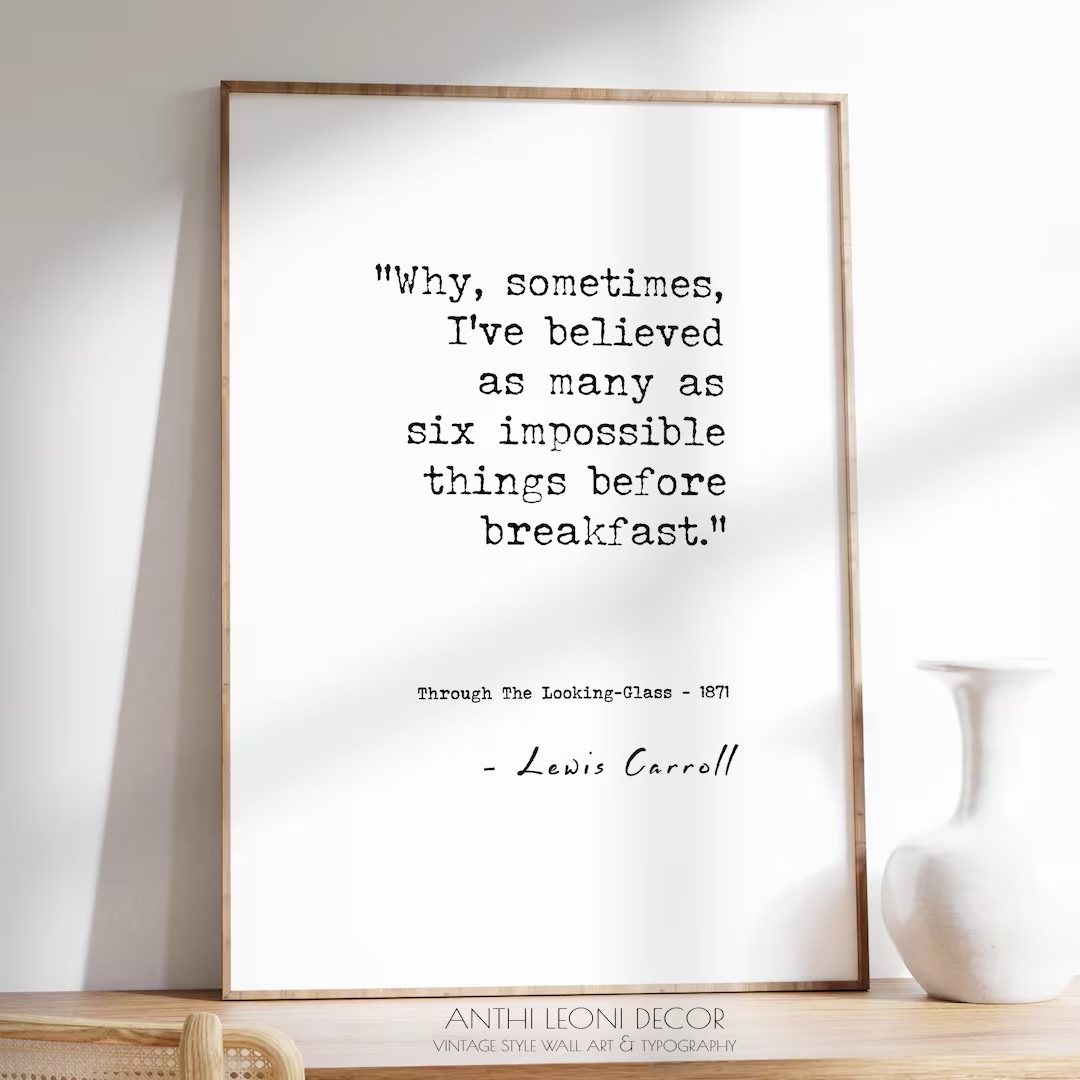
And I found myself thinking that Alice in Wonderland was neurodivergent, because “I too have believed in as many as six impossible things before breakfast.”

That kind of imagination, that sense of reality not being fixed but expandable, feels very familiar to me. My mind doesn’t naturally separate “realistic” from “impossible” in a rigid way first thing in the morning—it just explores what could be.

And in that same space, I started thinking about the White Rabbit.

The White Rabbit isn’t really just a character to me—it’s a symbol of how my mind actually works. It’s that sense of something already in motion before I’ve caught up to it. It’s curiosity pulling me forward, thought leading before structure, awareness already moving before I’ve even named what I’m looking at. It’s not about chasing something external—it’s about following the flow of attention that already exists inside me.

The White Rabbit, for me, is that part of thinking that doesn’t wait for permission. It’s the urgency of ideas, the pull of curiosity, the way meaning starts forming before I’ve had time to organise it. It’s what happens when I stop trying to slow my mind down and instead just follow where it naturally wants to go.

But out of all of those thoughts, images, questions, and scenarios my mind gave me this morning, the one thought that came through clearly wasn’t chaotic at all.

It was simple.

“Today is the first day of the rest of my life.”

And that shifted something in me.

Not in a dramatic way, but in a grounding way. Like something quietly aligned and said: start here. And from that, I ended up journaling my ideas and plans and how to achieve them —-so much so that I actually reached for a new journal to write in. Not because the old one was wrong, but because something in me wanted a fresh space to meet this moment properly.

And I started thinking about procrastination, and how I often fall into this pattern of feeling like I need to fully understand myself, fully process everything, fully get it all figured out before I can properly move towards what I want. Like I need to be complete first. But I’m starting to see that that mindset actually holds me in place more than it helps me.

To achieve the impossible, you have to believe in it first. And sometimes that means embracing creativity by rejecting rigid logic—the kind that says “this is possible” and “this isn’t” before anything has even had a chance to unfold. Because impossibility doesn’t usually become reality through some kind of magic. It happens when self-limitation gets replaced with self-directed possibility.

It’s about no longer accepting “I can’t” as the final truth. It’s about choosing to act from what might be possible, even if I don’t fully see it yet. And often that means throwing away not just my own internal restraints, but also other people’s impressions and narrow definitions of what is realistic for me.

And underneath all of that, there’s something I’ve found really grounding in Islam.

Because in Islam, I don’t have to be fully figured out before I turn back to Allah. I don’t have to be perfect, or fully healed, or fully sorted. I just keep turning back. Even when I’m messy. Even when I’m inconsistent. Even when I don’t fully understand myself. I just keep taking that step back towards Him, and understanding comes along the way.

And that removes something heavy.

Because it means I’m not waiting to become a finished version of myself before I’m allowed to live my life. I’m already living it. I’m already on the path. I’m already returning. And I figure it out as I go.

And that ties back into everything I felt this morning.

Understanding myself isn’t the door I need to find before I start walking. It’s something I discover while I’m already walking through it.

So today, with all the noise and movement in my mind, I still come back to that one simple thing:

“Today is the first day of the rest of my life.”

And I start it not as someone who is finished, but as someone who is willing to keep moving anyway.

Deen & Depression

There are three verses that I’ve been drawn to recently when I’ve been kind of deep diving into what depression means and what it looks like, and how it affects our deen and our everyday life.

There are moments when stress doesn’t just feel like pressure—it feels like distance. Not just from peace, but from your own sense of spiritual grounding. You don’t necessarily stop believing, but you start feeling far away from the version of yourself that used to turn easily toward God. Prayer becomes heavier. Consistency slips. And then comes the quiet fear: have I fallen too far?

In that state, the mind often becomes its own kind of prison. Depression doesn’t always announce itself loudly—it can show up as numbness, avoidance, or the sense that even small acts of worship feel out of reach. The dunya becomes overwhelming not because it is new, but because it feels unrelenting. Responsibilities stack up, emotions blur, and the heart starts to believe it has become too “tired” for devotion.

But the Qur’an repeatedly interrupts that narrative of abandonment.

“Say, ‘O My servants who have transgressed against themselves, do not despair of the mercy of Allah. Indeed, Allah forgives all sins.’” (39:53)

This is not a verse that asks for emotional strength first. It speaks directly into exhaustion. It does not say fix yourself, then return. It says do not despair. Meaning the door is not closed at the very moment you feel least worthy of approaching it. The feeling of distance is not proof of rejection.

And when you feel like you have been spiritually “left behind,” another reminder comes:

“Your Lord has not forsaken you, nor has He become displeased.” (93:3)

This speaks directly to the quiet assumption depression often creates—that silence means abandonment, that struggle means disconnection. But the verse reframes it: absence of ease is not absence of care. You are not discarded in your lowest state, even when your inner world feels unfamiliar to you.

Then there is the subtle shift that happens when you try, even slightly, to return. Not perfectly, not consistently—but honestly.

“And those who strive for Us, We will surely guide them to Our ways.” (29:69)

This verse in particular does not describe a person who has already mastered their state. It describes effort as enough of a beginning for guidance to respond. The return itself becomes meaningful, even if it is slow, even if it is fragmented. What matters is not the absence of struggle, but the direction of movement.

Falling off your deen in times of stress is not always a sign of rejection or weakness of belief. Sometimes it is a sign of overload—of a human nervous system reaching its limits. The spiritual path, in those moments, is not about forcing intensity. It is about refusing the finality of despair.

Because in Islamic framing, distance is not the end of the story. Not feeling close is not the same as being cut off. And struggling to return is not failure—it is still movement.

Even in the heaviness, the door is described as open. Even in the delay, guidance is described as responding. And even in the fear that you have drifted too far, the reminder comes again and again: what you are feeling is not the final judgment on where you stand.

To step out of urgency… and into presence.

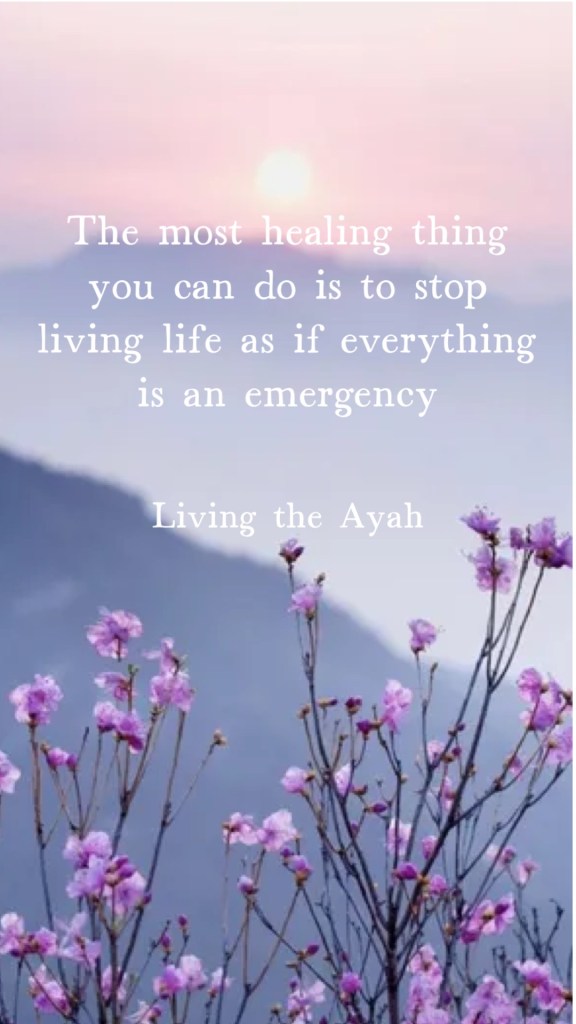
The most healing thing you can do is to stop living life as if everything is an emergency.

We’ve become so used to rushing that we barely let our feet touch the ground before we’re already onto the next three things. The next task. The next responsibility. The next demand. Our days are planned, our weeks are full, and before a new school week even begins, we already know our feet are going to hit the ground running.

And somewhere in all of that… we disappear.

We rush through meals. We rush through conversations. We rush through rest. Even the quiet moments meant to care for ourselves—taking off our makeup, doing our skincare, sitting down for a breath—we treat them like boxes to tick before we collapse into bed, just to do it all over again.

But healing was never meant to be rushed.

Taking care of yourself is not something you squeeze in between responsibilities. It is part of your responsibility. It is an act of love. An act of preservation. An act of honouring the body and soul Allah entrusted to you.

And this is where salah becomes something deeper.

Allah says in the Qur’an:
“Verily, in the remembrance of Allah do hearts find rest.” (13:28)

Salah is not just something we fit into our day—it is something that breaks our day. It interrupts the chaos. It calls us back. Whether you pray five separate prayers or combine them, these moments are رحمة. They are pauses. They are space to breathe, to ground yourself, to realign.

To step out of urgency… and into presence.

There is healing in standing still.
Healing in bowing.
Healing in placing your forehead on the الأرض and remembering you are held, sustained, and never alone.

And yet, even in healing—we rush.

We rush journaling.
We rush reflection.
We rush through understanding ourselves, as if we’re trying to “complete” our healing like another task on the list.

But you are not a task to be completed.

As mothers—especially those carrying full, heavy, beautifully demanding lives—it can feel like everything depends on how quickly and efficiently we move. The responsibility is constant. The giving is endless.

But self-care is not in competition with that responsibility.
It is what supports it.

You are allowed to write yourself into your own diary.
You are allowed to take an hour.
You are allowed to move slowly, even when life around you is fast.

So as this new week begins, and your feet hit the ground running… pause.

Not for long. Just enough.

Enough to breathe before you rush.
Enough to feel your feet before they carry you.
Enough to turn to Allah not just in obligation—but in need, in softness, in العودة.

And see how you feel… when life is no longer one long emergency,
but a series of moments you are actually present in.

Alhamdulillah

Today, I took the children to the beach. The tide was slowly going out, leaving just enough room to sit and breathe. The air smelled of salt and seaweed, the sun warmed my shoulders, and the waves whispered over the pebbles. Sitting there, I felt relief wash over me—the tension and worry from the last eight weeks drifting away, carried by the ocean.

The children laughed, threw stones, and waded into the cold water, fully immersed in the joy of the moment. Watching them was like watching myself—they share the same deep connection to the ocean that I do. The beach became a reflection of humanity: each of us unique, all imperfect, yet together forming the shore. The ocean reflected Allah’s attributes—His peace, His mercy, His presence—bringing calm and lightness of heart. “My mercy encompasses all things.” In the waves, in the pebbles, in the children’s joy, I felt that mercy flow through creation, comforting and restoring.

As we left, the children hugged me and thanked me, and I realised that even without knowing it, Allah had touched them as well, bringing them peace. Today reminded me that sometimes, the deepest relief comes simply from stepping into the present, seeing the world through His creation, and letting everything else slip away with the tide.

Love is a human offering.

Love is a human offering given freely.

It does not always arrive in obvious ways, and it is not limited to romance. More often, it exists in the quiet decisions people make every day—to check in, to listen, to notice, to stay a little longer than necessary. These acts seem small, but they carry something deeper: the choice to care.

To offer love is to give something of yourself that cannot be measured or guaranteed in return. Your attention. Your patience. Your presence. And still, people give it—without certainty, without assurance. That is what makes it an offering.

In Islam, love is not only a feeling but something lived through action. The Prophet Muhammad taught, “None of you truly believes until he loves for his brother what he loves for himself.” This kind of love is not passive—it asks you to extend الخير, the good you hope for, beyond yourself.

The Qur’an describes love as something placed between people in the form of affection and mercy: “And We placed between you affection and mercy” (Qur’an 30:21). Not intensity, not constant emotion—but mawaddah and rahmah: a steady willingness to care, to be gentle, to remain.

This is why love often goes unnoticed. It does not always feel extraordinary. It feels like someone remembering you. Like being asked how you are and knowing the answer matters. Like being seen in a moment you did not ask to be seen in.

Even outside of faith, this understanding repeats itself. As bell hooks puts it, “The will to extend one’s self for the purpose of nurturing one’s own or another’s spiritual growth” is love. And Rumi reminds us, “Where there is love, there is life,” because love is what gives meaning to our presence with one another.

To be fully seen and still cared for can feel miraculous, as Elizabeth Gilbert observes: “To be fully seen by somebody then, and to be loved anyhow, this is a human offering that can border on the miraculous.” But maybe what feels miraculous is actually something deeply human—something we are quietly offering each other all the time.

Love is a human offering given freely.

Not because it is easy.

Not because it is always returned.

But because, even in our imperfection, we are still capable of giving it.

Every moment of your life is an act of worship

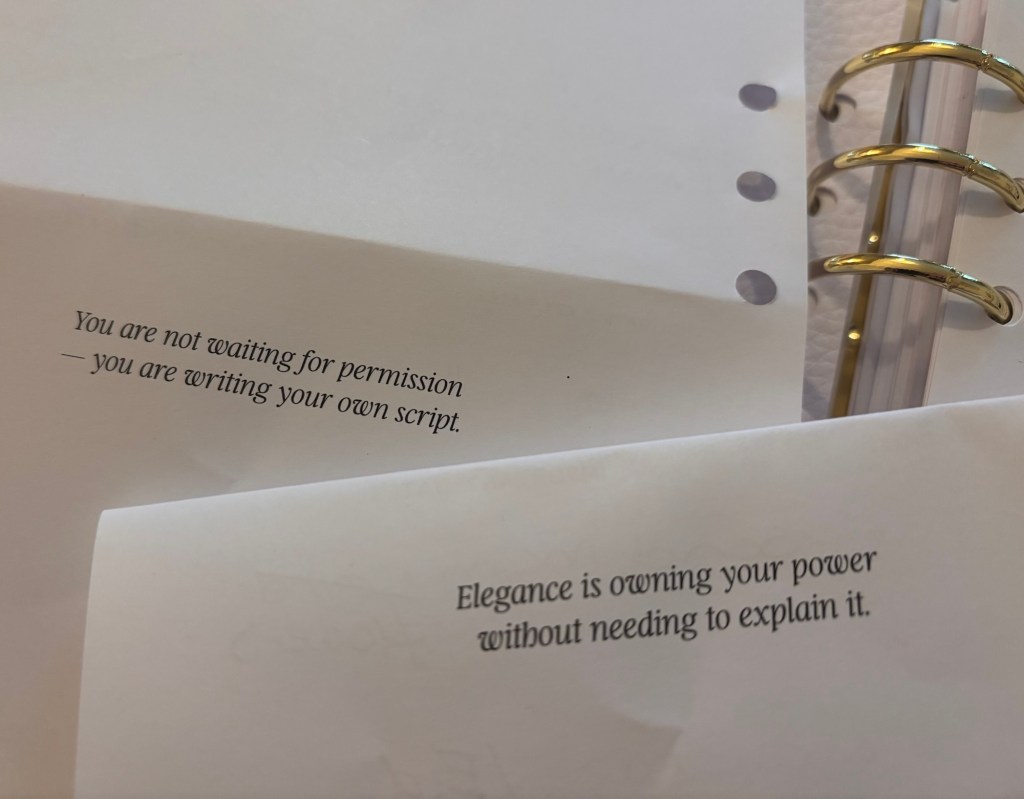
I was going through my journal today, clearing out the past months to make room for new pages, when I came across two sheets I had actually pulled out before. On one, it read: “You are not waiting for permission, you are writing your own script.”

I paused. There’s something incredible about how Allah guides us through subtle reminders exactly when we need them. Today—of all days—I finally sat down to plan this book properly. My second book. And while I don’t want to give too much away, it’s intertwined with my journey of growth, healing, and stepping into a new chapter of my life.

Flipping through, I noticed the other page, and the words struck me deeply: “Elegance is only in your power without needing to explain it.”

Two messages. Both could have been tossed aside, dismissed, or lost, yet here they were, placed before me at the right time. They reminded me of something essential: the power and strength Allah has already placed within me, and the grace that comes from owning my path without needing to justify it to anyone.

Inner child work, at its heart, is about reclaiming what has been taken from us and returning to ourselves with compassion and awareness. It’s about recognizing the ways our past shaped us, and, with Allah’s guidance, taking back the strength, courage, and dignity that is rightfully ours.

So, these two pieces of paper are no longer just loose reminders or fleeting thoughts. They’re tucked safely into the back of my journal—a visible reminder for days when I doubt myself, when I forget myself, or when I need to remember that true strength, grace, and elegance come from within, and are part of Allah’s guidance in our lives.

Today, Allah reminded me: I am not waiting for permission. I am writing my own script. And in every step I take—every page I write, every choice I make—my life itself can be an act of worship, when it is done sincerely for Him.

I finally found myself.

There is a point in life where everything else fades—

the missed texts, the unanswered calls, the fleeting judgments of others.

At this point, only one thing matters: pleasing Allah subḥānahu wa ta‘ālā.

The niqab calls to me again but on a much deeper level this time.

It is a challenge, yes, and I know there will be days when its weight feels heavy, when the world’s gaze feels sharp,when my human heart whispers, “Not today.”

Yet wisdom guides me: I will wear it when I seek closeness to Allah, in spaces where I feel safe, where devotion can breathe,in the mosque, in my car, in corners of the world that hold my sanctuary.

I do not aspire to perfection.I am human, fragile, flawed—but striving.

Striving to be better than yesterday, to make every choice, every change, every breath for Him alone.

I do not seek knowledge for status, nor through division or sects. I seek it through the Qur’an, through a personal, intimate relationship with the One who knows all.

I know I will never fully understand Allah subḥānahu wa ta‘ālā, yet the striving, the yearning, the awe—these threads bind my heart to Him.

Six years on, the zest for knowledge burns brighter than ever: the closer I feel, the more I realize how vast His wisdom is.

This is not discouragement, but devotion.This is iman, tawakkul, and tawhid alive in my heart.

Dua from my heart ❤️

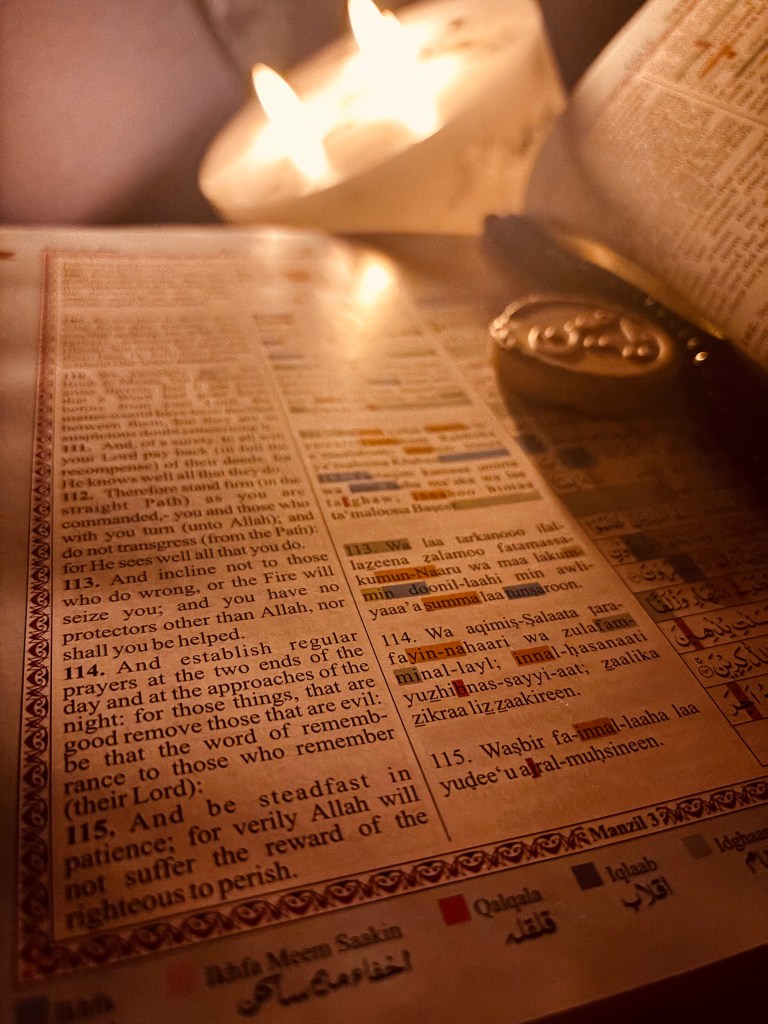
O Allah, grant me strength and courage to wear the niqab with confidence and devotion, to dive deeper into this path of knowledge and closeness to You.

Protect me in my striving,let my heart find peace in surrender,and let my choices reflect nothing but love for You alone.

Ameen.

The Weight of the Veil

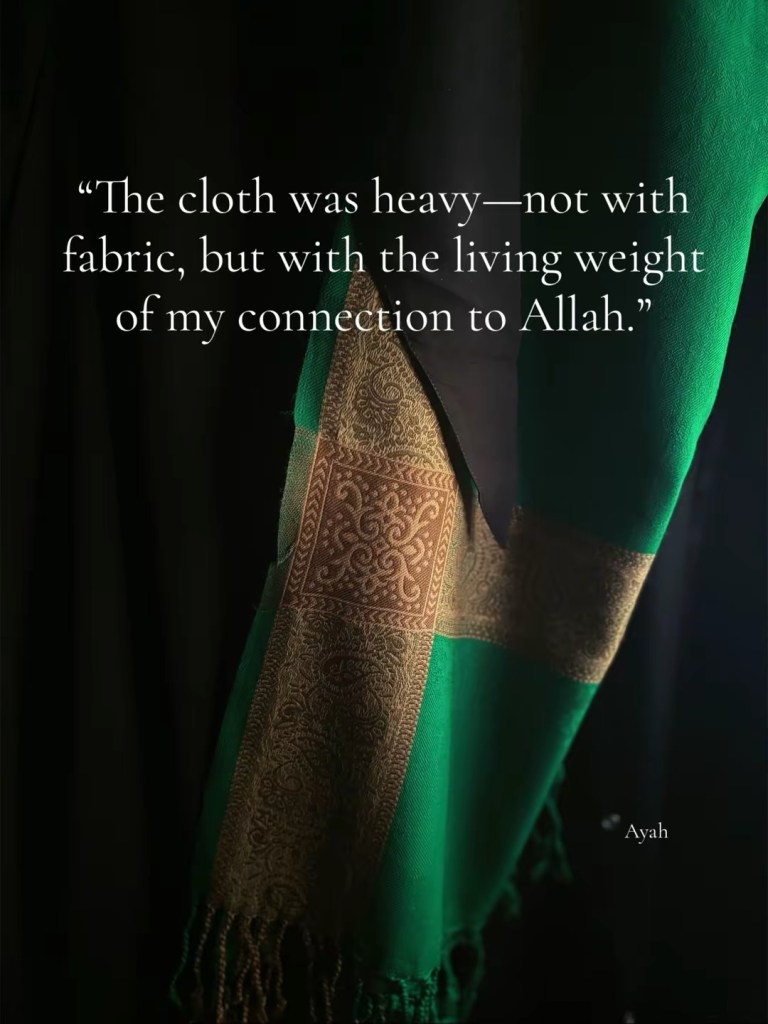
Tonight, I wore a different veil, a shayla for prayer—a heavy one. As I bent into sujood, the cloth fell over my face, layer by layer, until I could see nothing but the veil and feel only the ground beneath my forehead. It was as though, in that moment, I shared a vision with Fatima alayhi salam, and all the veils of devotion across history unfolded around me.

The veil is not merely fabric. It is a screen, a boundary, a focus. It softens the world so the soul can lean closer to Allah, so every whisper of prayer lands fully. Once I finished my salah, I hung the shayla on the edge of my bed. At that moment, I realised the weight I had felt was not the weight of the cloth, it was the weight of my connection, the gravity of love, devotion, and surrender to Allah subhanahu wa ta’ala.

In that heaviness, I learned something essential: that devotion has weight, and the closer one leans, the more it is felt.

Beyond the veil

There is a quiet pull toward the niqab that doesn’t always begin with certainty. It doesn’t arrive fully formed with clear answers or neat reasoning. Sometimes, it begins as a feeling—persistent, gentle, and difficult to explain.

And the questions come:

Do I really understand this? Am I missing something?

Is it extreme? Is it unnecessary? Is it oppressive?

What will people think when I walk outside?

Will I be judged, stared at, misunderstood?

Am I putting myself in danger? Are my children safe beside me?

These questions are real and weighty, shaped by a world that often frames the niqab as restrictive, something imposed, something to be feared. But beneath all that noise, there is something else—a quieter truth.

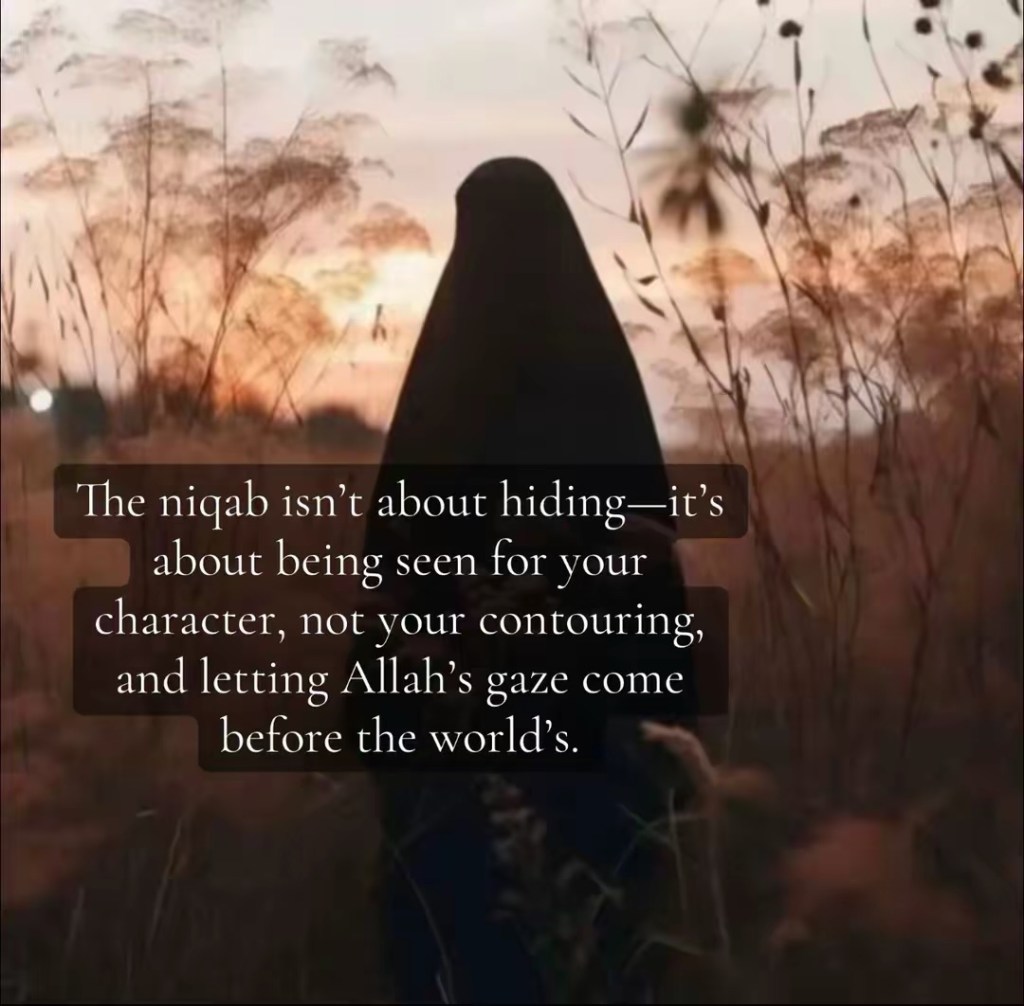
Because wearing the niqab does not feel like hiding. It is not about disappearing into the background, stepping out of sight, or erasing oneself. It is about being seen differently. It is about choosing the lens through which the world encounters you.

You want to be perceived for your character, not your contouring.

This distinction matters. Hiding is born from fear or shame. It carries the weight of withdrawal, a desire to escape observation. But covering, as an intentional act of devotion, is different. It is choice. It is intention. It is a form of turning inward toward Allah while still being fully present outwardly.

The niqab does not remove you from being seen—if anything, it can make you more noticeable. But what shifts is the basis of that perception. Without immediate access to the face, a woman is encountered through her words, her presence, her character. The face is no longer the first introduction; intention, behavior, and essence take precedence.

And in that space, a different awareness emerges: the awareness of being seen not just by people, but by Allah. This touches directly on the concept of Ihsan—worshipping Allah as though you see Him, and if you cannot see Him, knowing that He sees you. In the presence of the veil, the social gaze softens, and the inner gaze—His gaze—becomes more central. The niqab becomes a physical reminder that the most important observation is not external approval or judgment, but the awareness of Divine sight.

The questions about safety, about perception, about societal judgment do not vanish. They coexist with the pull toward this form of devotion. But the internal shift is clear: the niqab does not erase a woman; it redirects how she is known. It is not hiding. It is covering. It is living intentionally in a space where the first encounter is with Allah, and only then with the world.

And in that quiet, intentional space, the pull toward the niqab can be understood—not purely as a rule or a requirement, but as a lived experience of being known for what truly matters: the heart, the character, the devotion.

The Weight of Over-Explaining

This morning, I logged onto my personal blog—a small space where I share my journey as a Revert, the struggles, the questions, the quiet moments of reflection. And yet, I was met with something unexpected: a reply to another commenter that read more like a thesis than a comment—A4-sized paragraphs, video links, citations, and an insistence that the original commenter “correct” themselves according to the responder’s view.

I couldn’t help but pause. Why do some feel entitled to occupy someone else’s personal space with a full lecture, especially when it’s a space meant for reflection and shared experience? Why, in the name of “guidance” or “truth,” does the digital age encourage people to step into someone else’s corner of the world, not to share, but to dominate? do they not have their own platform or have they taken upon themselves the role of online sheik to correct others and for what purpose?

Social media has a strange way of inflating egos while deflating empathy. It whispers that our knowledge, our perspective, our opinion, is urgent and must be imposed—especially in matters of faith. And yet, Islam, in its depth, does not call for such displays of performative authority. The heart of Tawheed, the oneness of God, is not served by blind imitation, nor by clipping the wings of someone trying to find their own understanding. As Ayatollah Ali Khamenei writes, true faith does not merely dwell on recitation or rote learning; it demands reason, reflection, and questioning. To follow another blindly, without question or understanding, is not humility—it is a form of shirk.

When someone steps into another’s personal space online and delivers a monologue meant to “correct” or “instruct,” it often reflects not wisdom, but ego. It is far removed from the spirit of Tawheed, which asks us to align ourselves sincerely with God, not to assert our dominance over another’s journey. Faith is cultivated in the heart, nurtured by reflection, not dictated by the keyboard of a stranger.

Before we rush to respond, before we craft that long monologue meant to correct or instruct, perhaps the first step should be reflection. Pause and ask: Where am I actually coming from as I write this? What is my intention? how does this rest in the arms of divine unity and Tawhid ?

Islam calls us to check our hearts as much as our words. Are we speaking to guide, to share, to illuminate—or are we simply asserting our own ego? Too often, a lengthy, impassioned reply does little for anyone else, and everything for ourselves. It becomes a public performance, a monument to our knowledge, rather than an act of sincere dialogue or support.

Questioning ourselves, being mindful of intention, and stepping back before pressing “reply” is not weakness—it is wisdom. It is the heart of humility in Islam, the very humility that Tawheed calls for. When we write from ego, we may convince ourselves we are teaching, correcting, or guiding—but in truth, we are only displaying our own sense of authority.

Faith, reflection, and true understanding grow in spaces of patience and respect. So before we take over another person’s corner of the world with a lecture, we owe it to ourselves—and to the Divine—to pause, reflect, and ask: Am I here to elevate understanding, or simply to elevate myself?