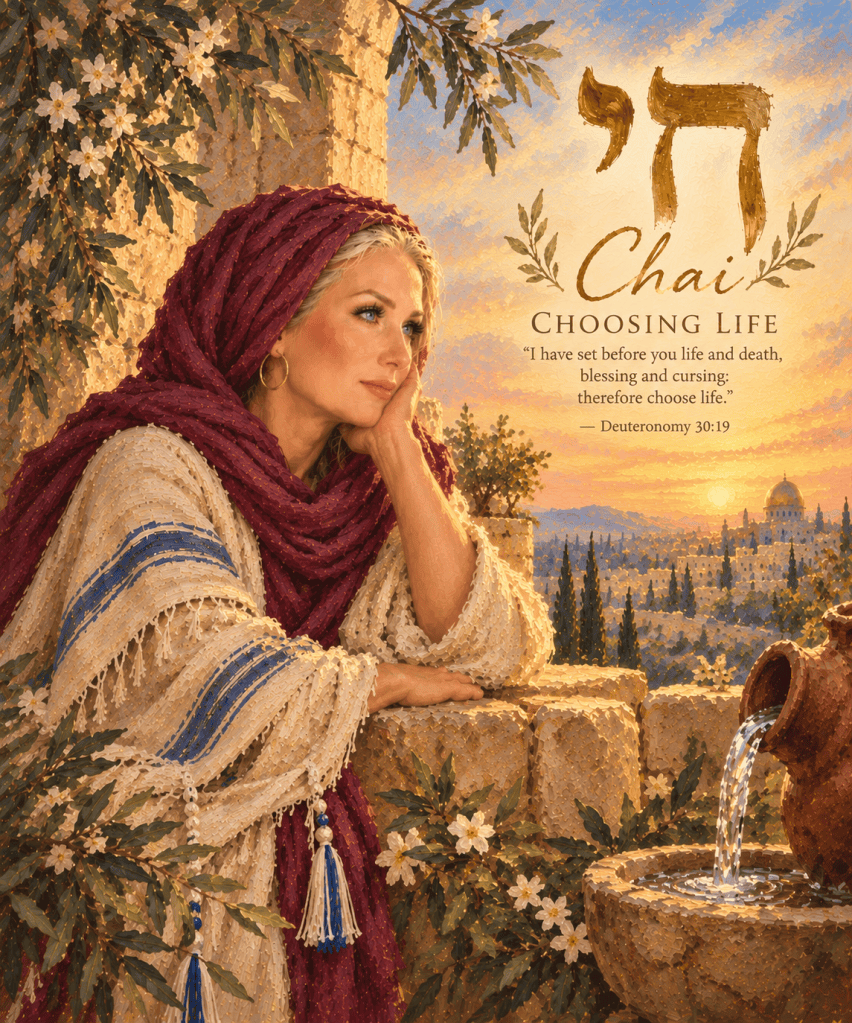
“I have set before you life and death, blessing and cursing: therefore choose life.” — Deuteronomy 30:19
There is something deeply profound about the Hebrew word חי — Chai. It means life. Two small letters that have come to represent something deeply personal to me: the decision to stop merely surviving and begin truly living.
Life has brought its share of struggles. Raising children alone, caring for children with additional needs, managing my own health, navigating difficult family relationships and carrying the weight of old wounds have all shaped my journey. Sometimes, when the burdens become too heavy, we can often find ourselves reaching for ways to escape rather than ways to heal.
I can look back now with greater understanding of the circumstances that led me to addiction. I don’t need to condemn myself for the struggles I’ve faced, but I do need to recognise that my life is precious enough to protect. My struggles are part of my story, but they do not have to define its ending.
And this is where my journey towards the Torah and the teachings of Jesus has brought me to a profound realisation:
I choose life now.
Not simply the absence of suffering, nor a life free from difficulty, but a life rooted in something deeper. A life guided by faith, nourished by truth and sustained by the living God.
The words of Deuteronomy 30:19 are no longer simply words on a page.
Choose life. To love God, to hold fast to Him, and to recognise the preciousness of the life He has given us.
Through the teachings of Jesus, I have found myself reflecting on the living water spoken of in John 4:14. I think about the thirst within us, the emptiness we sometimes try to fill with things that cannot truly sustain us, and the peace that comes from turning towards God instead.
Perhaps choosing life means learning where to turn when we are thirsty.
It means understanding that we can be accountable without condemning ourselves, that we can acknowledge our past without remaining imprisoned by it, and that we can begin again even after periods of struggle.
It also means recognising that we cannot always change our circumstances, our health or the behaviour of those around us. But we can begin to change the way we care for ourselves, the patterns we choose to break and the direction in which we want our lives to move.
This is what Chai has come to mean to me.
It’s the connection to the Hebrew Scriptures, to the God of Israel, and to the Torah’s enduring call to choose life. Through my faith in Jesus, it has also become a reminder of the living water that nourishes the soul.
When I wear these two small Hebrew letters, I want them to remind me that my life is valuable, even when it is difficult. That I am allowed to rest, to seek help, to heal and to begin again. That I do not have to be endlessly strong to be worthy of compassion, rest and love.
I cannot rewrite the past, but I can choose how I walk into the future.
I choose to live rather than merely survive. I choose to seek God rather than escape my pain. I choose to break the patterns that have hurt me and to approach myself and others with greater compassion.
I do not know everything that lies ahead, and I know there will still be difficult days. But I want my life to be shaped by faith rather than fear, by hope rather than shame, and by the understanding that even after struggle, there is still the possibility of renewal חי — Chai. Life.
I choose life, not because life has always been kind to me, but because I am beginning to understand just how precious it is.
And when I am thirsty, I know where I want to turn: to the living God, the fountain of living water.
Today, I choose life. And tomorrow, I will choose it again.
Discover more from The Daughter at the Well
Subscribe to get the latest posts sent to your email.


You must be logged in to post a comment.