Reflection
Recently, I went to a respected friend with questions. I wasn’t looking for someone to simply give me answers; I was looking for guidance, reflection, and inspiration because I felt that something within my spirituality had become a little lost.
Before Islam, I had a very spiritual life. I found meaning in meditation and stillness, Reiki and sound practices, singing bowls and gongs, incense, candles, crystals, journaling, reflection, and creating peaceful spaces. I was drawn to moments of connection, peace, and a sense of something deeper beyond the everyday.
When I came to Islam, that longing for connection did not disappear. I was seeking that same closeness to the Divine through a new path — through the Qur’an, prayer, dhikr, and my relationship with Allah.
But recently, I found myself asking: Where has that sense of spirituality gone? Had I lost something, or was my understanding of spirituality changing?
My friend asked me questions that encouraged me to look inward:
What do you find spiritual? What did you find spiritual before?
Do you allow yourself to contextualise and question difficult verses of the Qur’an?
Those questions stayed with me.
As I reflected, I began exploring what it means to have a relationship with the Qur’an that is not only based on receiving interpretations, but also on sincerely engaging, reflecting, and seeking understanding.
This led me to discover the concept of tadabbur — deep reflection and contemplation.
I realised that perhaps what I had been searching for was not a way away from the Qur’an, but a deeper way into it.
For me, tadabbur means sitting with an ayah and allowing myself to reflect:
What is this teaching me?
Why does this verse affect me?
What does this reveal about Allah, His mercy, His justice, His compassion, and my own life?
This does not mean ignoring the original meaning of the Qur’an. Context matters. Language matters. History matters. The understandings of scholars and generations before us matter.
But I also believe there is space for sincere reflection.
It means allowing myself to ask:
Is this interpretation the only possible understanding?
Is this a timeless principle, or was it revealed in response to a particular situation?
How does this fit with the wider themes of the Qur’an?
For me, this is not about changing the Qur’an to fit my own desires. It is about approaching it with humility, honesty, and a genuine desire to understand.
A sincere relationship with revelation can include moments of questioning, searching, and even struggling. A person can say:
“I believe this is from Allah, but I am struggling to understand it. I want to explore its meaning.”
That is not necessarily a turning away from faith. Sometimes questions come because we want a deeper and more authentic connection.
I find myself wanting to hold both things together: respect for scholarship and tradition, while also allowing myself to reflect personally. I can explore classical interpretations, commentaries, and different perspectives, while also recognising that my relationship with Allah is personal.
My friend also shared her own thoughts about what inspires her in other Muslims. Her reflections made me think about my own sources of inspiration: what draws me closer to Allah, what nourishes my soul, and what expressions of faith help me feel connected.
She also encouraged me to consider that if certain practices or expressions of faith do not inspire me, perhaps they are not the right expression for me at that particular time. That does not mean rejecting them; it means recognising that spiritual growth can take different forms.
She reminded me that Islam itself unfolded gradually over 23 years. Revelation came step by step, and the Prophet Muhammad ﷺ guided people with wisdom, patience, and understanding of their circumstances.
Perhaps my journey is not about finding a perfect version of faith that someone else has defined for me. Perhaps it is about discovering a sincere relationship with Allah that allows me to grow, reflect, question, and return.
Maybe my spirituality was never truly lost.
Maybe it was asking to be deepened.
Maybe what I am learning is that spirituality is not only found in familiar practices, but in the courage to reflect, to seek understanding, and to remain open to being transformed by what I learn.
In that sense, tadabbur is not separate from spirituality — it is part of it. Reflection becomes a way of drawing nearer to Allah, and questioning becomes a way of seeking truth with sincerity. Personal growth, then, is not a departure from faith, but one of its fruits.
And perhaps that is the insight I was looking for all along: that my path back to spirituality is not a return to who I was before Islam, but a deeper, more grounded way of being who I am — finding my way back to Allah through a connection that is personal, sincere, and rooted in my own journey rather than shaped only by the voices around me, which can sometimes become so loud that they drown out my own conviction and the quiet sincerity of my relationship with Allah.
I was once again beautifully reminded of these words, often attributed to Rumi:
“Let yourself be silently drawn by the strange pull of what you really love. It will not lead you astray.”
I believe there is One God — Allah — the source of all existence, love, mercy, wisdom, and beauty. I believe Muhammad ﷺ is His Messenger, the Qur’an is the final revelation, and my relationship with Allah remains at the heart of my spiritual life.
Where my understanding differs from more literal interpretations is in how I view the world’s religions and spiritual traditions.
I think much of this perspective has been shaped by my experiences of travelling the world and by being married to someone from a Brahmin Hindu background. Living alongside different cultures and traditions has shown me the depth of humanity’s search for meaning and connection with the Divine.
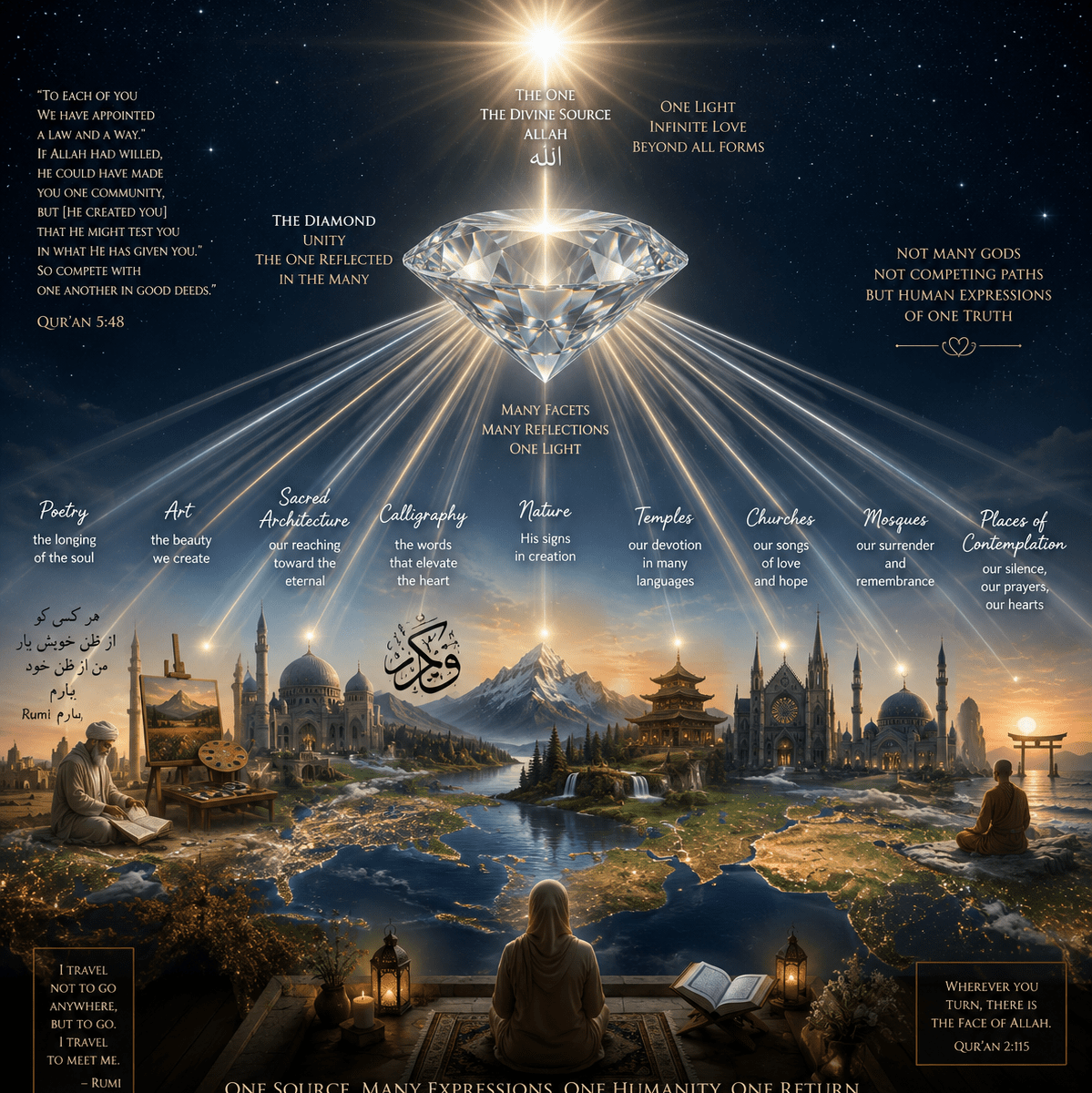
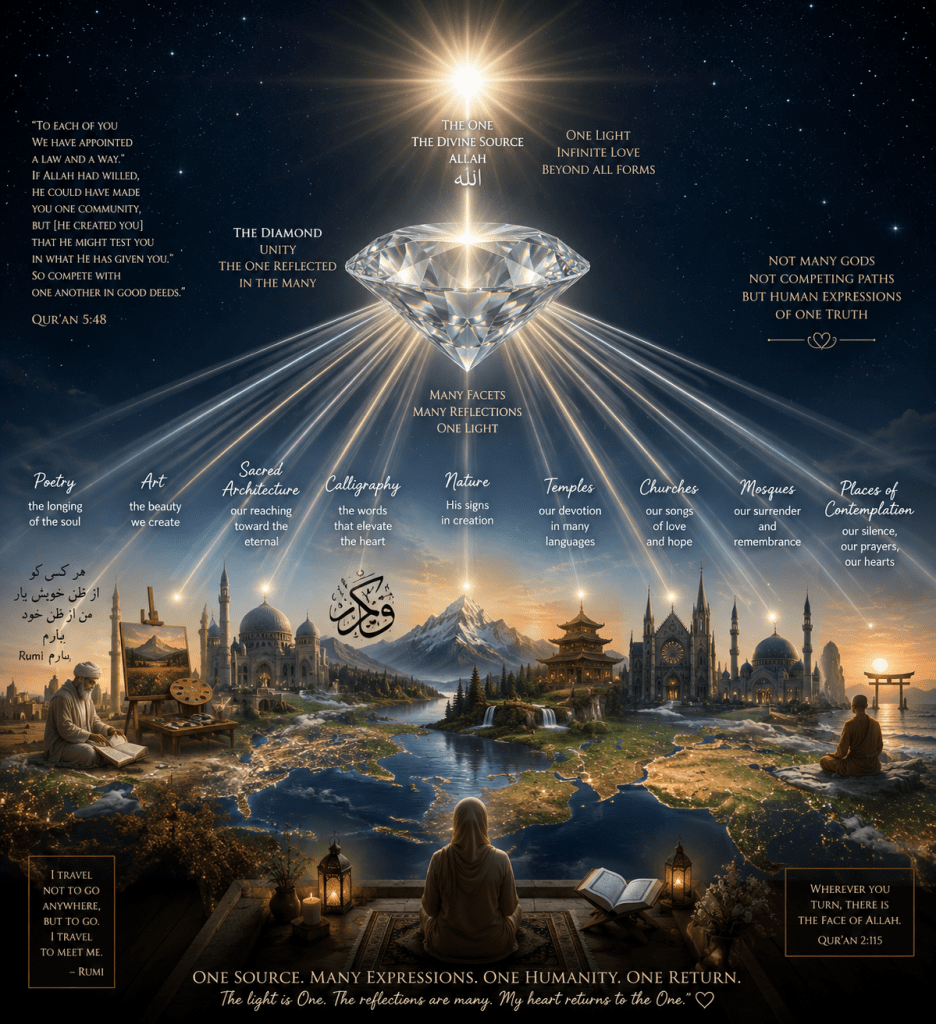
Whilst I do not believe there are many gods, nor that every religion is equally true in every teaching, I do believe humanity has always been reaching towards the same Divine Reality — expressing that search through the stories, symbols, poetry, art, rituals, and traditions of their own cultures.
I see the gods, goddesses, and sacred figures of different traditions not as separate divine beings, but as human ways of expressing and understanding qualities that ultimately come from Allah.
To me, creation is full of signs pointing back to the One.
Love, compassion, justice, beauty, and wisdom are reflections of Divine qualities. The forms may differ, the languages may differ, and the symbols may differ, but the longing behind them is the same: humanity’s desire to know, seek, and draw closer to God.
I do not see the diversity of spiritual traditions as taking away from Allah’s Oneness. Instead, I see it as a reflection of humanity’s ongoing search for Him and the many ways people throughout history have tried to understand, express, and respond to the Divine.
Perhaps this is where I find myself closest to the Perennial Philosophy — not because I believe every belief or teaching is the same, but because I recognise a shared human longing for the Sacred that appears across cultures and throughout history.
My journey is not about abandoning Islam or replacing it with something else. It is about understanding my faith more deeply: recognising Allah as the source of all truth, while acknowledging that humanity has always been searching for Him.
Maybe my spirituality was never lost.
Maybe it was leading me here all along.
Discover more from Seeking Sakina
Subscribe to get the latest posts sent to your email.
 Seeking Sakina