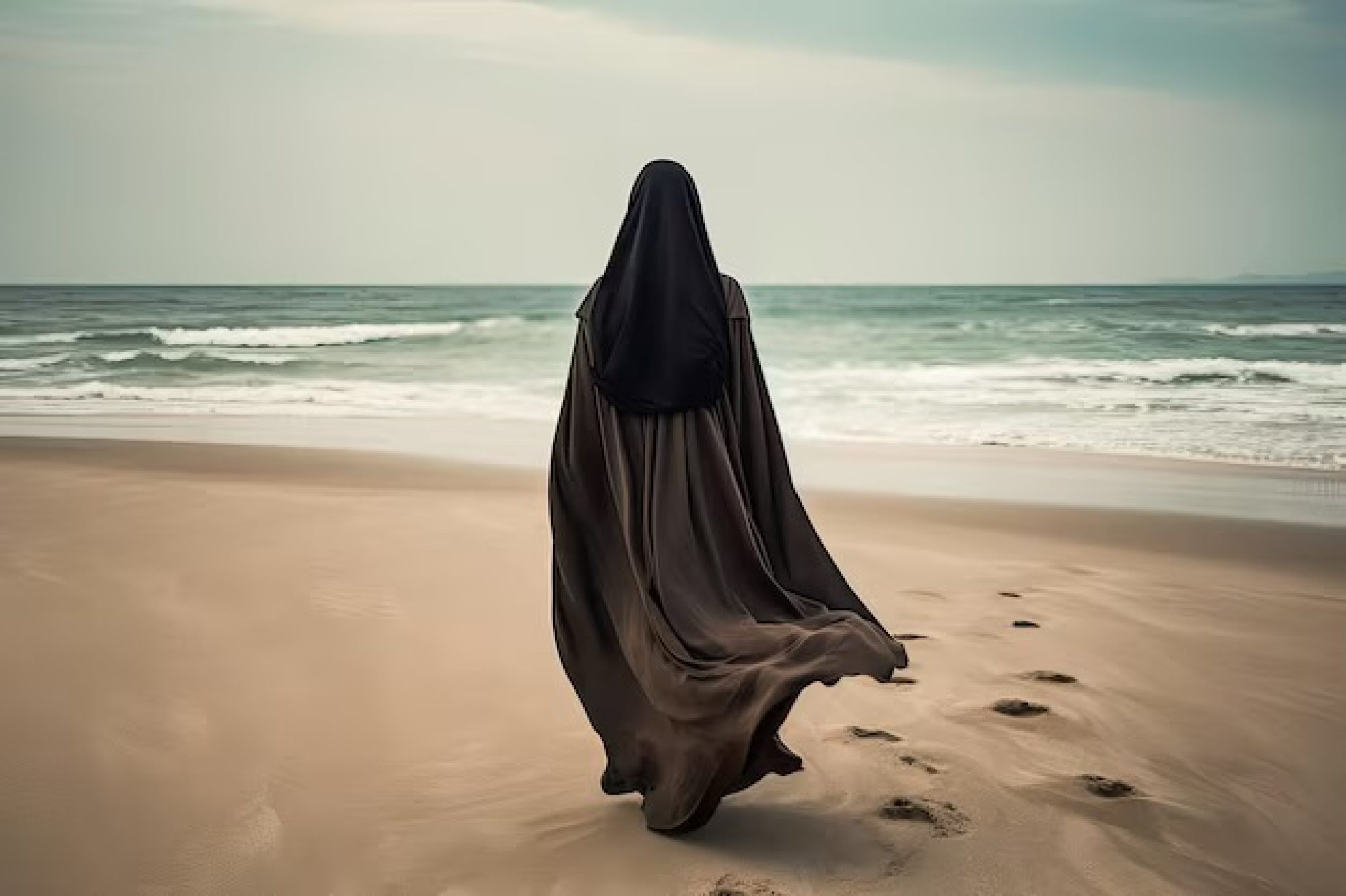
I have spent a long time struggling with my relationship to hijab, modesty, visibility, and faith. For a while, I thought the struggle meant my iman was weak or that I was somehow failing as a Muslim woman. But the more honestly I reflect, the more I realise my struggle is not with Allah, nor with morality, nor with wanting to expose myself or seek attention. My struggle is with carrying the emotional and psychological weight of being visibly Muslim all the time, especially while navigating identity, femininity, exhaustion, and sincerity.
As a woman in my mid-fifties who is past the menopause and no longer seeking marriage, I find myself thinking more deeply about what the Qur’an actually says, versus what culture, community pressure, or inherited tradition have added around it.
To be clear here I do not reject modesty. I still value dignity, humility, and respectful dress. I still cover my chest area and avoid clothing that feels deliberately provocative. I still wear hijab during prayer and often cover my hair in softer, looser ways. But I no longer believe that my entire faith rests upon whether every strand of my hair is covered every moment I step outside.
The Qur’an itself places its strongest emphasis on sincerity, conduct, humility, justice, compassion, prayer, remembrance of Allah, and care for others. While modesty is certainly part of Islam for both men and women, the Qur’an does not spend pages detailing exact fabrics, styles, colours, or universal dress codes for every woman in every place and every century.
One verse that has become deeply meaningful to me is Qur’an 24:60, where Allah speaks specifically about older women past childbearing age who are no longer seeking marriage. The verse says there is no blame upon them for relaxing some of their outer garments, provided they are not displaying adornment in a provocative way, though modest restraint remains better. To me, this verse reflects mercy, realism, and nuance. It acknowledges that women’s lives, bodies, circumstances, and social realities change with age. It recognises that modesty is not a rigid prison but a principle rooted in dignity and intention.
For a long time, I wore hijab in a way that felt emotionally heavy. Every day I would put it on and feel dread, resistance, or sadness. I began to realise that constantly wearing something from fear, guilt, or emotional suffocation was not bringing me closer to Allah. My faith was becoming tangled in anxiety and all-or-nothing thinking. But spiritual life is rarely that simple.
I am beginning to understand that my relationship with hijab does not have to be all or nothing. I do not need to disappear as a woman in order to remain faithful to God. I can still dress with modesty while allowing softness, beauty, femininity, breathability, and comfort into my life. I can wear looser flowing scarves, boho wraps draped around my shoulders and chest, relaxed clothing suited to heat and travel, and styles that feel emotionally sustainable rather than performative.
This is by no means an address or a call for women to remove their hijab. It is simply an acknowledgement of a personal journey, a sincere struggle, and an attempt to understand faith, modesty, and identity with honesty rather than fear.
Most importantly, I am learning that my faith is bigger than what I wear on my head.
Allah sees my sincerity, my struggle, my intention, my reflection, my prayers, my compassion, my motherhood, my exhaustion, my searching heart, and my efforts to remain truthful. I do not believe Allah is waiting to reject me because my hijab has become softer, looser, or different from before.
I am not abandoning faith. I am trying to remain spiritually honest.
And perhaps that honesty itself is part of worship.
Discover more from Seeking Sakina
Subscribe to get the latest posts sent to your email.
 Seeking Sakina