“Blessed is the One in whose hands rests all authority, and He is Most Capable of everything.”
The very first word of this verse, Tabāraka (تَبَارَكَ), comes from the root baraka, meaning to grow, to increase, or to overflow with goodness. Today, it is often translated as “blessing,” but in the context of Allah, its meaning is far richer. It refers to a unique kind of divine abundance — a pure and supreme goodness that originates from Allah and is spread throughout His creation. He is not only the source of blessings, but also the One who distributes them with wisdom and mercy.
This divine barakah is often visible in the world around us — in nature, in our sustenance, in moments of ease — signs designed to awaken our awareness and appreciation of Allah’s presence. The word Tabāraka, used right at the beginning of Surah Al-Mulk, sets a profound tone for the rest of the chapter. It reminds us that Allah’s blessings are not separate from His authority; they are part of the very fabric of His kingship.
The term Al-Mulk refers to absolute dominion — complete control over the heavens, the earth, and all that lies between and beyond. The use of the definite article “Al” (meaning the) emphasises that this is not just any kingdom — it is the kingdom. Everything that exists falls under His rule, and every individual is both created and sustained by Him.
The verse concludes by describing Allah as Qadīr, which comes from the root Qadara, meaning to decree, to measure out, or to determine. It highlights that Allah’s power is not just limitless but also precise and purposeful. He doesn’t just have power — He uses it with wisdom, and nothing is outside His ability.
This concept of divine barakah — of Allah’s overflowing goodness — is found throughout the Qur’an. One of the most beautiful examples is in Surah Al-Isra (17:1), where Allah refers to Masjid Al-Aqsa in Palestine:
”… to al-Masjid al-Aqsa, whose surroundings We have blessed (ٱلَّذِى بَـٰرَكْنَا حَوْلَهُۥ)…”
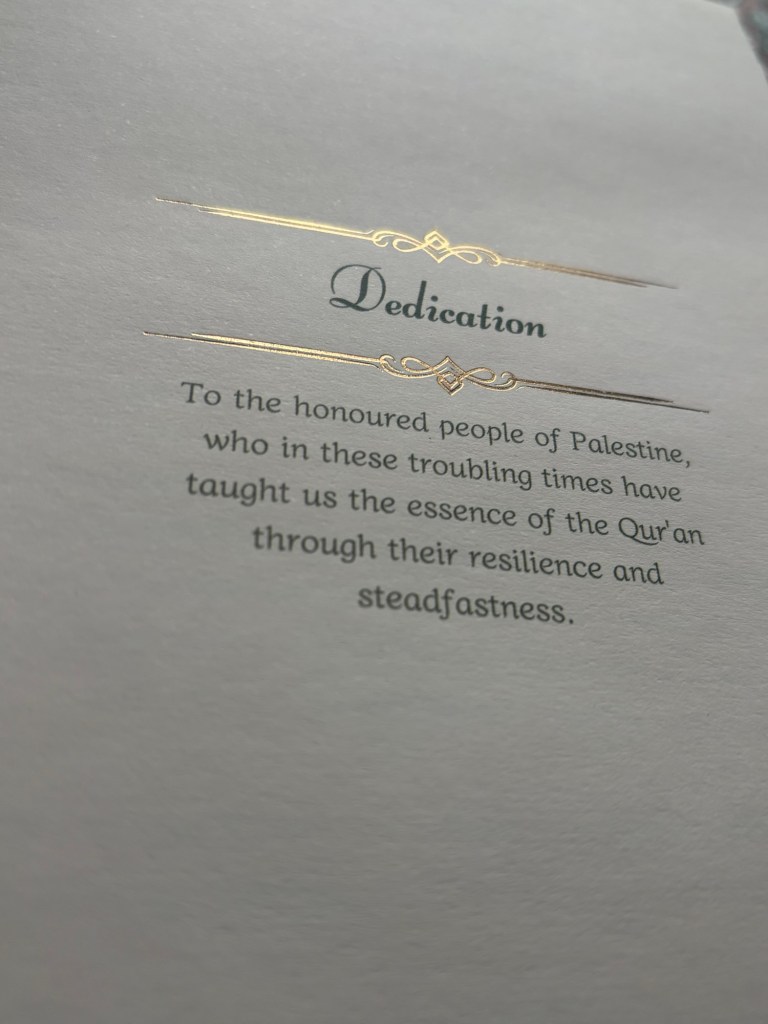
Here, the phrase “baraknā ḥawlahu” — “We have blessed its surroundings” — refers to the sacred land of Palestine, showing us that the barakah of Allah is also tied to places, not just people or moments. This land has witnessed the footsteps of prophets and carries a spiritual weight recognised and preserved in the divine text.
So from the grandeur of divine rule in Surah Al-Mulk to the blessed lands mentioned in Surah Al-Isra, the concept of barakah weaves through the Qur’an like golden thread — pointing us always back to Allah, the Most Generous, the Most Capable, and the source of all true increase.
 Seeking Sakina