
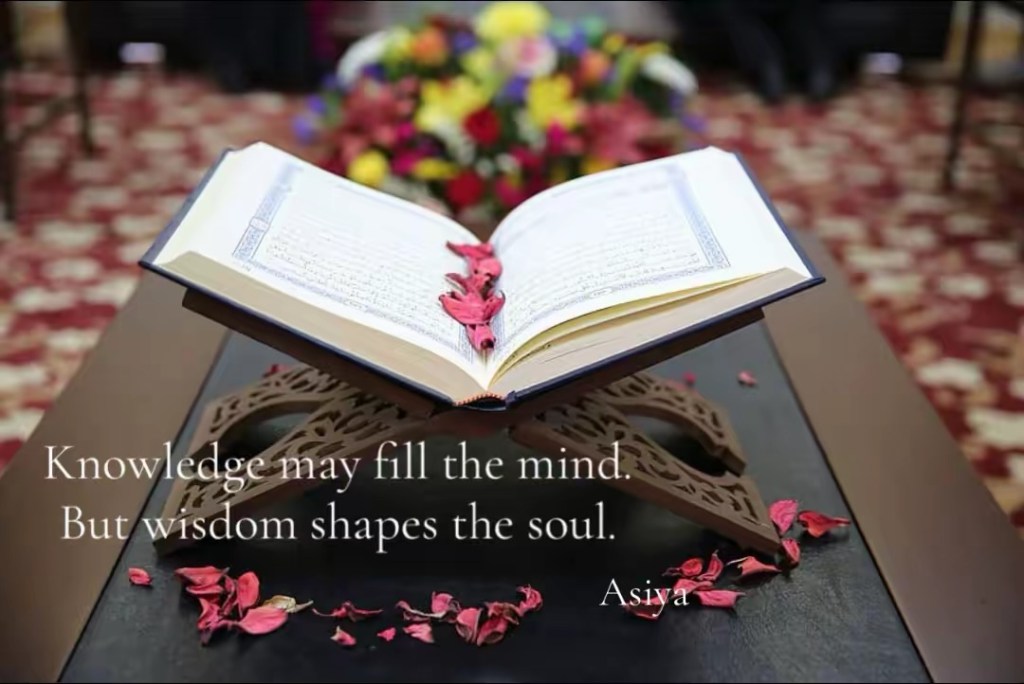
But wisdom shapes the soul.
A Reflection for My Fellow Revert Sisters
Sometimes, as reverts, we feel small in comparison to those who seem to know everything about Islam — who can recite the Qur’an flawlessly, quote hadith by heart, and remember every lesson. We may worry that our journey is incomplete, that our understanding is lacking.
But the truth is, the beauty of this path is not measured by memory or perfection. It is measured by the depth of our hearts, the sincerity of our reflection, and the way the Qur’an takes root within us.
With this in mind, I want to share a letter to my fellow revert sisters — a reminder that wisdom is found in the heart, and that your connection to Allah is unique, precious, and enough.
⸻
A Letter to My Fellow Revert Sisters
My dear sisters,
There is something I want to share with you, especially for those of us who came to Islam later in life. Many of us carry a quiet worry in our hearts: “I don’t know enough. I can’t remember enough. I’ll never catch up to those who were born into this faith.”
I want you to pause here, take a breath, and let me tell you — you are not less. Not in the sight of Allah. Not in the value of your journey. Not in the weight of your worship.
There is a difference between reading to gain knowledge and reading to gain wisdom. Knowledge is about remembering facts, recalling names, and reciting details. It makes a person seem knowledgeable, and there is goodness in that — but it is not the full picture.
Wisdom is something gentler, deeper. It is not measured by what the mind can store, but by what the heart can hold. It is not about carrying every verse in memory, but about letting even a single verse move you, shape you, and become part of your soul.
As reverts, we do not need to compare ourselves to those who can recite the Qur’an from beginning to end without stumbling or pausing for breath. That is their gift, and it is beautiful. But your gift may be different — and it is no less. You are not any less than somebody who can recite the Qur’an from beginning to end without taking a breath. What matters most is to understand the Qur’an in the same way you feel your heartbeat — constant, alive, and within you.
The Qur’an itself reminds us:
“None will grasp its meaning except those firmly grounded in knowledge.” (3:7)
And Imam Ali (as) taught us:
“Knowledge is of two kinds: what is heard and what is practiced. That which is heard does not profit if it is not practiced, but that which is practiced is knowledge indeed.” (Nahj al-Balaghah, Saying 366)
So let this bring peace to your heart. Do not measure your worth by what you can recall on command, but by how sincerely you live what you have understood. One verse lived is greater than a hundred verses recited without reflection.
For some, knowledge is stored in libraries of memory. For others — especially those who cannot retain details easily — wisdom is carried in a different way. It is carried in the heart, in the quiet understanding that stays with you long after the words have faded.
Knowledge may fill the mind.
But wisdom — wisdom shapes the soul.
With love and solidarity,
From one revert sister to another
⸻
Duʿa
O Allah, make us among those who are firmly grounded in knowledge,
those who live the Qur’an with sincerity,
who practice what they understand,
and who carry Your words in their hearts
as steadily as the beating of their own hearts.
Āmeen.

 Seeking Sakina