To My Dearest Sisters,

To that sister in the abaya.

To that sister who’s trying.

To the one who left behind everything she knew, and still sometimes wonders where she belongs — I see you.

But more importantly, Allah sees you.

You weren’t always like this. Maybe you were the hoodie and jeans type, the one who never imagined herself wrapped in an abaya. Maybe dressing modestly doesn’t feel natural yet — maybe it even feels like a costume some days. But still, you put it on. Still, you showed up. Not for people. Not for praise. But for Him.

That alone speaks volumes about your heart.

You’re a revert. You left behind a life, a mindset, a world — and now you’re walking a new one, brick by brick, often alone. And some days, it hits you hard: the loneliness, the confusion, the weight of not quite fitting in anywhere. Your īmān dips. You question whether you’re doing enough, whether you even belong here. You wonder: Who am I now?

Let me tell you, from one sister who knows that feeling too well — you are not lost. You are not an imposter. You are in the middle of becoming.

We don’t talk enough about this part of the revert journey. The quiet grief of leaving behind your old life. The silent tug-of-war between who you were and who you’re trying to be. The courage it takes to obey when everything inside you is still catching up.

And yet, even in that chaos, you chose Allah.

“Allah chooses for Himself whom He wills, and guides to Himself whoever turns to Him.”

(Qur’an 42:13)

He saw something in you — even when you didn’t see it in yourself. You didn’t stumble into Islam. You were chosen, handpicked by the Most Merciful. And if He brought you here, He will carry you through.

But here’s the reminder we all need:

This journey isn’t about how others see you — it’s about how deeply you turn to Allah.

It’s not about being perfect. It’s not about looking the part. It’s about seeking Him with a sincere heart.

So when it gets too loud, when the dunya pulls you back, when the whispers say you’re not good enough — quiet them with dhikr. Drown them in sujood. Let your heart fall in love with your Lord again and again.

“So flee to Allah.”

(Qur’an 51:50)

Turn to Him not just when you’re strong, but especially when you’re weak. That’s when He is closest.

You don’t have to be graceful. You don’t have to have it all figured out. You just have to keep going.

You in your abaya, unsure but sincere.

You in your prayer, dry-eyed but trying.

You, choosing obedience over comfort.

You, learning to let go of this dunya, piece by piece.

That is strength. That is beauty. That is īmān.

So focus your gaze, your heart, your everything — on Him. Not on the world. Not on your past. Not even on the version of you that you haven’t met yet.

Because in the end, it was always about Allah.

And He is always enough.

With love, understanding, and du‘ā’ from a sister who truly sees you,

Your sister,

U.A. Noor
Title: In Her Shadow: Reflecting on Hijab and the Legacy of Fatima (as)

There are days when the scarf feels heavier than cloth. When it clings to the back of my neck under the weight of a summer sun, or when the air feels thick with judgment—from within and without. I’ve had my struggles with hijab. I won’t pretend otherwise. I’ve wrestled with questions, with shame, with the feeling of being visibly other. But through it all, there’s one figure who keeps returning to me, like a soft light breaking through my own confusion: Fatima al-Zahra (as).

Fatima. The daughter of the Prophet ﷺ. The woman whose dignity is remembered not just through her words, but through her silence. Through her modesty. Through the way she carried herself even when the world turned its back on her. I think about her a lot—especially on the hard days.

When I wear the hijab, I often feel like I’m stepping into her legacy, one fold at a time. Not perfectly. Not always confidently. But with a kind of quiet love. It’s strange, because the hijab can sometimes feel like a battleground—especially as a revert, especially in the West. But then I remind myself: it was never about performance. It was about presence. Being before Allah in a state of humility, and letting that humility bloom into strength.

What’s more, lately I’ve been walking down the street and seeing sisters in niqab—full black, flowing, unapologetically radiant under the same boiling sun I’m hiding from—and I’m just… in awe.

These women are fierce. Fearless in the most graceful way. Choosing modesty in a culture that constantly ridicules it? That’s strength. That’s freedom. That’s power. And I see you. Every single one of you out there doing it in this heat, choosing haya over ease—you are my inspiration.

Sometimes I feel like I’m dragging myself through this journey—one pin, one fold, one step at a time. But then I remember Fatima. How she walked to the masjid to speak truth to power, covered head to toe, her modesty not muting her, but amplifying her voice. How even in her death she requested privacy. A woman who never needed a stage to shine—her light came from her nearness to Allah. That’s the legacy I want to be part of.

Hijab doesn’t erase us. It refines us. And I’ve come to realise that every time I struggle and still choose to wear it, I’m part of something sacred. Something ancient. Something revolutionary.

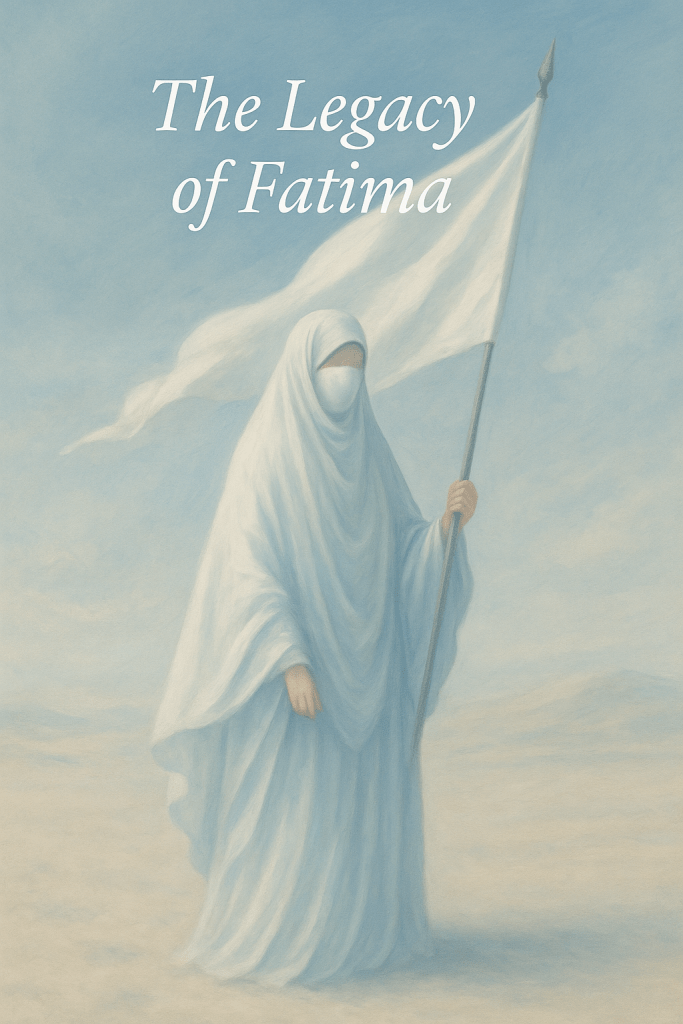
This isn’t just fabric. It’s a flag. It’s a love letter to Fatima.

And on the hardest days, that’s enough to keep me going.

This Muharram, I Choose to Live Authentically on the Haqq

This Muharram, I am not just making a promise — I am taking a stand.

A stand to live more authentically.

To walk with integrity.

To align my life with the Haqq — the Truth of Allah.

Authenticity, in its truest form, is not self-indulgence or rebellion. It’s submission. It’s aligning your soul with Divine truth, even when it hurts. Even when it costs you people, comfort, or belonging.

I’ve never really “fit in.” I’ve always stood out — but more importantly, I’ve always stood up.

I don’t turn a blind eye, not even to those closest to me.

Right is right. Wrong is wrong.

That’s something my parents instilled in me — a clear moral compass, no sugar-coating, no excuses, no loyalty to wrongdoing.

Just truth. Just justice.

And yes, it’s cost me friendships. People don’t always want truth — they want allegiance.

But you can’t be loyal to people and to truth when those two paths divide.

You have to choose.

This Muharram, I am choosing.

I am choosing to live like the Prophet’s family — the Ahl al-Bayt — who stood for truth even when they stood alone.

Who were not afraid to confront injustice, even when it came from within the ummah.

Who bore the weight of truth with grace and unshakeable resolve.

There’s a quote I carry in my heart:

“Stand for what is right, even if you’re standing alone.”

It has defined me for as long as I can remember.

And this year, it defines my path forward.

I no longer want to be around gossip, or people who thrive on low-vibrational energy.

If someone is comfortable gossiping to you, don’t think for a second they won’t gossip about you.

Authenticity requires discernment. And discipline.

So this Muharram, I walk forward.

Toward Allah.

Toward truth.

Toward a version of myself that fears no one but Him, and seeks no validation but His.

This Muharram, I am choosing to live upon the Haqq.

And I pray, by the end of this sacred month, I come out of it closer to Allah,

closer to Ahl al-Bayt,

and closer to who I was always meant to be:

authentic.

Unapologetically, faithfully, sincerely — for Him alone.

When I Hit Rock Bottom, I Called His Name

Tonight, after a day where everything seemed to fall apart — when every door closed, and every thread of patience unravelled — I lay in bed, empty and aching. Just hours before, I had written about Karbala, about Gaza, about grief — and yet, what washed over me next wasn’t the grief of history, or of others. It was my own.

A heavy, unbearable sadness began to rise in me. Not for Hussain, not for the martyrs, but for me. For how far I felt from Allah. From my Deen. From the steadiness I once had. I felt it in every part of me — the distance, the disconnection, the doubt.

And in that moment of complete vulnerability, I broke.

The tears came hard and fast, and all I could do was say it — “Ya Allah, Ya Allah.”

Over and over again. Not with eloquence. Not with hope. Just desperation.

“Ya Allah.”

I didn’t know if He would respond.

I wasn’t expecting a response.

I just needed to cry out — to say His name.

And then… something came.

Not a sign. Not a voice.

Just a whisper from within:

La ilaha illallah.

There is no god but Allah.

Again, and again, my lips moved with it.

La ilaha illallah.

And the crying softened.

And then, almost like a breath rising from the depths of me:

Inna ma‘iya Rabbi sayahdeen.

“Indeed, my Lord is with me, and He will guide me.”

I don’t know what happens next.

I don’t know what tomorrow will bring, or what path lies ahead.

But I know this: He never left me.

Even when I felt furthest from Him, He was there.

Even in the dark, even in the silence — He was always there.

And sometimes, you only remember that at rock bottom.

Because it’s from rock bottom that you finally stop looking in every direction except up.

And when you finally do — you realise you’re not lost.

You were being drawn back.

Back to Him.

Back to truth.

Back to the only One who has never let you go.

All I have to do now…

is keep calling His name

As Muharram Approaches: A Reflection from the Heart

As the sacred month of Muharram approaches, I feel a weight in my chest — a lump in my throat I can’t quite swallow. This is the month of mourning. The month in which Imam Hussain, the beloved grandson of our Prophet Muhammad (peace be upon him and his family), was brutally martyred on the plains of Karbala.

This year, I feel it differently. I feel it deeply.

Last year, I had just embraced the path of the Ahl al-Bayt. I was still learning, still finding my footing as a Shia. But this year… this year, the grief feels alive. My soul recognises what is coming, even before the crescent appears.

Islam is a journey — and my journey into Shia Islam has transformed me on every level. Spiritually, emotionally, intellectually. And in this transformation, I’ve found myself drawn to the Ahl al-Bayt: to Fatima al-Zahra, to Ali, and above all, to Hussain — all through the luminous heart of our Prophet.

Knowing their stories, feeling their pain, honouring their sacrifices — it overwhelms me. My chest tightens with emotion. My eyes well with tears. And in this month of Muharram, everything is intensified. The pain is sharper, the sorrow heavier, the love stronger.

At Karbala, alongside Hussain, stood the most loyal and courageous souls: Abbas, his lion-hearted brother; Ali al-Akbar, his radiant son; Qasim, the brave young nephew; and so many others who gave their lives not for power, but for truth (Haqq).

And then there was Lady Zaynab.

Zaynab, the mountain of patience.

Zaynab, who stood amidst devastation — her family slaughtered, her brother’s head raised on a spear — and still said, “I saw nothing but beauty.”

How can one soul endure such loss, such horror, and still speak with that kind of strength, that unwavering dignity?

Her courage leaves me breathless.

This year, more than ever, I feel her words echo within me. I feel the pain of Karbala mirrored in the suffering of Gaza, where once again the innocent are slaughtered, where children die in the arms of their mothers, and the world looks away. The parallels are haunting. The injustice is unbearable.

And I wonder — how many in our Ummah have lost their hearts? How many have become so indoctrinated, so desensitised, that they cannot see the truth? How many dismiss what happened to the family of the Prophet as mere politics, when it was oppression, pure and simple? When it was the silencing of Haqq.

The pain of seeing people glorify those who stood against Ahl al-Bayt, or justify their crimes, is almost as heavy as the grief itself. It feels like betrayal. A betrayal of love. A betrayal of truth.

So this Muharram, I will withdraw into myself. I will sit with the sorrow. I will connect more deeply with Karbala. With the stories. With the legacy. With the heartbreak.

And like Lady Zaynab, I will strive to see beauty in it all.

Not because the pain is beautiful. But because the resistance, the courage, the unwavering stand for truth — that is beauty. That is love. That is Islam.

Ya Hussain.

Ya Zaynab.

Peace and blessings be upon all those who gave everything for truth

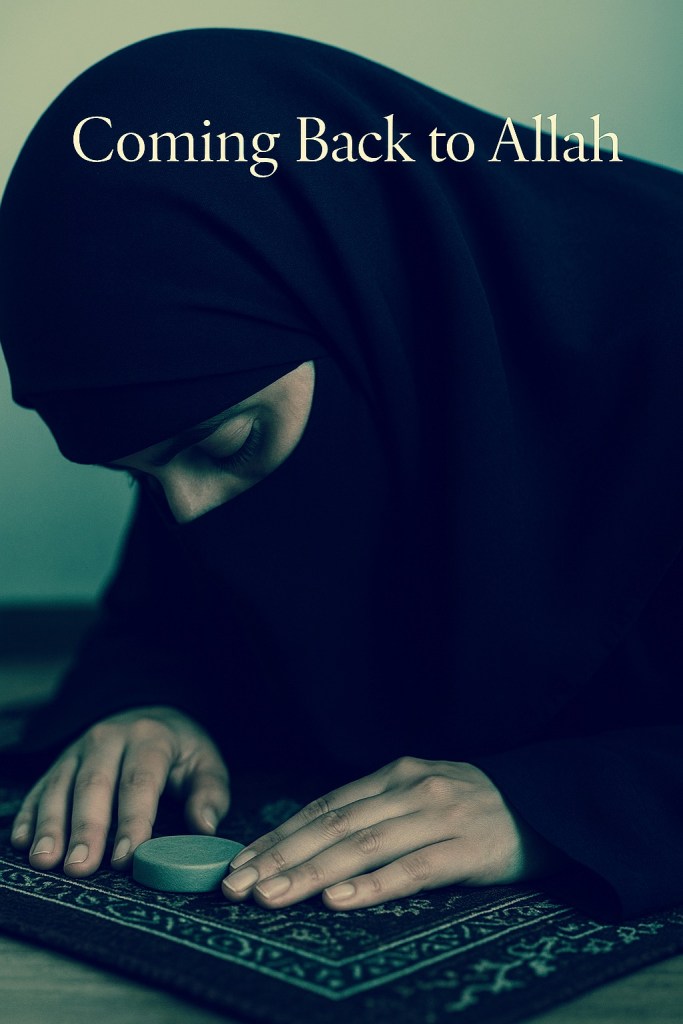
Coming back to Allah

There are moments in life when we feel so far from Allah, we wonder if we even know how to come back. We hear the Adhan we hit it like a snooze button and turn over in bed.

We carry the heaviness of this dunya, the exhaustion, the grief, the guilt—and prayer becomes distant. Like something for someone stronger. Someone better.

But the truth is, Salah isn’t for the perfect. It’s for the broken. It’s for the weary. It’s for the hearts that ache with longing, even when they’ve been silent for too long.

Today, on the Day of Arafah, I returned.

In pain, physically and spiritually, I laid my prayer mat on the ground I placed my turbah on top and I stood before Allah—no grand gestures, no eloquence. Just a heart cracked open. Before I could even finish reciting Al-Fatiha, the tears began to fall. Not just one or two—waves of them.

And in each tear was a door.

A door to forgiveness.

A door to mercy.

A door to coming home.

It was as if the heavens opened in that moment—not because I was worthy—but because I was willing. Willing to turn back. Willing to say, “I need You, Ya Allah.”

There’s a sacred truth that lives in our faith:

“Whoever comes to Me walking, I will come to him running.”

— (Hadith Qudsi, Sahih Muslim)

And today, I saw that truth unfold with my own soul. I had taken only a step—but Allah met me with overwhelming mercy.

When we abandon Salah, we do not punish Allah—we punish ourselves. We carry the weight of disconnection and call it depression. We feel the ache of loneliness and call it failure. But the ache is simply the soul longing for its Creator.

Allah never moves away from us. We move away from Him. And yet, the instant we turn—even half a turn—He is already near. Closer than the pain, closer than the tears.

So if you are struggling… if your prayer mat has been untouched for days or weeks or even years—know this: it only takes one moment. One whisper. One tear.

Let your tears fall. Let them carry your pleas for forgiveness. Let each one become a door to something sacred. Allah is not waiting to punish you. He is waiting to embrace you.

Come back.

Come back to the One who has never turned away from you.

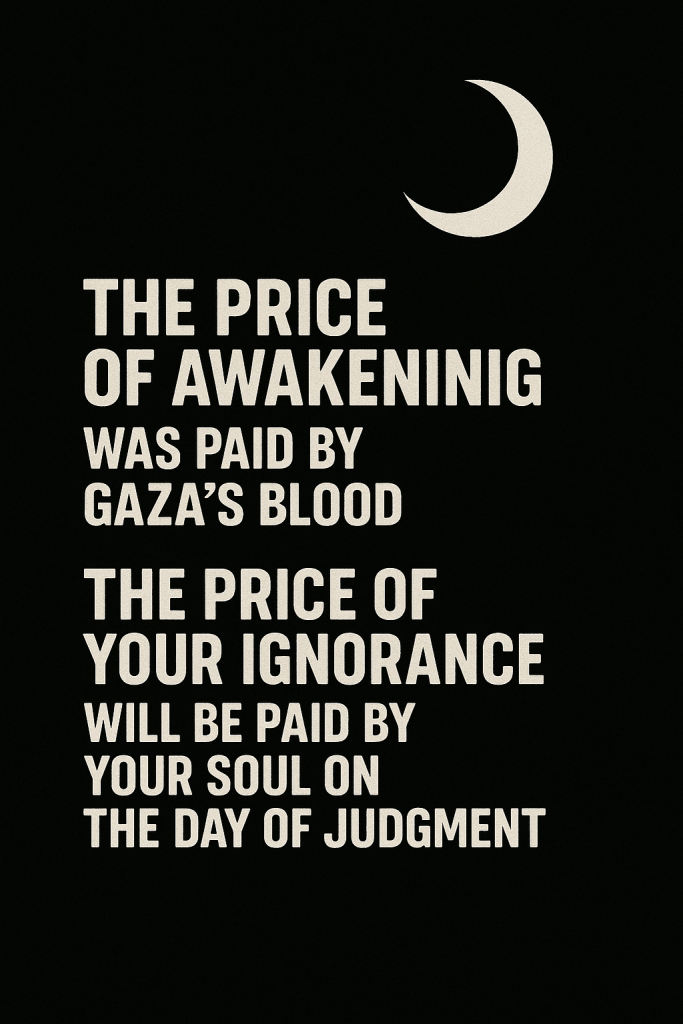
The Price of Awakening

The price of your awakening was paid in Gaza’s blood. Don’t you dare forget that.

These words has sliced through me today as once again I opened my laptop to be faced with overwhelming ignorance from people claiming to be woke. I honestly didnt know that after all the exposure, after 589 days of Genocide that people could still be blind to what is unfolding live right in front of their eyes.

Yet as the rest of the world blinked open its eyes to the machinery of empire, to the savage clarity of colonialism laid bare, it was Gaza who paid the toll. Gaza — not just a place, but a people, a breath, a prayer buried beneath rubble — handed you the gift of sight. You didn’t wake up on your own. You were dragged, screaming or silent, into awareness by the sound of children being obliterated on livestream.

And yet.

There are still people pretending to be awake.Still trying to intellectualise their cowardice, still preaching nuance while bodies are turned to dust.

Still speaking of Hamas as though resistance is terrorism, as though occupied people owe their colonisers compliance. Still choosing the side of genocide while wearing the mask of enlightenment.

This did not begin on October 7th. That date is not the start of anything but your discomfort. Gaza’s struggle, Palestine’s pain, predates your timeline. It is layered with decades of theft, murder, humiliation, and siege — of a people imprisoned in their own land, punished for refusing to die quietly.

You talk about humanity, but only when it serves your politics.

You cry for peace, but only when the oppressed raise their fists.

You condemn “both sides,” but only when the side resisting dares to survive.

This isn’t awakening. This is performance.

Real awakening means rupture. Grief. Accountability.

It means recognising that what you now know came at the cost of a child’s life, a mother’s scream, a city flattened.

And that you owe them — not your pity, but your voice. Your alignment. Your truth.

Because yes, the price of your awakening was paid by Gaza in blood.

But the price of your silence — your ignorance, your willful blindness — will be paid by your soul on the Day of Judgment.

May you not be among the liars who claim they didn’t know.

May you not be among the cowards who claimed neutrality while genocide marched on.

And may you remember — every time you speak, every time you post, every time you choose sides — that someone else died to show you the truth.

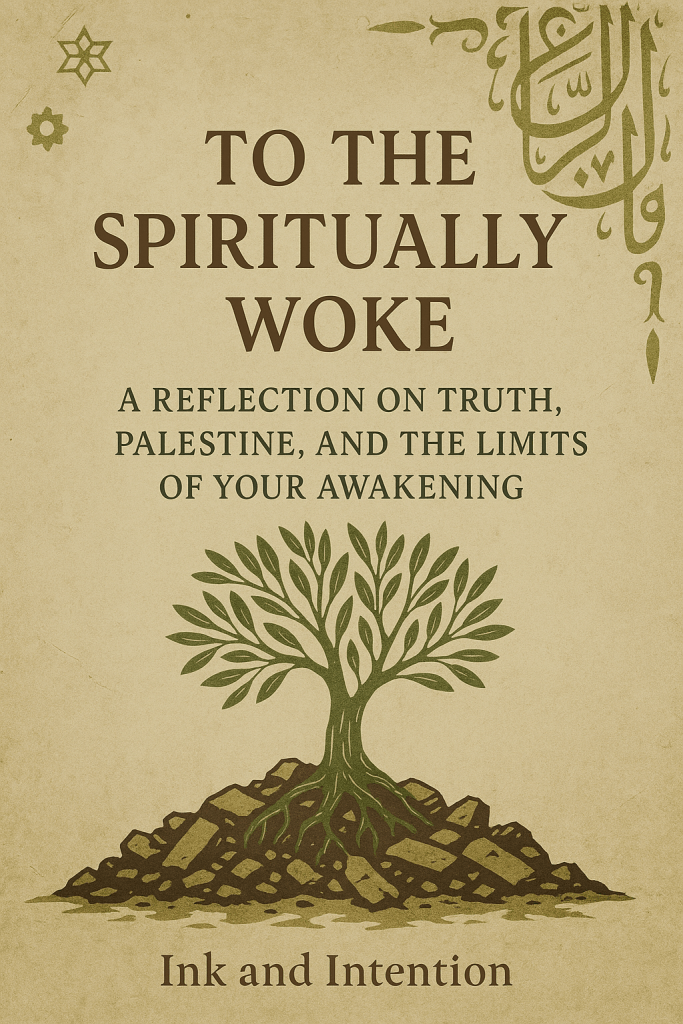
“To the Spiritually Woke: You Are Not Who You Think You Are”

“To the Spiritually Woke: You Are Not Who You Think You Are”

by Ink and Intention

In an age where everyone claims to be awakened — bathed in incense smoke, steeped in divine feminine wisdom, draped in crystals and cosmic truth — it is bewildering to find that so many remain deeply asleep.

They chant about liberation, about rising consciousness, about the sacredness of all things. They speak of universal love, of goddess energy, of breaking ancestral chains. And yet, when faced with a people being bombed, starved, and erased in real time, they somehow manage to take the side of the oppressor — or worse, they suggest solutions that are nothing more than polite ethnic cleansing.

This morning, I encountered a few such voices. Sisters, supposedly. Spiritually awakened, allegedly. But what I heard from them wasn’t truth. It was empty, packaged rhetoric. They suggested that Palestinians should simply leave. That perhaps Libya could offer refuge. That somehow, the people of Gaza must want to leave this devastation behind.

Let me be clear: this is not awakening.
This is not alignment.
This is complicity.

To suggest that the people of Gaza — who have endured unimaginable violence, who have chosen to remain rooted on their land even as it is turned to rubble — would want to leave, is to expose just how far removed you are from truth. It is to misunderstand not only the political reality, but the spiritual force that binds them to their home.

They are not enduring this genocide because they lack options. They are enduring it because they refuse to give up what is sacred.

They stay because their land is not a piece of negotiable real estate. It is not something they can sell or exchange for safety. It is home. It is legacy. It is prayer and history and covenant.

Their grandfathers planted olive trees that still bear fruit. Their ancestors are buried in the soil they walk on. Every stone is part of their story. Every inch of land has witnessed their love, their prayers, their blood. This isn’t nationalism — it is a spiritual, historical, and divine relationship with the land.

And more than that — they stay because of tawakkul. Because of their trust in Allah, subḥānahu wa taʿālā. Because they know that every hardship, every death, every loss, is written. That there is no true safety except with Him. That even in the face of bombs and starvation, what matters most is not survival at any cost, but submission to the Divine Will.

They sit on the ruins of their homes not because they have nowhere to go — but because to leave would be to betray everything they believe in. Everything they’ve lived for. Everything they were entrusted to protect.

And you — you in the West, with your temples and your tarot decks, your moon water and your sacred baths — you dare to speak on this? You, who live in lands built on the blood of displaced peoples, dare to advise the oppressed to become refugees again?

You are not awakened.
You are not enlightened.
You are parroting settler-colonial logic with prettier words and softer lighting.

You speak of divine feminine energy, but you cannot recognize the raw sacred feminine power of a mother in Gaza holding her baby in the rubble and refusing to leave.

You speak of vibration and frequency, but you do not feel the frequency of truth in the voice of a father who has lost everything and still says, “Alḥamdulillāh.”

You speak of ancestors, but you deny the dignity of a people walking the same streets their great-grandparents walked, even if those streets are now bombed-out shadows.

You say Palestinians should leave. But where, exactly, should they go? Libya, which has been torn apart by Western war? Jordan, already overflowing? Egypt, whose gates remain closed? The very idea is absurd. And yet, more disturbingly, it is exactly what Israel wants: an emptied land. A silent Nakba. A second expulsion, disguised as a humanitarian gesture.

And you — in your spiritual self-righteousness — are carrying that message forward.

You want to talk about hostages. Fine. Talk about them. But talk honestly. Hamas has repeatedly said: “We will release every hostage, all at once — if the bombing stops.” But the bombing hasn’t stopped, because Israel doesn’t want peace. It wants submission. It wants annihilation. It wants silence.

And every time you repeat, “Why won’t they just leave?” — you’re doing its work for it.

You are not neutral. You are not compassionate. You are not spiritual. You are colonized. Mentally and morally colonized, dressed in the language of awakening but devoid of substance.

Being truly awake means understanding the weight of oppression. It means standing with the oppressed even when it makes you uncomfortable. It means dismantling your illusions, not reinforcing them with incense and ego.

Real consciousness demands that you understand this: the people of Gaza are not martyrs because they want to die. They are martyrs because they refuse to abandon life — real life — a life of honour, of faith, of rootedness, of resistance. Their lives are drenched in meaning. In sacred defiance. In belief.

You, on the other hand, are asleep. And worse — you think you’re awake.

If your version of spirituality does not include the oppressed, does not understand the holiness of land, does not weep for the children buried beneath rubble, then your spirituality is a lie.

So sit with your discomfort. Sit with your hypocrisy. Sit with the realization that you are not who you thought you were.

And maybe — if you’re brave enough — start again.

Into the Cave, and Out Again

I’ve been walking this path for a while now — this journey of Islam, of returning and retreating, of losing myself and finding Allah again. It hasn’t been easy, and it hasn’t been smooth. But if I’ve learned anything over these years as a revert, it’s that falling off the path doesn’t mean you’re lost forever. Sometimes, falling off makes you return deeper. Not because turning away was good — it wasn’t — but because the return wakes something in you. It reminds you that you’re human, that you’re fallible, and that mercy waits for you regardless. That is the beauty of Allah, subhanahu wa ta’ala.

I’m not one of those social media reverts with the glossy testimony. I haven’t married the perfect Muslim man. I’m still single. My children haven’t reverted, and I won’t force them to. We live in a respectful, balanced home, where compassion is a two-way street. My job isn’t to mold my children’s faith — it’s to live mine sincerely, to lead by example. And part of that example is honesty: Islam is beautiful, yes, but the journey isn’t always easy, especially not for reverts. The challenges often come not from the religion itself, but from the pressure and expectations of the ummah.

There was a time not long ago where I slipped into a period of very low Iman. I withdrew from people. I stopped showing up in ways I used to. And it felt dark. But in hindsight, I see now — that was Allah pulling me away from what didn’t serve me, drawing me into silence so I could hear Him again. Sometimes, you have to go into the cave to rediscover Allah in the darkness. And that cave, while lonely, is where your heart starts to beat again with sincerity.

When I stepped out again, I felt different. Stronger, somehow. Lighter. Closer. And with that return came a new pull — toward the niqab. I’ve worn it on and off over the past year, sometimes full, sometimes half, never consistently. But recently, my heart has been drawing closer and closer to it — not just as an act of devotion to Allah, but as a form of protection. Because that’s what it is: not a symbol of invisibility, but a shield. A way to step into the world with strength.

Living where I live — a very Western area where the streets flood with red and white after every football match — wearing the niqab isn’t easy. But it feels necessary. Which may sound like a contradiction. It’s not that I want to be seen. It’s that I want to be seen differently — or perhaps, not seen at all. My connection with the niqab has grown as my connection with Allah has deepened. It’s ironic in a way, but it’s real.

This morning, I joined a live with some incredible niqabi sisters — strong, grounded women who wear their niqab with confidence and sincerity. They weren’t judgmental. They weren’t rigid. They were kind and balanced, and they reminded me of the kind of woman I want to be. For so long, I avoided the niqab because of the criticism I’d faced: “If you’re not wearing it full-time, why wear it at all?” or “If you can’t wear it at work, what’s the point?” That harshness held me back. But today, I felt seen — by sisters who understand, who encourage, who support. Alhamdulillah for them.

And alhamdulillah for the women in our history who remind us what strength really is. One of the women I admire most is Lady Zaynab, the granddaughter of the Prophet (peace be upon him). A woman of fierce truth and unwavering courage. In the aftermath of Karbala, surrounded by loss and devastation, she looked upon the horror and still said, “I saw nothing but beauty.” Her strength, her steadfastness in the face of unimaginable grief, humbles me. It inspires me. She stood for justice, for truth, for faith — not just with her words, but with her presence. That is the kind of woman I want to be. When I wear the niqab, I wear it not just in devotion to Allah, but as a reminder of the women I come from — women like Zaynab.

So my niqab journey is just beginning. I don’t know what it will look like in the weeks and months to come. But I do know that it’s mine. It’s not perfection I’m chasing — it’s sincerity. It’s connection. It’s that quiet, unshakeable strength that only Allah can give.

And if I have to go into the cave again one day, I will. Because I know now — even in the darkness, Allah is there.

My Hijab, My Niqab My Choice – Not Yours

It is delusional to think that as a woman, I’m only free if I strip down, show off, and serve a society obsessed with my body.

I chose the hijab—and sometimes the niqab—not out of fear, not because a man told me to, and certainly not because I was forced. No one told me to put it on, and no one gets to tell me to take it off. Like the majority of women who wear it—especially reverts like me—I made that choice with full awareness and full agency. And I’m not alone.

You say we’re oppressed?

Either we’re oppressed because we hide our bodies from the sick and perverse male world, or we’re ‘free’ because we expose ourselves to it? That’s not freedom. That’s a narrative. And it’s one I no longer serve.

What is actually delusional is believing that Western society has freed women. Let’s talk about real oppression:

Let’s talk about eating disorders bred by impossible beauty standards.

Let’s talk about women having to sexualize their bodies just to sell products, win attention, or feel validated.

Let’s talk about wage gaps, objectification, and being told our worth lies in how desirable we are to men.

Let’s talk about a society where girls are groomed by screens to believe they are never enough unless they perform.

You want to talk about freedom? That’s not it.

Covering isn’t about shame. It’s not about erasing myself. It’s about reclaiming my autonomy, my space, my peace. It’s not freedom to serve the perversions of the white European man—nor anyone else. That’s just a new kind of slavery.

Even within Islam, there are women who say I shouldn’t cover my face. And just as I accept their journey, they must accept mine. Islam doesn’t erase individuality. It embraces choice—with accountability.

So no—I’m not oppressed. I’m empowered. And the real tragedy is that the people shouting the loudest about saving me are the ones who can’t see the chains around their own necks.

This isn’t submission. This is strength.

This isn’t silence. This is resistance.

And this cloth on my head? It’s mine.

Not yours to question.

Not yours to remove.

Not yours to define.