“To the Spiritually Woke: You Are Not Who You Think You Are”

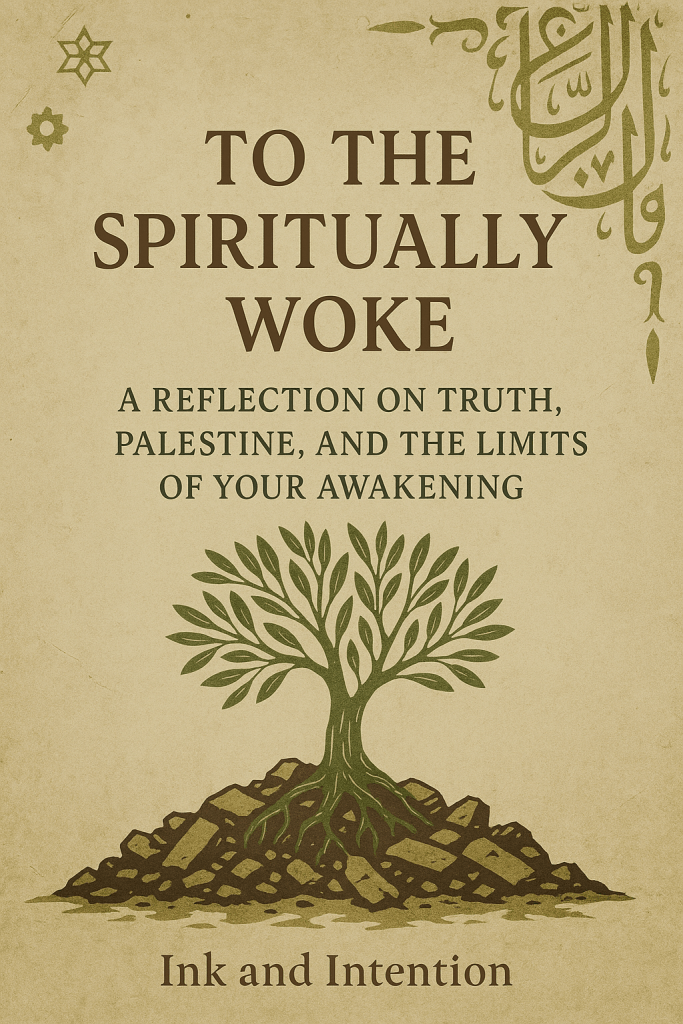
“To the Spiritually Woke: You Are Not Who You Think You Are”

by Ink and Intention

In an age where everyone claims to be awakened — bathed in incense smoke, steeped in divine feminine wisdom, draped in crystals and cosmic truth — it is bewildering to find that so many remain deeply asleep.

They chant about liberation, about rising consciousness, about the sacredness of all things. They speak of universal love, of goddess energy, of breaking ancestral chains. And yet, when faced with a people being bombed, starved, and erased in real time, they somehow manage to take the side of the oppressor — or worse, they suggest solutions that are nothing more than polite ethnic cleansing.

This morning, I encountered a few such voices. Sisters, supposedly. Spiritually awakened, allegedly. But what I heard from them wasn’t truth. It was empty, packaged rhetoric. They suggested that Palestinians should simply leave. That perhaps Libya could offer refuge. That somehow, the people of Gaza must want to leave this devastation behind.

Let me be clear: this is not awakening.
This is not alignment.
This is complicity.

To suggest that the people of Gaza — who have endured unimaginable violence, who have chosen to remain rooted on their land even as it is turned to rubble — would want to leave, is to expose just how far removed you are from truth. It is to misunderstand not only the political reality, but the spiritual force that binds them to their home.

They are not enduring this genocide because they lack options. They are enduring it because they refuse to give up what is sacred.

They stay because their land is not a piece of negotiable real estate. It is not something they can sell or exchange for safety. It is home. It is legacy. It is prayer and history and covenant.

Their grandfathers planted olive trees that still bear fruit. Their ancestors are buried in the soil they walk on. Every stone is part of their story. Every inch of land has witnessed their love, their prayers, their blood. This isn’t nationalism — it is a spiritual, historical, and divine relationship with the land.

And more than that — they stay because of tawakkul. Because of their trust in Allah, subḥānahu wa taʿālā. Because they know that every hardship, every death, every loss, is written. That there is no true safety except with Him. That even in the face of bombs and starvation, what matters most is not survival at any cost, but submission to the Divine Will.

They sit on the ruins of their homes not because they have nowhere to go — but because to leave would be to betray everything they believe in. Everything they’ve lived for. Everything they were entrusted to protect.

And you — you in the West, with your temples and your tarot decks, your moon water and your sacred baths — you dare to speak on this? You, who live in lands built on the blood of displaced peoples, dare to advise the oppressed to become refugees again?

You are not awakened.
You are not enlightened.
You are parroting settler-colonial logic with prettier words and softer lighting.

You speak of divine feminine energy, but you cannot recognize the raw sacred feminine power of a mother in Gaza holding her baby in the rubble and refusing to leave.

You speak of vibration and frequency, but you do not feel the frequency of truth in the voice of a father who has lost everything and still says, “Alḥamdulillāh.”

You speak of ancestors, but you deny the dignity of a people walking the same streets their great-grandparents walked, even if those streets are now bombed-out shadows.

You say Palestinians should leave. But where, exactly, should they go? Libya, which has been torn apart by Western war? Jordan, already overflowing? Egypt, whose gates remain closed? The very idea is absurd. And yet, more disturbingly, it is exactly what Israel wants: an emptied land. A silent Nakba. A second expulsion, disguised as a humanitarian gesture.

And you — in your spiritual self-righteousness — are carrying that message forward.

You want to talk about hostages. Fine. Talk about them. But talk honestly. Hamas has repeatedly said: “We will release every hostage, all at once — if the bombing stops.” But the bombing hasn’t stopped, because Israel doesn’t want peace. It wants submission. It wants annihilation. It wants silence.

And every time you repeat, “Why won’t they just leave?” — you’re doing its work for it.

You are not neutral. You are not compassionate. You are not spiritual. You are colonized. Mentally and morally colonized, dressed in the language of awakening but devoid of substance.

Being truly awake means understanding the weight of oppression. It means standing with the oppressed even when it makes you uncomfortable. It means dismantling your illusions, not reinforcing them with incense and ego.

Real consciousness demands that you understand this: the people of Gaza are not martyrs because they want to die. They are martyrs because they refuse to abandon life — real life — a life of honour, of faith, of rootedness, of resistance. Their lives are drenched in meaning. In sacred defiance. In belief.

You, on the other hand, are asleep. And worse — you think you’re awake.

If your version of spirituality does not include the oppressed, does not understand the holiness of land, does not weep for the children buried beneath rubble, then your spirituality is a lie.

So sit with your discomfort. Sit with your hypocrisy. Sit with the realization that you are not who you thought you were.

And maybe — if you’re brave enough — start again.

Into the Cave, and Out Again

I’ve been walking this path for a while now — this journey of Islam, of returning and retreating, of losing myself and finding Allah again. It hasn’t been easy, and it hasn’t been smooth. But if I’ve learned anything over these years as a revert, it’s that falling off the path doesn’t mean you’re lost forever. Sometimes, falling off makes you return deeper. Not because turning away was good — it wasn’t — but because the return wakes something in you. It reminds you that you’re human, that you’re fallible, and that mercy waits for you regardless. That is the beauty of Allah, subhanahu wa ta’ala.

I’m not one of those social media reverts with the glossy testimony. I haven’t married the perfect Muslim man. I’m still single. My children haven’t reverted, and I won’t force them to. We live in a respectful, balanced home, where compassion is a two-way street. My job isn’t to mold my children’s faith — it’s to live mine sincerely, to lead by example. And part of that example is honesty: Islam is beautiful, yes, but the journey isn’t always easy, especially not for reverts. The challenges often come not from the religion itself, but from the pressure and expectations of the ummah.

There was a time not long ago where I slipped into a period of very low Iman. I withdrew from people. I stopped showing up in ways I used to. And it felt dark. But in hindsight, I see now — that was Allah pulling me away from what didn’t serve me, drawing me into silence so I could hear Him again. Sometimes, you have to go into the cave to rediscover Allah in the darkness. And that cave, while lonely, is where your heart starts to beat again with sincerity.

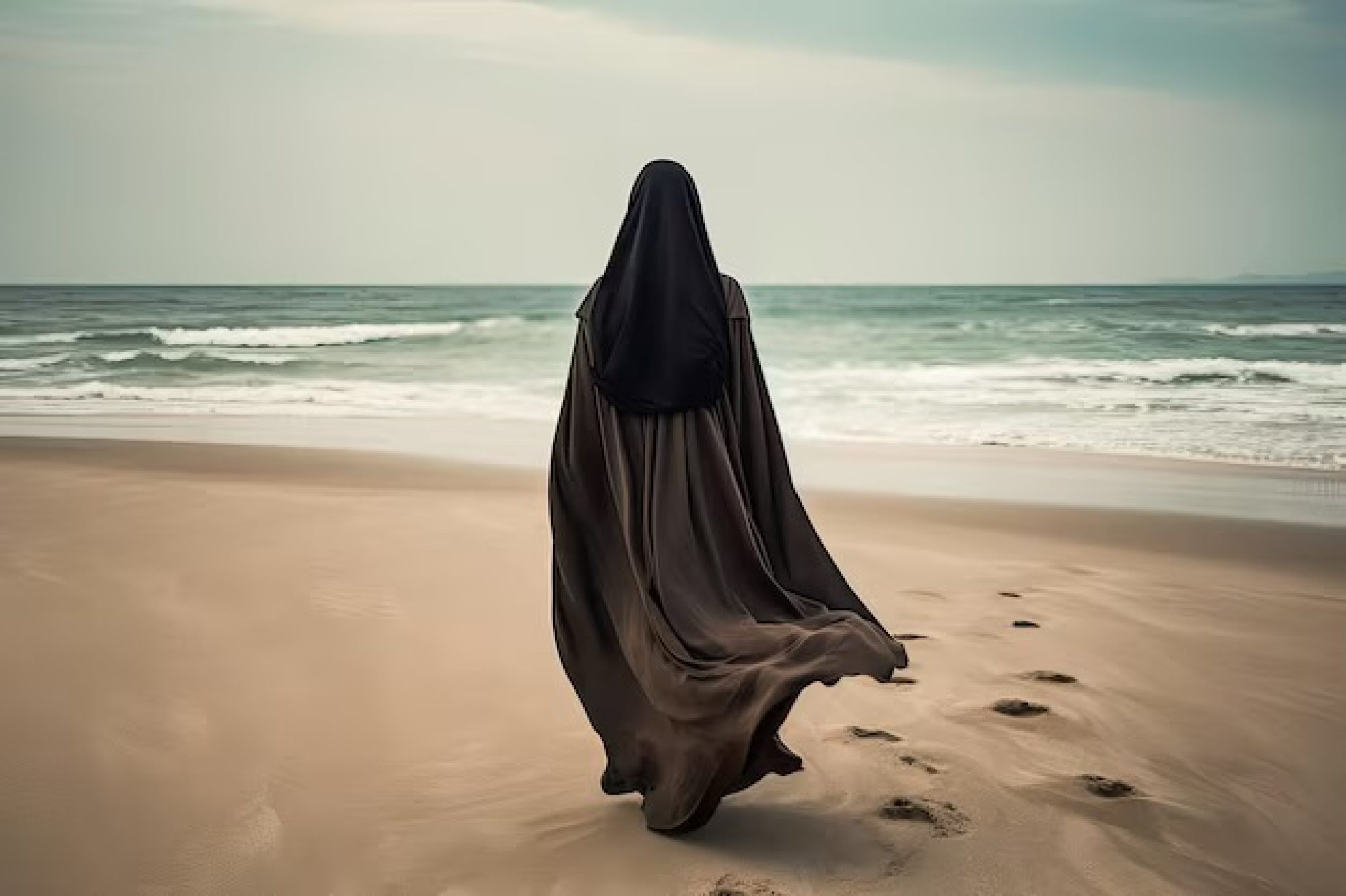
When I stepped out again, I felt different. Stronger, somehow. Lighter. Closer. And with that return came a new pull — toward the niqab. I’ve worn it on and off over the past year, sometimes full, sometimes half, never consistently. But recently, my heart has been drawing closer and closer to it — not just as an act of devotion to Allah, but as a form of protection. Because that’s what it is: not a symbol of invisibility, but a shield. A way to step into the world with strength.

Living where I live — a very Western area where the streets flood with red and white after every football match — wearing the niqab isn’t easy. But it feels necessary. Which may sound like a contradiction. It’s not that I want to be seen. It’s that I want to be seen differently — or perhaps, not seen at all. My connection with the niqab has grown as my connection with Allah has deepened. It’s ironic in a way, but it’s real.

This morning, I joined a live with some incredible niqabi sisters — strong, grounded women who wear their niqab with confidence and sincerity. They weren’t judgmental. They weren’t rigid. They were kind and balanced, and they reminded me of the kind of woman I want to be. For so long, I avoided the niqab because of the criticism I’d faced: “If you’re not wearing it full-time, why wear it at all?” or “If you can’t wear it at work, what’s the point?” That harshness held me back. But today, I felt seen — by sisters who understand, who encourage, who support. Alhamdulillah for them.

And alhamdulillah for the women in our history who remind us what strength really is. One of the women I admire most is Lady Zaynab, the granddaughter of the Prophet (peace be upon him). A woman of fierce truth and unwavering courage. In the aftermath of Karbala, surrounded by loss and devastation, she looked upon the horror and still said, “I saw nothing but beauty.” Her strength, her steadfastness in the face of unimaginable grief, humbles me. It inspires me. She stood for justice, for truth, for faith — not just with her words, but with her presence. That is the kind of woman I want to be. When I wear the niqab, I wear it not just in devotion to Allah, but as a reminder of the women I come from — women like Zaynab.

So my niqab journey is just beginning. I don’t know what it will look like in the weeks and months to come. But I do know that it’s mine. It’s not perfection I’m chasing — it’s sincerity. It’s connection. It’s that quiet, unshakeable strength that only Allah can give.

And if I have to go into the cave again one day, I will. Because I know now — even in the darkness, Allah is there.

Judging vs. Advising: A Line Often Crossed, But Not Erased

In Islam, we are taught not to judge others harshly. “Perhaps the one you mock is more beloved to Allah than you.” We are reminded to advise with gentleness, to call one another to good with wisdom and sincere intention. But there is a difference between sincere advice and turning a blind eye to what openly harms the ummah.

When a Muslim sins privately, we cover it. When someone struggles inwardly, we extend compassion. But when sin is made public—boasted, normalized, glamorized—especially by influencers with massive platforms, it becomes more than personal. It becomes influential. And that matters.

There is a grave difference between someone stumbling in private, saying “I am human,” and someone publicly flaunting haram under the guise of being relatable. Sins don’t become less damaging just because someone says, “I know I’m flawed.” And being human doesn’t mean making Islam look hollow.

When a man parades his haram relationship online, only to later claim the woman took her shahadah on the same day they married—it raises red flags. The shahadah is sacred. It’s not a tool for marriage; it’s a declaration of truth. A soul should embrace Islam for Allah, not for love or status or a ring.

And yes, when someone takes their shahadah, their sins are wiped clean. But the path forward should reflect change—not a continuation of the same lifestyle. Leaving inappropriate photos, behaviour, and messages online while calling yourself Muslim misrepresents the deen, and misleads thousands who are watching.

People often say, “Only Allah can judge.” And yes, that’s true. But when something is done publicly, the ummah has the right to speak, because silence in the face of public harm is not piety—it’s passivity. Public platforms carry public responsibility. If you influence others, you’re accountable for what you normalize.

So no, it’s not “judgment” to speak out. It’s naseeha. And in a time where followers are more loyal than faith, the ummah must remember: Islam is not a brand. It’s not aesthetics. It’s not content. It’s a way of life. And that way deserves to be respected—not distorted for views.

For the sake of Allah.

There is a Version of Us That Longs for Allah, a version of us we hold in our hearts—a version that prays all five Salah on time, that opens the Qur’an every morning before the world wakes, that speaks gently, forgives quickly, and walks humbly. That version of us dreams of a home built on love and taqwa, where faith is the center and peace feels endless. That version of us longs to be near to Allah in everything.
But this dunya—this chaotic, relentless dunya—often gets in the way.
There’s work. There are children. There are dishes in the sink, aches in the body, expectations from society, and parents who need us. There are deadlines, doctor appointments, errands, and days when we can barely catch our breath—let alone open the Qur’an with presence.
And somewhere in between all that, we whisper: Ya Allah, I’m trying.
Sometimes we think we’ve failed, because we can’t be that “perfect” Muslim we imagined. But maybe the failure isn’t in what we do—it’s in what we expect. Islam was never meant to be a burden. The Prophet (sallallahu alayhi wa sallam) came to make it easy, not overwhelming.
Still, we push ourselves to change overnight, to abandon entire lifestyles in a moment, and then wonder why so many reverts and born Muslims alike feel burnt out. But Islam is a path. A journey. One that accommodates fatigue, grief, trauma, and real life.
This is why the five daily Salah matter so much. They’re a gift, not a task. Just 50 minutes a day—less than an hour to stand before the One who gives us every hour. If we can’t give Him that, then maybe the question isn’t about time. Maybe it’s about what we’re prioritizing in our hearts.
Still, even in our imperfection, Allah is Merciful. He knows our struggles. He sees our broken efforts. And He never demanded perfection—just sincerity.
So we try. Not to impress anyone. Not to meet impossible standards. But for His sake alone.
Because that’s what for the sake of Allah really means—to keep going, even when it’s hard, because our love for Him is greater than the chaos around us

“I Am Not Less Than”

Lately, I haven’t wanted to write.

The words that once poured so easily now feel like strangers.

I’ve been carrying the weight of trauma — old wounds reopened and new heartbreaks too raw to name.

And in the middle of it all, I’ve been editing myself.

Self-editing.

Holding back, trimming down my truth.

It reminds me of my days in print — how we’d slice a piece until it fit.

But this time, it’s not paper I’m trimming. It’s me.

And I feel invisible.

I’ve felt invisible for a long time.

And when you feel invisible long enough, even your voice begins to disappear.

There were moments I thought I had left —

or worse, that Allah had left me.

But the truth is, this has been a test.

A hard, sacred test.

I’m beginning to see the patterns now.

When I pull away.

When I stop wearing my hijab.

When I chase validation from people instead of seeking the pleasure of the One who created me.

That’s when I feel the most lost — because I’m trying to impress the creation, not the Creator.

And it’s only now, through deep reflection, I’m beginning to understand:

I’m not too sensitive.

I’m not broken.

I’m not depressed.

I’m struggling.

And it’s not a bad life. It’s just a hard day.

And even in that — I am still Muslim.

Still loved by Allah.

Still worthy.

We have to stop the mindset that tells Muslims they’re “less than” if they’re not perfect.

I don’t always pray Fajr.

Sometimes I sleep through 20 alarms and an adhan  ringtone.

I don’t read Qur’an every single day — that’s why I joined a Qur’an group.

I don’t always wear abaya — it’s not always practical for the work I do.

And on some days, when the nosebleeds and headaches hit, I can’t even bear to wear my hijab.

But if I can extend myself grace, I know without a doubt that Allah already has.

He is:

Ar-Rahman – The Most Compassionate

Ar-Raheem – The Most Merciful

Al-Ghafoor – The Most Forgiving

Al-Lateef – The Most Gentle

Al-Hakeem – The All-Wise

If He, in all His Mercy, still counts me worthy —

then why am I letting people convince me otherwise?

Especially other Muslims.

We need to stop weaponising Islam against each other.

Stop measuring worthiness by rituals alone.

Islam is not a checklist.

It’s a connection.

It’s a returning.

And returning often starts at our lowest — when we realise just how far we’ve fallen.

That’s where the sincerity begins.

Because it’s not just about ticking off your five daily prayers, or reciting a random surah.

It’s about your heart.

Your relationship with Allah.

Your desire to deepen that bond.

Because without that, we’re just living Islam on a surface level.

Yes — it’s especially hard when you’re visible.

When you’re known, followed, or watched.

You become a target.

And it hurts.

I recently told a sister, who was being abused for wearing hijab, that it’s okay to take it off if it means protecting herself —

especially when she’s alone, in her car, with her children, being shouted at by strangers.

That’s not just okay — it’s Islamic.

“And do not throw [yourselves] with your [own] hands into destruction.”

(Surah Al-Baqarah 2:195)

This is not about abandoning hijab.

It’s about protecting yourself.

Understanding your context.

Caring for your heart.

So this piece, for me, is a reflection.

I’m going through a lot — and that’s okay.

I drop the ball — and that’s okay.

I give my energy to people and things that don’t deserve it — and I’m working on that.

This dunya is temporary.

And so are the people in it.

And if someone or something is pulling me away from my focus,

from my purpose,

from my closeness with Allah —

then they have to go.

Because anything that pulls you away from your path,

clouds your clarity,

or steals your peace —

is not your qadr.

Right now, I’m standing at a crossroads.

I have decisions to make.

And I don’t make decisions under pressure.

So I’m turning to Allah — again and again and again.

Because I don’t know what’s next.

But I know the One who does.

And that is enough.

Where Are the Feminists for the Hijabi Girls?

Feminism, at its core, is meant to champion the rights of all women — to protect their dignity, autonomy, and voice, no matter where they come from or what they wear. But where are these voices when hijabi girls are beaten, stabbed with pens, and left in critical condition simply for being visibly Muslim?

Recently, a disturbing attack took place in the U.S. — three young Afghan girls, still in school, surrounded by more than twenty students. They were assaulted, their hijabs torn off, their bodies violated — not just physically, but symbolically. This wasn’t just bullying. This was a hate crime, an act of Islamophobia, misogyny, and racism all in one. Yet the silence from feminist and women’s empowerment groups is deafening.

Why is it that the moment a woman covers herself, she is no longer seen as worthy of protection? Why does her choice to wear a hijab disqualify her from sisterhood in the eyes of the West? These so-called “goddess collectives” and “mystery schools” preach divine feminine energy and women’s freedom — but that freedom, it seems, is conditional. Conditional on how much skin we show. Conditional on whether we fit into a Western mold of liberation. Conditional on whether our choices look like theirs.

To wear a hijab is not to be silenced. To cover is not to be caged. But the Western media constantly paints Muslim women as oppressed, even when they speak for themselves. This narrative is a form of colonial feminism — one that claims to uplift but instead erases and excludes.

Real feminism should be expansive. It should stand for the girls in hijab just as loudly as it does for the girls in crop tops. It should mourn the wounds of Afghan students as passionately as it would any other act of violence against women. If your feminism has borders, if it only fights for women who reflect your own lifestyle, it is not feminism — it is a performance.

Where are the voices now? Where are the protests, the candlelight vigils, the viral hashtags?

We will not be silent. We will not let this hypocrisy go unchecked. Our hijab is not a symbol of oppression — but your silence might be.

Self-Care and the Holistic Nature of Islam: A Personal Reflection

Yesterday was one of those physically demanding days — the kind that pulls everything out of you, body and soul. In the past, I might have ignored the toll it took, brushing off my aches and tiredness. But after spending the last two years navigating chronic illness, I’ve learned to listen. Now, when I know I’ve pushed myself, I follow it with a day of intentional self-care — a day of rest, healing, quiet, and reflection.

And this, too, is Islam.

So often we forget that our religion is not just about salah and fasting and hijab in isolation. Islam is meant to be lived as a whole. It is not a religion of pieces, but a way of life — a holistic path that integrates the body, the mind, the heart, and the soul.

The Prophet Muhammad (peace be upon him) said: “Your body has a right over you.” (Bukhari)

We often quote it, but how often do we live it?

In my journey, I’ve seen people say things like:

“At least she’s praying, even if she doesn’t wear hijab.”

“At least she wears hijab, even if she’s not praying five times a day.”

But I think we need to gently challenge that mindset.

Yes, of course, growth takes time. And yes, everyone is on their own path. But we’ve created this culture — especially online — where Islam is accepted in fragments, like checklists of visible deeds, instead of a deeply rooted, living relationship with Allah that encompasses everything. A relationship that changes the way we speak, think, eat, rest, dress, pray, and even heal.

People often say, “You can’t do everything at once.”

But I ask: Why not?

When people embrace Christianity, they receive a rosary, wear a crucifix, go to church, accept the belief and the symbols that go with it.

So why, when we accept Islam, do we shy away from doing the same?

This was our choice. No one forced us. We chose Islam — so shouldn’t we try, with love, sincerity, and effort, to embrace all of it?

That doesn’t mean perfection. It means wholeness. It means acknowledging that just as prayer is important, so is sleep. Just as wearing hijab is an act of worship, so is feeding your body nourishing food. Just as dhikr soothes the soul, so does silence and slowing down. Islam doesn’t pit the physical against the spiritual. It teaches us to honour both.

The Qur’an reminds us:

“And do not forget your share of the world.”

(Surah Al-Qasas, 28:77)

Take care of your worldly needs — your health, your family, your mind — while seeking the hereafter.

“Allah does not burden a soul beyond what it can bear.”

(Surah Al-Baqarah, 2:286)

This is not an excuse to give up, but a reassurance that we are always equipped for the path we’re on — especially when we walk it with intention.

“Indeed, in the remembrance of Allah do hearts find rest.”

(Surah Ar-Ra’d, 13:28)

Hearts, not just minds. Our hearts need nourishment, too — not just through rituals, but through gentleness, reflection, and rest.

So today, I rest — and that rest is not laziness. It is worship. It is trust. It is healing.

And tomorrow, I’ll walk forward again, in shā’ Allāh, trying — not to be perfect — but to be whole.

Because Islam is not a piece of clothing, or a single prayer. It is a whole way of being. And I want to live it fully, not just in parts.

The Barakah of Gratitude

Across all religions, there’s a common thread: when we’re in need, we turn to God. We’re taught to make dua, to pray, to call on Him when life feels heavy or uncertain. And it’s true—those moments of surrender, when we realise how little control we really have, often bring us closest to the Divine.

But how often do we turn to Allah just to say thank You?

Gratitude is more than a feeling—it’s a way of being. It’s not just about saying “Alhamdulillah” when something good happens. It’s about living in a state of awareness and appreciation, even when things feel ordinary. Because the truth is, nothing is really ordinary. Waking up each morning is a gift. Having food on the table is a blessing. Feeling the warmth of a loved one’s voice, the safety of a roof over your head, the ability to move through your day—these are things we can so easily overlook.

And yet, they’re everything.

For me, living a life of gratitude means living a life of openness. When we express thanks for what we already have, we open the door to receive more. It’s a cycle—giving thanks softens the heart, and a soft heart is a heart that receives. Gratitude is one of the most powerful acts of worship, because it doesn’t come from a place of lack, but from fullness. It says, “I see what You’ve given me. I acknowledge it. I honour it.”

So when we make dua for something we desire, we should also take time to make dua for something we’ve already been given. Before we ask, we must remember to thank. And not just in hard times, or in those moments of desperation—but in the quiet times too. In the everyday moments where everything feels okay.

Because that’s when true gratitude lives.

Personally, every morning when I wake up, the first thing I say is Alhamdulillah. Not out of habit, but from a place of real knowing—He allowed me to wake. That alone is reason to be grateful. Whether it’s unexpected good news, a moment of peace in a noisy day, or simply the blessing of still being here, breathing, witnessing—it all deserves thanks.

Alhamdulillah for everything I have.

Before I ask for more, I remember what already fills my hands.

And that is where barakah begins.

Divine Disconnection: The Selling of Women’s Mysteries and Islamic Empowerment

There’s a rise of women in these spaces calling themselves fierce, calling themselves warriors—but what I’m seeing isn’t strength.
It’s ego.
It’s being dismissive, controlling, unwilling to hear any view but their own.

That’s not power. That’s not maturity. That’s not sacred.

When you shut down conversation, when you bulldoze anyone who doesn’t mirror your beliefs—you’ve narrowed your mind. That’s the very definition of being closed off. And that kind of self-righteousness? It kills growth.

When you’re unwilling to be questioned, you can’t evolve.
When you attack others publicly because they dared to disagree, you’re not holding space—you’re holding a megaphone.
It’s not compassion. It’s not truth.
It’s a performance.

I’ve watched this for years. I didn’t just dip my toes in—I was in it.
I held red tents when they were first beginning. I trained women to hold space before it became trendy.
I used to run full festivals where genuine embodiment was the heartbeat of the work. We had deep trainings that prepared us for this path—how to recognise ego dynamics in circles, how to stay anchored, how to listen.

And now? I’m watching women pass through, cherry-pick bits of what they’ve seen at those festivals or trainings, glue them together into a “program,” run it for a while—and it fizzles. Because it’s not rooted. It’s not real.

It wasn’t born from the heart. It was born from the desire to make money.
And when something comes from ego—it will collapse. Every time.

I stepped away from all of this over a decade ago.
I saw it imploding even back then.
I saw the packaging, the rebranding, the endless cycle of women copying each other’s work, selling it on again with a new name. It lost its heart. And I couldn’t be part of that.

But now I’m watching it burn down—and I need to speak.

This isn’t a callout post. This is a warning to younger sisters:
Be discerning. Don’t confuse volume with truth. Don’t confuse polished branding with integrity.
There’s a poison leaking into what were once sacred spaces.
And if we stay silent, that poison spreads.

These spaces were always meant to be safe.
They were meant to be nurturing.
They were meant to promote growth, to support free thinking.
Because while there may be a common goal in the collective, each individual’s journey is sacred and unique.
There’s no one-size-fits-all model to empowerment.
This push of “either you agree with me or you’re wrong” has to end.
Two truths can coexist.
Multiple truths can coexist.
And that’s what so many women locked in this warrior-blindsided mindset need to remember.

But amidst all of this—there are women I deeply respect.
And I can count them on one hand. I’m actually wearing a scared shawl by one of these very women in my picture, one of many I own as I respect the heart in her work.

So who are these women? They’re not the loudest.
They’re gentle. They’re rooted. They’ve done the work.
They’ve moved through the fire and come out the other side softened, not hardened.

They don’t even realise what they carry is wisdom—because to them, it’s just life. Just love. Just truth.
They glow differently. Their words feel safe. Their work moves differently.

They took time. They let the teachings settle in their bones before they passed anything on.
They bloomed in private before ever teaching in public.
And to those women—I tip my hat.
You’re the ones carrying the medicine.

So no—I’m not angry. I’m not bitter. I’m just deeply sad.
Sad that what was once sacred is now a stage.
Sad that rage is mistaken for empowerment.
Sad that performance has replaced presence.

And no, we don’t need to go back to dancing around the fire.
We need to move with the times, but stay anchored in our bodies.
Rooted in humility.
Grounded in love.

That’s what this work was always meant to be.

And this isn’t just happening in the spaces of feminine mysteries or red tents or embodiment circles.
It’s happening in Islamic spaces too.

There’s a growing wave of Muslim women calling themselves coaches, mentors, guides—selling empowerment from an Islamic lens. And yet so many of these offerings are neither rooted in real feminine work nor grounded in actual Islamic knowledge.

They pull from hadith that may not even be sahih.
They draw loosely from teachings that have been molded to support a personal narrative, not a divine one.
And while they call it Islamic life coaching or Islamic mentoring, what you’re often getting is a confused blend of empowerment language and selective religious references.

It’s not empowerment.
It’s not scholarship.
And it’s certainly not sacred.

And I say this with love—but also with clarity—because I’ve walked both paths.
I’ve trained in the feminine mysteries. I’ve held sacred space long before it became fashionable.
And now I walk the path of Islam, too.

So I see it. The gap.

You can’t sell female empowerment in the ummah if you’ve never truly walked that path.
Because that path isn’t born in textbooks or on Canva slides. It’s born in the body. In blood. In grief. In rites of passage that tore you open and rebuilt you from the inside out.

And in the world of Islamic female empowerment—most of that is missing.

You’re trying to empower women through a patriarchal framework—and yes, Islam grants women rights Western feminism still doesn’t—but the spiritual empowerment people are trying to create here doesn’t quite have a place in the tradition as it stands. Not in the way it’s being packaged.

Because the divine feminine? The goddess current? The womb as a spiritual portal?
That’s not part of Islamic theology.
And if you haven’t lived and understood that current deeply, you can’t pretend to translate it into a sharia-compliant package.

It doesn’t work.
It confuses.
And it quietly disempowers while selling the illusion of growth.

So this is me speaking—not from bitterness, but from deep, heartbroken experience.
From the trenches of real sacred work.
From the path of witnessing what happens when ego tries to masquerade as spirit.

It’s time we remembered the difference.
And honoured it.

Allah Heard, and the Sky Wept

It began raining this afternoon—soft at first, then steadier, almost as if the sky had been holding something in and finally let go. I stood by the window and just watched. I’d been making du’a all day—some of it quietly on my tongue, and some of it just sitting there in my chest, like a knot that needed untangling. I didn’t even realise how constantly I’d been calling out until the rain came and something in me softened.

You know, in Islam, these are not mere coincidences or empty sounds from the sky. Thunder and rain are seen not just as weather, but as signs—ayat—from Allah. Subtle and mighty. They speak in a language deeper than words, and sometimes they say exactly what the heart needs to hear.

The Qur’an says that thunder glorifies Allah. That verse always moves me. The idea that thunder isn’t just noise—it’s dhikr. Worship. It’s glorifying the One who controls everything. That roaring sound that shakes the air? It’s not chaos. It’s praise. Even the angels, we’re told, follow it in awe of Him. That changes everything for me. It makes the storm feel like a prayer in motion.

And rain… rain is mercy. It’s a reminder that something soft and life-giving can fall from the heights of the unseen. Surah An-Nur tells us how Allah gathers the clouds, layers them, and brings forth rain. It’s not a random process—it’s orchestrated. Carefully, lovingly. And it’s said that when it rains, du’as are more likely to be accepted. So when the drops began to fall this afternoon, I couldn’t help but wonder: is this Your way of answering me? Of letting me know You heard me?

I think sometimes Allah responds in ways only our hearts can translate. A feather. A verse. A breeze. A conversation that hits the right chord. Or rain—quietly soaking the earth and something within me at the same time.

Imam Ja’far as-Sadiq (peace be upon him) said that nothing is without meaning. And so I choose to see the signs. Not because I’m desperate for proof, but because I believe in a God who sees me in my stillness. In my longing. In my quiet, constant prayers.

Maybe the rain today was just rain.

But maybe it wasn’t.

And maybe that’s enough.