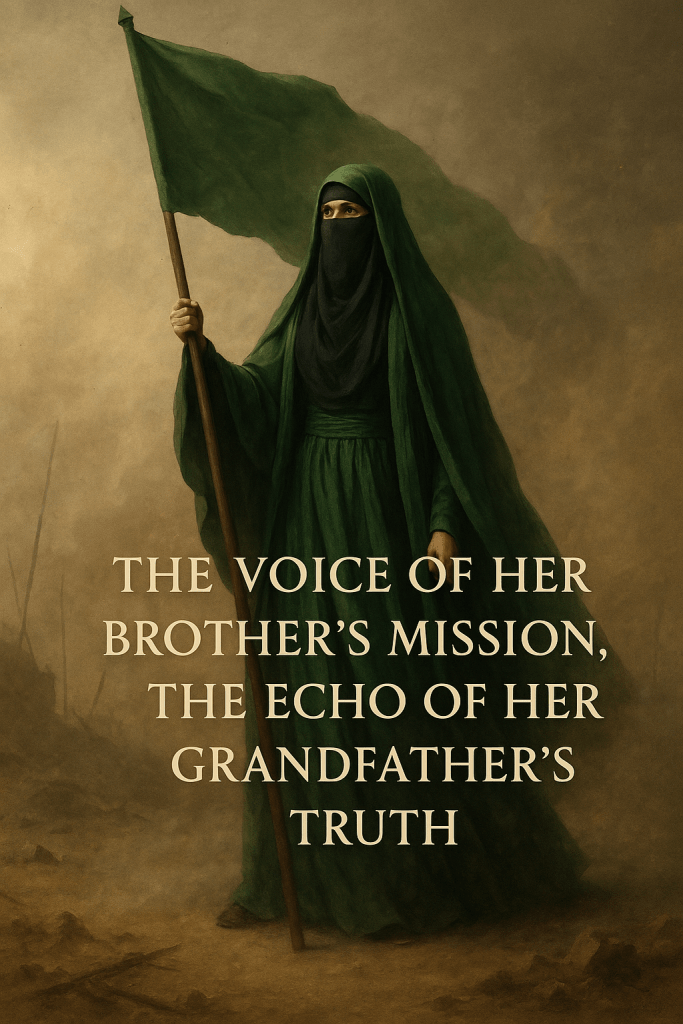
The voice of her brother’s mission,The echo of her grandfather’s Truth

I’ve been recently drawn to Sayyida Zaynab, daughter of Ali and Fatima, sister of Husayn, and a woman whose strength continues to echo through the ages.

 The Ahl al-Bayt were not ordinary people. They were chosen. Their lives were marked by divine purpose. The events of Karbala weren’t random tragedies — they were destinies written by Allah, subhanahu wa ta‘ala. Just as Imam Husayn was chosen to stand for truth with his blood, Zaynab was chosen to carry that truth with her voice.

She wasn’t a passive witness. She was central to the preservation of this message. She bore the weight of tragedy — the loss of her family, the desecration of their rights — and yet she rose. And when she rose, she rose victorious. Her power wasn’t in sword or numbers. It was in her eloquence, her unshakeable faith, and her ability to speak truth into the faces of tyrants.

Zaynab knew who she was — the granddaughter of the Prophet, the daughter of Fatima and Ali. She carried within her a legacy of light and truth. When she spoke in the court of Yazid, her words were so piercing, so clear, that even the hardened hearts of her enemies were shaken. And that’s what truth does — it shakes us. It wakes the deadened heart. And Zaynab was that voice. The voice that stirred a sleeping ummah.

She was more than a survivor — she was the seed of the revolution. It was her strength that planted the conscience of Karbala into the hearts of generations. Though others had fallen into silence, though many knew the truth was with the Ahl al-Bayt but were too weak to defend them, Zaynab stood firm. She stood so that generations after would know the truth. And from her seed, the revolution bloomed — a revolution of conscience, of justice, of divine loyalty.

Five years after Karbala, that spark ignited into uprising. The memory of Husayn, the blood-soaked banner of martyrdom, was held aloft by Zaynab — and it continues to flutter in the hearts of those loyal to the Ahl al-Bayt.

She was the fruit of her mother’s dua,. She was nobility, patience, eloquence, and resistance all in one. And I send peace and endless gratitude to her — peace be upon her, her grandfather Muhammad, her mother Fatima, her father Ali, and her brothers Hasan and Husayn.

May Allah allow us to honour her memory, to stay loyal to her message, and to rise — even if just a little — in her footsteps.

Judging vs. Advising: A Line Often Crossed, But Not Erased

In Islam, we are taught not to judge others harshly. “Perhaps the one you mock is more beloved to Allah than you.” We are reminded to advise with gentleness, to call one another to good with wisdom and sincere intention. But there is a difference between sincere advice and turning a blind eye to what openly harms the ummah.

When a Muslim sins privately, we cover it. When someone struggles inwardly, we extend compassion. But when sin is made public—boasted, normalized, glamorized—especially by influencers with massive platforms, it becomes more than personal. It becomes influential. And that matters.

There is a grave difference between someone stumbling in private, saying “I am human,” and someone publicly flaunting haram under the guise of being relatable. Sins don’t become less damaging just because someone says, “I know I’m flawed.” And being human doesn’t mean making Islam look hollow.

When a man parades his haram relationship online, only to later claim the woman took her shahadah on the same day they married—it raises red flags. The shahadah is sacred. It’s not a tool for marriage; it’s a declaration of truth. A soul should embrace Islam for Allah, not for love or status or a ring.

And yes, when someone takes their shahadah, their sins are wiped clean. But the path forward should reflect change—not a continuation of the same lifestyle. Leaving inappropriate photos, behaviour, and messages online while calling yourself Muslim misrepresents the deen, and misleads thousands who are watching.

People often say, “Only Allah can judge.” And yes, that’s true. But when something is done publicly, the ummah has the right to speak, because silence in the face of public harm is not piety—it’s passivity. Public platforms carry public responsibility. If you influence others, you’re accountable for what you normalize.

So no, it’s not “judgment” to speak out. It’s naseeha. And in a time where followers are more loyal than faith, the ummah must remember: Islam is not a brand. It’s not aesthetics. It’s not content. It’s a way of life. And that way deserves to be respected—not distorted for views.

For the sake of Allah.

There is a Version of Us That Longs for Allah, a version of us we hold in our hearts—a version that prays all five Salah on time, that opens the Qur’an every morning before the world wakes, that speaks gently, forgives quickly, and walks humbly. That version of us dreams of a home built on love and taqwa, where faith is the center and peace feels endless. That version of us longs to be near to Allah in everything.
But this dunya—this chaotic, relentless dunya—often gets in the way.
There’s work. There are children. There are dishes in the sink, aches in the body, expectations from society, and parents who need us. There are deadlines, doctor appointments, errands, and days when we can barely catch our breath—let alone open the Qur’an with presence.
And somewhere in between all that, we whisper: Ya Allah, I’m trying.
Sometimes we think we’ve failed, because we can’t be that “perfect” Muslim we imagined. But maybe the failure isn’t in what we do—it’s in what we expect. Islam was never meant to be a burden. The Prophet (sallallahu alayhi wa sallam) came to make it easy, not overwhelming.
Still, we push ourselves to change overnight, to abandon entire lifestyles in a moment, and then wonder why so many reverts and born Muslims alike feel burnt out. But Islam is a path. A journey. One that accommodates fatigue, grief, trauma, and real life.
This is why the five daily Salah matter so much. They’re a gift, not a task. Just 50 minutes a day—less than an hour to stand before the One who gives us every hour. If we can’t give Him that, then maybe the question isn’t about time. Maybe it’s about what we’re prioritizing in our hearts.
Still, even in our imperfection, Allah is Merciful. He knows our struggles. He sees our broken efforts. And He never demanded perfection—just sincerity.
So we try. Not to impress anyone. Not to meet impossible standards. But for His sake alone.
Because that’s what for the sake of Allah really means—to keep going, even when it’s hard, because our love for Him is greater than the chaos around us

“I Am Not Less Than”

Lately, I haven’t wanted to write.

The words that once poured so easily now feel like strangers.

I’ve been carrying the weight of trauma — old wounds reopened and new heartbreaks too raw to name.

And in the middle of it all, I’ve been editing myself.

Self-editing.

Holding back, trimming down my truth.

It reminds me of my days in print — how we’d slice a piece until it fit.

But this time, it’s not paper I’m trimming. It’s me.

And I feel invisible.

I’ve felt invisible for a long time.

And when you feel invisible long enough, even your voice begins to disappear.

There were moments I thought I had left —

or worse, that Allah had left me.

But the truth is, this has been a test.

A hard, sacred test.

I’m beginning to see the patterns now.

When I pull away.

When I stop wearing my hijab.

When I chase validation from people instead of seeking the pleasure of the One who created me.

That’s when I feel the most lost — because I’m trying to impress the creation, not the Creator.

And it’s only now, through deep reflection, I’m beginning to understand:

I’m not too sensitive.

I’m not broken.

I’m not depressed.

I’m struggling.

And it’s not a bad life. It’s just a hard day.

And even in that — I am still Muslim.

Still loved by Allah.

Still worthy.

We have to stop the mindset that tells Muslims they’re “less than” if they’re not perfect.

I don’t always pray Fajr.

Sometimes I sleep through 20 alarms and an adhan  ringtone.

I don’t read Qur’an every single day — that’s why I joined a Qur’an group.

I don’t always wear abaya — it’s not always practical for the work I do.

And on some days, when the nosebleeds and headaches hit, I can’t even bear to wear my hijab.

But if I can extend myself grace, I know without a doubt that Allah already has.

He is:

Ar-Rahman – The Most Compassionate

Ar-Raheem – The Most Merciful

Al-Ghafoor – The Most Forgiving

Al-Lateef – The Most Gentle

Al-Hakeem – The All-Wise

If He, in all His Mercy, still counts me worthy —

then why am I letting people convince me otherwise?

Especially other Muslims.

We need to stop weaponising Islam against each other.

Stop measuring worthiness by rituals alone.

Islam is not a checklist.

It’s a connection.

It’s a returning.

And returning often starts at our lowest — when we realise just how far we’ve fallen.

That’s where the sincerity begins.

Because it’s not just about ticking off your five daily prayers, or reciting a random surah.

It’s about your heart.

Your relationship with Allah.

Your desire to deepen that bond.

Because without that, we’re just living Islam on a surface level.

Yes — it’s especially hard when you’re visible.

When you’re known, followed, or watched.

You become a target.

And it hurts.

I recently told a sister, who was being abused for wearing hijab, that it’s okay to take it off if it means protecting herself —

especially when she’s alone, in her car, with her children, being shouted at by strangers.

That’s not just okay — it’s Islamic.

“And do not throw [yourselves] with your [own] hands into destruction.”

(Surah Al-Baqarah 2:195)

This is not about abandoning hijab.

It’s about protecting yourself.

Understanding your context.

Caring for your heart.

So this piece, for me, is a reflection.

I’m going through a lot — and that’s okay.

I drop the ball — and that’s okay.

I give my energy to people and things that don’t deserve it — and I’m working on that.

This dunya is temporary.

And so are the people in it.

And if someone or something is pulling me away from my focus,

from my purpose,

from my closeness with Allah —

then they have to go.

Because anything that pulls you away from your path,

clouds your clarity,

or steals your peace —

is not your qadr.

Right now, I’m standing at a crossroads.

I have decisions to make.

And I don’t make decisions under pressure.

So I’m turning to Allah — again and again and again.

Because I don’t know what’s next.

But I know the One who does.

And that is enough.

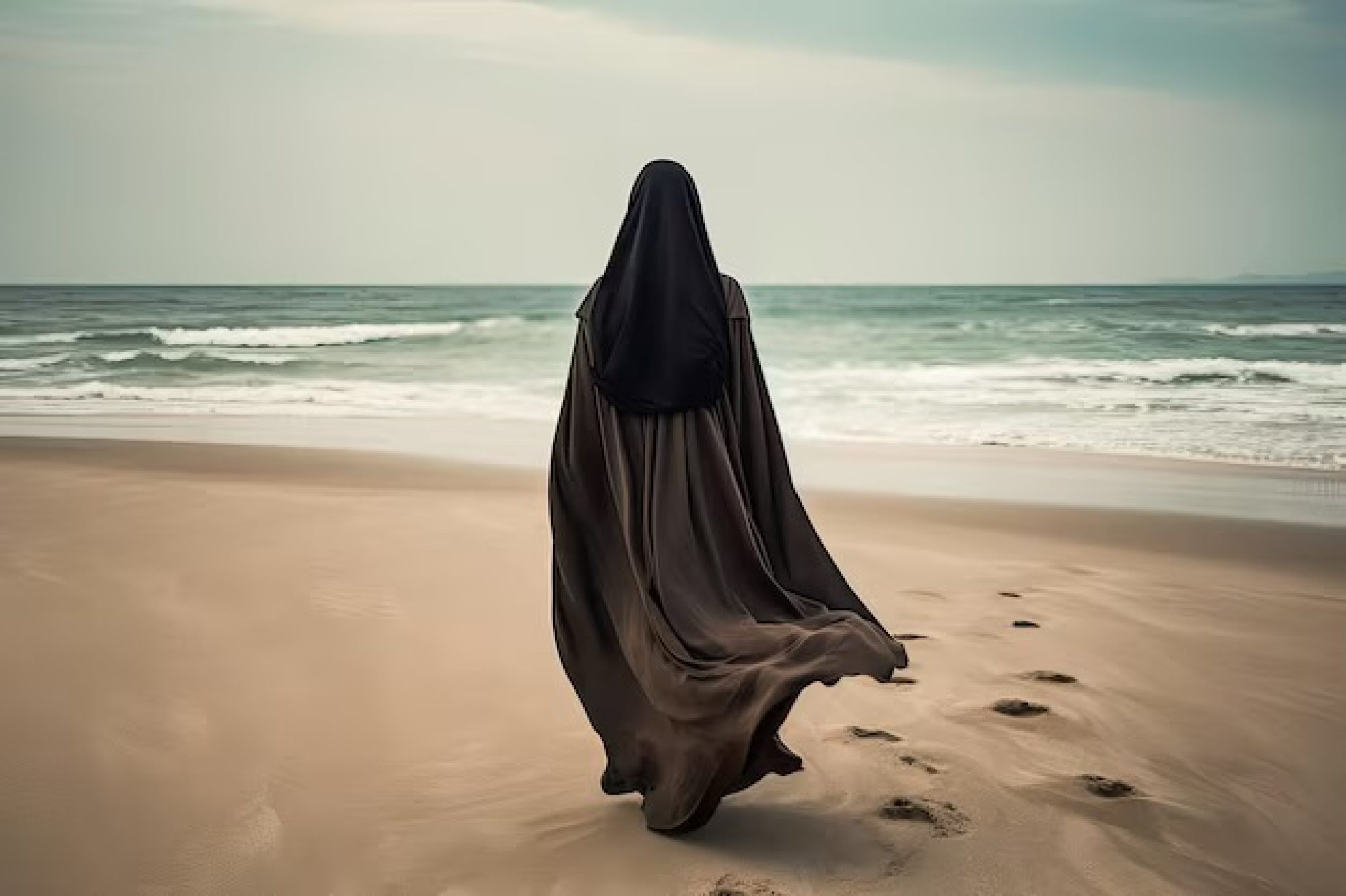
My Hijab, My Niqab My Choice – Not Yours

It is delusional to think that as a woman, I’m only free if I strip down, show off, and serve a society obsessed with my body.

I chose the hijab—and sometimes the niqab—not out of fear, not because a man told me to, and certainly not because I was forced. No one told me to put it on, and no one gets to tell me to take it off. Like the majority of women who wear it—especially reverts like me—I made that choice with full awareness and full agency. And I’m not alone.

You say we’re oppressed?

Either we’re oppressed because we hide our bodies from the sick and perverse male world, or we’re ‘free’ because we expose ourselves to it? That’s not freedom. That’s a narrative. And it’s one I no longer serve.

What is actually delusional is believing that Western society has freed women. Let’s talk about real oppression:

Let’s talk about eating disorders bred by impossible beauty standards.

Let’s talk about women having to sexualize their bodies just to sell products, win attention, or feel validated.

Let’s talk about wage gaps, objectification, and being told our worth lies in how desirable we are to men.

Let’s talk about a society where girls are groomed by screens to believe they are never enough unless they perform.

You want to talk about freedom? That’s not it.

Covering isn’t about shame. It’s not about erasing myself. It’s about reclaiming my autonomy, my space, my peace. It’s not freedom to serve the perversions of the white European man—nor anyone else. That’s just a new kind of slavery.

Even within Islam, there are women who say I shouldn’t cover my face. And just as I accept their journey, they must accept mine. Islam doesn’t erase individuality. It embraces choice—with accountability.

So no—I’m not oppressed. I’m empowered. And the real tragedy is that the people shouting the loudest about saving me are the ones who can’t see the chains around their own necks.

This isn’t submission. This is strength.

This isn’t silence. This is resistance.

And this cloth on my head? It’s mine.

Not yours to question.

Not yours to remove.

Not yours to define.