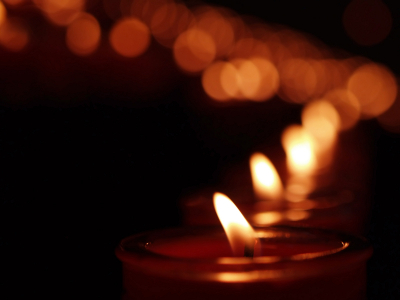
The lamps are different, but the Light is the same. It comes from beyond

OLYMPUS DIGITAL CAMERA

I’ve often been asked where my “spiritual formation” began, and it’s hard to point to one moment. My path has not been a straight line, nor a single point on a map. It has been more like a diamond — multifaceted, refracting light in countless directions. At the heart of it, though, there has always been one unshakeable truth: there is One God, Allah subḥānahu wa taʿālā, and the Prophet Muhammad ﷺ is His last Messenger.

Yet I’ve come to see that the way God reveals Himself to humanity is not one-dimensional. Like light through a diamond, revelation reaches different people, in different lands, in forms they can understand. The Qur’an itself hints at this when it tells us that if Allah were to reveal Himself fully, creation could not bear it:

“And when his Lord manifested His glory to the mountain, He made it crumble to dust, and Moses fell unconscious” (Qur’an 7:143).

The infinite condensed for the sake of the finite. This is why the Qur’an also declares: “For every people there is a guide” (13:7) and “We never sent a messenger except in the language of his people, to make things clear for them” (14:4). The light is one, but the languages are many.

In this way, what we call religions may be facets of the same diamond. Where some traditions see many gods, perhaps these are not rivals to the One but glimpses of His attributes, filtered into forms the human mind can grasp. Hindu philosophy, for instance, speaks of Brahman — the ultimate, formless reality — expressed through many deities, each embodying a facet of the divine. In Sufi understanding this is not foreign: the Asma’ul Husna, the 99 Names of Allah, are themselves facets of His unity, attributes refracted into qualities we can approach without being annihilated by His Essence.

The Shīʿa tradition often describes the Imams as “mirrors” or “gates” through which divine light is refracted into the world. Imam Jaʿfar al-Ṣādiq (ʿalayhi as-salām) is reported to have said: “We are the beautiful Names of Allah, and by us He is known.” Each Imam reflects a facet of the same divine truth, without dividing its unity.

And so, when I look across cultures, I see this diamond-light at work. I’ve met Muslims from Malaysia who still hold on to aspects of local festivals, and Muslims in the UK who celebrate Christmas not as a creed but as a cultural event. And each time I wonder: where is the line we keep drawing? If all paths are ultimately walking home to the same Source, why do we insist on the divisions? Did not the Qur’an say: “To each of you We have prescribed a law and a method. Had Allah willed, He would have made you one community, but [He willed otherwise] to test you in what He has given you. So race to all that is good. To Allah is your return, all together, and He will [then] inform you concerning that over which you used to differ” (5:48).

This is not to say that truth itself is relative — I still believe there is only One God, and that Muhammad ﷺ is His final Prophet. But it is to say that the rays of that truth shine everywhere, and what appears different may simply be another angle of the same light. In Ibn ‘Arabī’s words, “That which hides It is Its Oneness.” Perhaps what feels hidden is not hidden at all. Perhaps the Oneness of Allah is so obvious that we cannot see it, like the air we breathe.

When I sense this directly, the struggle to name it fades. The presence I feel at the center of my being is not separate from the presence that fills the world. It is a “wide-open center,” and yet centerless. It is the “luminous heart” — a goodness without opposite, a love beyond duality, a bliss beyond pleasure. As Imam ʿAlī (ʿalayhi as-salām) said in Nahj al-Balāgha: “He is with everything but not in physical nearness, and He is apart from everything but not in physical separation.” This is the same light that shines through every facet of the diamond, already here, already now.

We don’t need to go looking for it. It is already shining forth. All our practices, our prayers, our journeys and our cultures are ways of polishing our particular facet of the diamond so that the One Light can reflect more clearly. As Rūmī expressed: “The lamps are different, but the Light is the same. It comes from beyond.”

Reflections on Peace, Presence, and the Weight of Masculinity

There’s something I’ve been sitting with lately — a quiet shift in how I understand the role of men, especially within the home. It came from a tafsir I listened to recently. Not a dramatic revelation, just one of those verses you’ve heard a dozen times before… until it suddenly lands differently.

The verse was about Adam عليه السلام in Jannah.

But what struck me wasn’t the story — it was the structure.

Allah addresses Adam directly. He tells him to reside in Paradise, with his wife.

Not the two of them together.

Not a joint command.

The instruction is to him alone.

And the word used — uskun — isn’t just about living.

It’s rooted in stillness. In serenity. In sukoon.

It made me pause.

Because even in a place like Paradise — where peace is already a given — Allah still places the emotional tone of the home on the man.

It’s subtle, but it’s massive.

Before leadership, before provision, before family or tests or legacy — the first responsibility given to the man was to bring calm. Not to rule. Not to fix. Not to control. Just to be a presence of peace.

I keep coming back to that.

Because in this world we live in — full of noise, demands, overstimulation, emotional exhaustion — that responsibility becomes even more sacred.

But somewhere along the way, the definition of manhood shifted.

Now it’s often about dominance, performance, withholding.

Presence is rare. Peace, even more so.

And what I’m realising is: emotional maturity in a man isn’t something you “build together.”

It’s something you either witness in him — or you don’t.

He either brings sukoon into the space… or he brings disturbance.

There is no in-between.

And when he brings chaos? When you find yourself constantly managing, soothing, shrinking just to keep things together — that’s not your role. It was never meant to be.

We, as women, weren’t created to carry the emotional climate of the home alone.

We shift, we soften, we unravel and rebuild. That’s how Allah made us — in cycles.

But peace in the home? That isn’t our burden to bear.

Not entirely. Not always.

I’ve seen too many women asked to become the stillness and the structure — while the men around them remain emotionally unavailable, unaware, or even volatile.

And that tafsir reminded me:

That’s not how it’s supposed to be.

Peace is a man’s responsibility too — from the very beginning.

And if he hasn’t cultivated it within himself first, he has no business expecting partnership.

Because the kind of peace I want in my life isn’t performative. It isn’t external.

It’s something a man carries.

Something that shows in how he speaks. How he listens. How he responds in silence.

Something that cannot be faked.

And if he doesn’t bring sukoon, he doesn’t belong in that role.

It’s really as Simple as that.

This Muharram, I Choose to Live Authentically on the Haqq

This Muharram, I am not just making a promise — I am taking a stand.

A stand to live more authentically.

To walk with integrity.

To align my life with the Haqq — the Truth of Allah.

Authenticity, in its truest form, is not self-indulgence or rebellion. It’s submission. It’s aligning your soul with Divine truth, even when it hurts. Even when it costs you people, comfort, or belonging.

I’ve never really “fit in.” I’ve always stood out — but more importantly, I’ve always stood up.

I don’t turn a blind eye, not even to those closest to me.

Right is right. Wrong is wrong.

That’s something my parents instilled in me — a clear moral compass, no sugar-coating, no excuses, no loyalty to wrongdoing.

Just truth. Just justice.

And yes, it’s cost me friendships. People don’t always want truth — they want allegiance.

But you can’t be loyal to people and to truth when those two paths divide.

You have to choose.

This Muharram, I am choosing.

I am choosing to live like the Prophet’s family — the Ahl al-Bayt — who stood for truth even when they stood alone.

Who were not afraid to confront injustice, even when it came from within the ummah.

Who bore the weight of truth with grace and unshakeable resolve.

There’s a quote I carry in my heart:

“Stand for what is right, even if you’re standing alone.”

It has defined me for as long as I can remember.

And this year, it defines my path forward.

I no longer want to be around gossip, or people who thrive on low-vibrational energy.

If someone is comfortable gossiping to you, don’t think for a second they won’t gossip about you.

Authenticity requires discernment. And discipline.

So this Muharram, I walk forward.

Toward Allah.

Toward truth.

Toward a version of myself that fears no one but Him, and seeks no validation but His.

This Muharram, I am choosing to live upon the Haqq.

And I pray, by the end of this sacred month, I come out of it closer to Allah,

closer to Ahl al-Bayt,

and closer to who I was always meant to be:

authentic.

Unapologetically, faithfully, sincerely — for Him alone.

When Grief Is Truth: From Karbala to Gaza, and the Betrayal We Refuse to See

Muharram has arrived again.

A sacred month. A time when the air itself feels heavy with remembrance. For me, it’s never just about history. It’s personal. It’s raw. It’s a mirror held to the soul, a moment to ask: who do I stand with? And who do I stand as?

This year, I’ve stepped away from the noise—from social media, from performance, from the shallow conversations that scrape at the surface but never dare to go deeper. I’ve chosen silence. Reflection. I’ve chosen to retreat into my Deen—not for show, not even for healing, but for truth. Because truth is what Hussain stood for. And if we can’t find that in ourselves during this month… what are we really mourning?

Hussain (peace be upon him) was not a political figure. He was the beating heart of the Prophet’s legacy.

He was the grandson who the Prophet ﷺ used to cradle in his arms during prayer. The one he called Sayyid shabab ahl al-jannah—the leader of the youth of Paradise. He was known for his love, his generosity, his uprightness, and above all, his unwavering refusal to surrender to tyranny.

At Karbala, he stood with barely 70 followers against an army of thousands. No water. No mercy. No compromise. Because to him, truth was not negotiable. And to surrender to falsehood—even if it bought safety—was not an option.

He and his companions were butchered under the sun. Children murdered. Women taken prisoner. And all of this was done by people who claimed Islam. Who wore the cloak of religion. Who prayed, fasted, and recited Qur’an, all while slaughtering the bloodline of the Messenger of God ﷺ.

That truth alone should have shaken the ummah. But instead?

We forgot.

We forgot who the oppressors were. We erased the pain of the Ahl al-Bayt. We buried the truth beneath centuries of silence and scholarly revision. And we turned the very villains of our history into saints.

We praise those who betrayed the Prophet’s family. We quote those who stood at the Prophet’s door and crushed his daughter behind it.

Abu Bakr stole Fadak from Fatimah. Umar broke down her door and caused her to miscarry. Aisha raised an army against Ali, the rightful successor to the Prophet, in the Battle of Jamal. These are not fringe accounts—they are history. But we’ve been taught not to question them. We’ve been taught that “unity” means silence. That truth is divisive. That grief is sectarian.

But I ask you: If the price of unity is betrayal, then what are we uniting upon?

Today, I see Muslims around the world grieving the genocide in Gaza—and rightfully so. The suffering of the Palestinian people is unbearable. The bombs. The blood. The body bags. The lies.

And yet, some of these same Muslims glorify the very figures who laid the foundation for Karbala—the spiritual Gaza of our history.

They speak out against Israeli apartheid while quoting hadiths narrated by those who tore the house of Zahra apart.

They share du’as for the oppressed while venerating those who oppressed the Prophet’s own family.

They cry for martyrs today while silencing the ones whose blood built this ummah.

There is a deep, unspoken hypocrisy in our outrage.

We are willing to cry—but not willing to confront.

We are willing to mourn—but not to question.

We are willing to say “Free Palestine”—but not “Follow Hussain.”

So this Muharram, I ask myself again: what am I really grieving?

Because if I mourn Karbala, I must also mourn Saqifah.

If I cry for Gaza, I must ask who I glorify in my religion.

If I claim to love the Prophet ﷺ, then I must love his family not just in name—but in allegiance.

This grief I carry—this truth I refuse to abandon—it isolates me. It costs me. It makes me an outsider to many. But I think of Zaynab. I think of the women who walked in chains from Karbala to Kufa to Sham. I think of the courage it takes to speak truth not when it’s popular—but when it’s condemned.

Like Zaynab, I will not cry for sympathy. I will cry as a witness.

Like Hussain, I will not die for victory. I will live for loyalty.

And like Fatimah, I will guard my silence until it becomes louder than every lie.

This Muharram, I withdraw not out of weakness—but out of love. Love for the Ahl al-Bayt. Love for truth. Love for a God who sees every buried injustice and promises its resurrection.

From Karbala to Gaza, truth still bleeds. And I refuse to look away.

When I Hit Rock Bottom, I Called His Name

Tonight, after a day where everything seemed to fall apart — when every door closed, and every thread of patience unravelled — I lay in bed, empty and aching. Just hours before, I had written about Karbala, about Gaza, about grief — and yet, what washed over me next wasn’t the grief of history, or of others. It was my own.

A heavy, unbearable sadness began to rise in me. Not for Hussain, not for the martyrs, but for me. For how far I felt from Allah. From my Deen. From the steadiness I once had. I felt it in every part of me — the distance, the disconnection, the doubt.

And in that moment of complete vulnerability, I broke.

The tears came hard and fast, and all I could do was say it — “Ya Allah, Ya Allah.”

Over and over again. Not with eloquence. Not with hope. Just desperation.

“Ya Allah.”

I didn’t know if He would respond.

I wasn’t expecting a response.

I just needed to cry out — to say His name.

And then… something came.

Not a sign. Not a voice.

Just a whisper from within:

La ilaha illallah.

There is no god but Allah.

Again, and again, my lips moved with it.

La ilaha illallah.

And the crying softened.

And then, almost like a breath rising from the depths of me:

Inna ma‘iya Rabbi sayahdeen.

“Indeed, my Lord is with me, and He will guide me.”

I don’t know what happens next.

I don’t know what tomorrow will bring, or what path lies ahead.

But I know this: He never left me.

Even when I felt furthest from Him, He was there.

Even in the dark, even in the silence — He was always there.

And sometimes, you only remember that at rock bottom.

Because it’s from rock bottom that you finally stop looking in every direction except up.

And when you finally do — you realise you’re not lost.

You were being drawn back.

Back to Him.

Back to truth.

Back to the only One who has never let you go.

All I have to do now…

is keep calling His name

The Price of Awakening

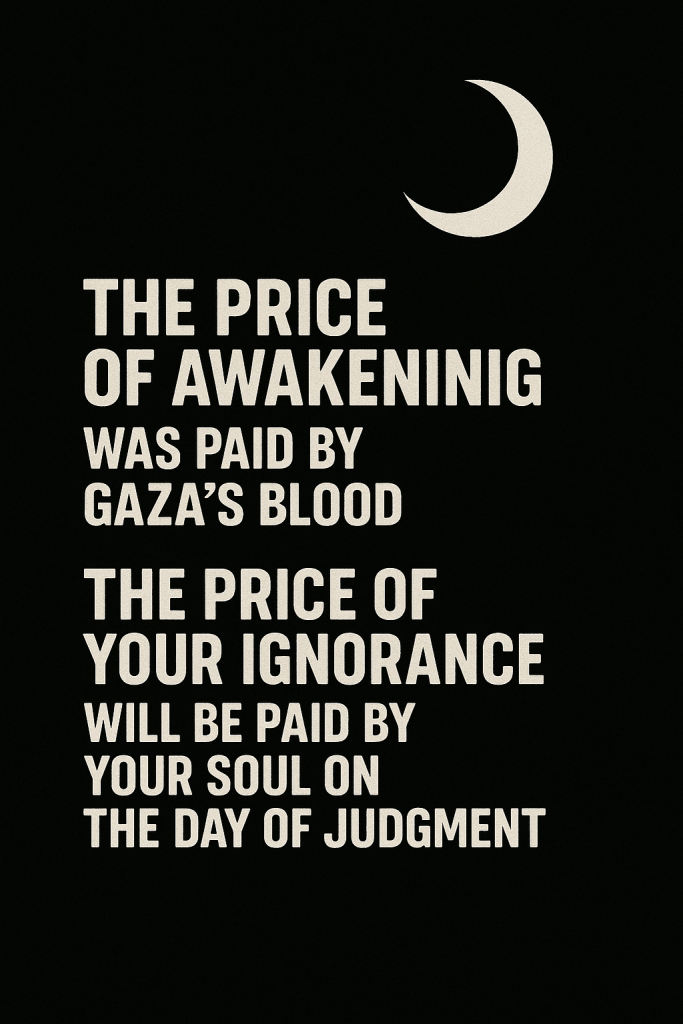
The price of your awakening was paid in Gaza’s blood. Don’t you dare forget that.

These words has sliced through me today as once again I opened my laptop to be faced with overwhelming ignorance from people claiming to be woke. I honestly didnt know that after all the exposure, after 589 days of Genocide that people could still be blind to what is unfolding live right in front of their eyes.

Yet as the rest of the world blinked open its eyes to the machinery of empire, to the savage clarity of colonialism laid bare, it was Gaza who paid the toll. Gaza — not just a place, but a people, a breath, a prayer buried beneath rubble — handed you the gift of sight. You didn’t wake up on your own. You were dragged, screaming or silent, into awareness by the sound of children being obliterated on livestream.

And yet.

There are still people pretending to be awake.Still trying to intellectualise their cowardice, still preaching nuance while bodies are turned to dust.

Still speaking of Hamas as though resistance is terrorism, as though occupied people owe their colonisers compliance. Still choosing the side of genocide while wearing the mask of enlightenment.

This did not begin on October 7th. That date is not the start of anything but your discomfort. Gaza’s struggle, Palestine’s pain, predates your timeline. It is layered with decades of theft, murder, humiliation, and siege — of a people imprisoned in their own land, punished for refusing to die quietly.

You talk about humanity, but only when it serves your politics.

You cry for peace, but only when the oppressed raise their fists.

You condemn “both sides,” but only when the side resisting dares to survive.

This isn’t awakening. This is performance.

Real awakening means rupture. Grief. Accountability.

It means recognising that what you now know came at the cost of a child’s life, a mother’s scream, a city flattened.

And that you owe them — not your pity, but your voice. Your alignment. Your truth.

Because yes, the price of your awakening was paid by Gaza in blood.

But the price of your silence — your ignorance, your willful blindness — will be paid by your soul on the Day of Judgment.

May you not be among the liars who claim they didn’t know.

May you not be among the cowards who claimed neutrality while genocide marched on.

And may you remember — every time you speak, every time you post, every time you choose sides — that someone else died to show you the truth.

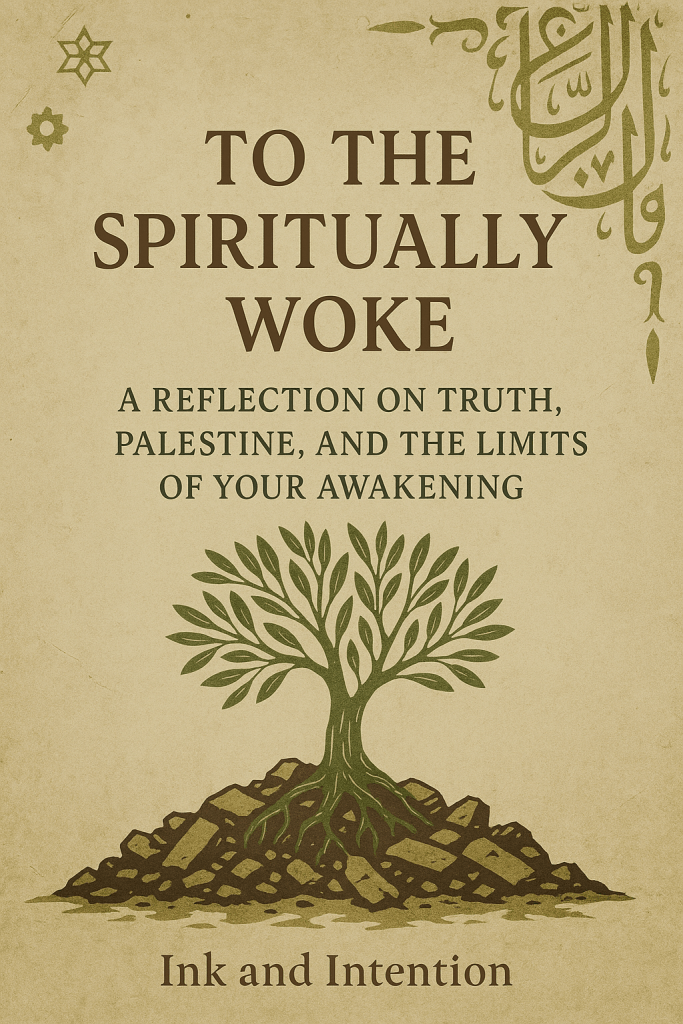
“To the Spiritually Woke: You Are Not Who You Think You Are”

“To the Spiritually Woke: You Are Not Who You Think You Are”

by Ink and Intention

In an age where everyone claims to be awakened — bathed in incense smoke, steeped in divine feminine wisdom, draped in crystals and cosmic truth — it is bewildering to find that so many remain deeply asleep.

They chant about liberation, about rising consciousness, about the sacredness of all things. They speak of universal love, of goddess energy, of breaking ancestral chains. And yet, when faced with a people being bombed, starved, and erased in real time, they somehow manage to take the side of the oppressor — or worse, they suggest solutions that are nothing more than polite ethnic cleansing.

This morning, I encountered a few such voices. Sisters, supposedly. Spiritually awakened, allegedly. But what I heard from them wasn’t truth. It was empty, packaged rhetoric. They suggested that Palestinians should simply leave. That perhaps Libya could offer refuge. That somehow, the people of Gaza must want to leave this devastation behind.

Let me be clear: this is not awakening.
This is not alignment.
This is complicity.

To suggest that the people of Gaza — who have endured unimaginable violence, who have chosen to remain rooted on their land even as it is turned to rubble — would want to leave, is to expose just how far removed you are from truth. It is to misunderstand not only the political reality, but the spiritual force that binds them to their home.

They are not enduring this genocide because they lack options. They are enduring it because they refuse to give up what is sacred.

They stay because their land is not a piece of negotiable real estate. It is not something they can sell or exchange for safety. It is home. It is legacy. It is prayer and history and covenant.

Their grandfathers planted olive trees that still bear fruit. Their ancestors are buried in the soil they walk on. Every stone is part of their story. Every inch of land has witnessed their love, their prayers, their blood. This isn’t nationalism — it is a spiritual, historical, and divine relationship with the land.

And more than that — they stay because of tawakkul. Because of their trust in Allah, subḥānahu wa taʿālā. Because they know that every hardship, every death, every loss, is written. That there is no true safety except with Him. That even in the face of bombs and starvation, what matters most is not survival at any cost, but submission to the Divine Will.

They sit on the ruins of their homes not because they have nowhere to go — but because to leave would be to betray everything they believe in. Everything they’ve lived for. Everything they were entrusted to protect.

And you — you in the West, with your temples and your tarot decks, your moon water and your sacred baths — you dare to speak on this? You, who live in lands built on the blood of displaced peoples, dare to advise the oppressed to become refugees again?

You are not awakened.
You are not enlightened.
You are parroting settler-colonial logic with prettier words and softer lighting.

You speak of divine feminine energy, but you cannot recognize the raw sacred feminine power of a mother in Gaza holding her baby in the rubble and refusing to leave.

You speak of vibration and frequency, but you do not feel the frequency of truth in the voice of a father who has lost everything and still says, “Alḥamdulillāh.”

You speak of ancestors, but you deny the dignity of a people walking the same streets their great-grandparents walked, even if those streets are now bombed-out shadows.

You say Palestinians should leave. But where, exactly, should they go? Libya, which has been torn apart by Western war? Jordan, already overflowing? Egypt, whose gates remain closed? The very idea is absurd. And yet, more disturbingly, it is exactly what Israel wants: an emptied land. A silent Nakba. A second expulsion, disguised as a humanitarian gesture.

And you — in your spiritual self-righteousness — are carrying that message forward.

You want to talk about hostages. Fine. Talk about them. But talk honestly. Hamas has repeatedly said: “We will release every hostage, all at once — if the bombing stops.” But the bombing hasn’t stopped, because Israel doesn’t want peace. It wants submission. It wants annihilation. It wants silence.

And every time you repeat, “Why won’t they just leave?” — you’re doing its work for it.

You are not neutral. You are not compassionate. You are not spiritual. You are colonized. Mentally and morally colonized, dressed in the language of awakening but devoid of substance.

Being truly awake means understanding the weight of oppression. It means standing with the oppressed even when it makes you uncomfortable. It means dismantling your illusions, not reinforcing them with incense and ego.

Real consciousness demands that you understand this: the people of Gaza are not martyrs because they want to die. They are martyrs because they refuse to abandon life — real life — a life of honour, of faith, of rootedness, of resistance. Their lives are drenched in meaning. In sacred defiance. In belief.

You, on the other hand, are asleep. And worse — you think you’re awake.

If your version of spirituality does not include the oppressed, does not understand the holiness of land, does not weep for the children buried beneath rubble, then your spirituality is a lie.

So sit with your discomfort. Sit with your hypocrisy. Sit with the realization that you are not who you thought you were.

And maybe — if you’re brave enough — start again.

Self-Care and the Holistic Nature of Islam: A Personal Reflection

Yesterday was one of those physically demanding days — the kind that pulls everything out of you, body and soul. In the past, I might have ignored the toll it took, brushing off my aches and tiredness. But after spending the last two years navigating chronic illness, I’ve learned to listen. Now, when I know I’ve pushed myself, I follow it with a day of intentional self-care — a day of rest, healing, quiet, and reflection.

And this, too, is Islam.

So often we forget that our religion is not just about salah and fasting and hijab in isolation. Islam is meant to be lived as a whole. It is not a religion of pieces, but a way of life — a holistic path that integrates the body, the mind, the heart, and the soul.

The Prophet Muhammad (peace be upon him) said: “Your body has a right over you.” (Bukhari)

We often quote it, but how often do we live it?

In my journey, I’ve seen people say things like:

“At least she’s praying, even if she doesn’t wear hijab.”

“At least she wears hijab, even if she’s not praying five times a day.”

But I think we need to gently challenge that mindset.

Yes, of course, growth takes time. And yes, everyone is on their own path. But we’ve created this culture — especially online — where Islam is accepted in fragments, like checklists of visible deeds, instead of a deeply rooted, living relationship with Allah that encompasses everything. A relationship that changes the way we speak, think, eat, rest, dress, pray, and even heal.

People often say, “You can’t do everything at once.”

But I ask: Why not?

When people embrace Christianity, they receive a rosary, wear a crucifix, go to church, accept the belief and the symbols that go with it.

So why, when we accept Islam, do we shy away from doing the same?

This was our choice. No one forced us. We chose Islam — so shouldn’t we try, with love, sincerity, and effort, to embrace all of it?

That doesn’t mean perfection. It means wholeness. It means acknowledging that just as prayer is important, so is sleep. Just as wearing hijab is an act of worship, so is feeding your body nourishing food. Just as dhikr soothes the soul, so does silence and slowing down. Islam doesn’t pit the physical against the spiritual. It teaches us to honour both.

The Qur’an reminds us:

“And do not forget your share of the world.”

(Surah Al-Qasas, 28:77)

Take care of your worldly needs — your health, your family, your mind — while seeking the hereafter.

“Allah does not burden a soul beyond what it can bear.”

(Surah Al-Baqarah, 2:286)

This is not an excuse to give up, but a reassurance that we are always equipped for the path we’re on — especially when we walk it with intention.

“Indeed, in the remembrance of Allah do hearts find rest.”

(Surah Ar-Ra’d, 13:28)

Hearts, not just minds. Our hearts need nourishment, too — not just through rituals, but through gentleness, reflection, and rest.

So today, I rest — and that rest is not laziness. It is worship. It is trust. It is healing.

And tomorrow, I’ll walk forward again, in shā’ Allāh, trying — not to be perfect — but to be whole.

Because Islam is not a piece of clothing, or a single prayer. It is a whole way of being. And I want to live it fully, not just in parts.

There is my plan, and there is Allah’s plan

.

On what could have been one of the nights of Laylatul Qadr, I had my own intentions set. I had planned to immerse myself in du’a, dhikr, and the recitation of the Quran, hoping to make the most of a night where every moment carries the weight of a thousand months. But before the evening even arrived, I was struck—suddenly and mercilessly—by chronic pain, dizziness, and a migraine so intense that it left me unable to do anything but lie there in the dark, eyes shut, body heavy with exhaustion.

It feels as though this Ramadan has tested me at every turn, challenging not just my physical endurance but my faith itself. And yet, each test has forced me—driven me—to seek out new ways to connect with Allah. Even as I lay there, unable to stand in prayer or hold the Quran in my hands, I found solace in the quiet whisper of dhikr. My lips moved in remembrance. My heart reached out in du’a. And in that moment, I realized: He was still there.

“And We have already created man and know what his soul whispers to him, and We are closer to him than his jugular vein.” (Quran 50:16)

I finally understood this verse—not just with my mind, but with my entire being. Even in my weakness, even when I could do nothing but endure, He is near. Not just when I am bowed in sujood or standing in prayer, but in my suffering, in my stillness, in my silence. Just as He was there in 2022, when I lay in intensive care, He is still here now.

And maybe, just maybe, one of His angels has been watching over me all along. Perhaps one of those Mu’aqqibat, the angels who guard by Allah’s decree, was also present today—just as they were before, just as they always have been. 

In that I take great comfort