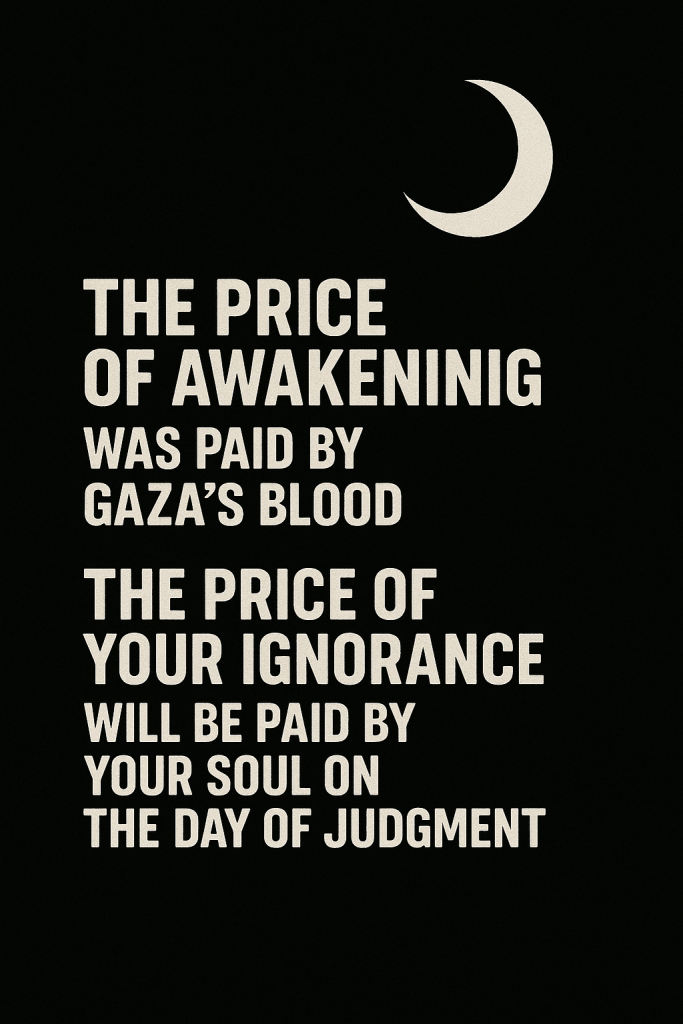
The price of your awakening was paid in Gaza’s blood. Don’t you dare forget that.
These words has sliced through me today as once again I opened my laptop to be faced with overwhelming ignorance from people claiming to be woke. I honestly didnt know that after all the exposure, after 589 days of Genocide that people could still be blind to what is unfolding live right in front of their eyes.
Yet as the rest of the world blinked open its eyes to the machinery of empire, to the savage clarity of colonialism laid bare, it was Gaza who paid the toll. Gaza — not just a place, but a people, a breath, a prayer buried beneath rubble — handed you the gift of sight. You didn’t wake up on your own. You were dragged, screaming or silent, into awareness by the sound of children being obliterated on livestream.
And yet.
There are still people pretending to be awake.Still trying to intellectualise their cowardice, still preaching nuance while bodies are turned to dust.
Still speaking of Hamas as though resistance is terrorism, as though occupied people owe their colonisers compliance. Still choosing the side of genocide while wearing the mask of enlightenment.
This did not begin on October 7th. That date is not the start of anything but your discomfort. Gaza’s struggle, Palestine’s pain, predates your timeline. It is layered with decades of theft, murder, humiliation, and siege — of a people imprisoned in their own land, punished for refusing to die quietly.
You talk about humanity, but only when it serves your politics.
You cry for peace, but only when the oppressed raise their fists.
You condemn “both sides,” but only when the side resisting dares to survive.
This isn’t awakening. This is performance.
Real awakening means rupture. Grief. Accountability.
It means recognising that what you now know came at the cost of a child’s life, a mother’s scream, a city flattened.
And that you owe them — not your pity, but your voice. Your alignment. Your truth.
Because yes, the price of your awakening was paid by Gaza in blood.
But the price of your silence — your ignorance, your willful blindness — will be paid by your soul on the Day of Judgment.
May you not be among the liars who claim they didn’t know.
May you not be among the cowards who claimed neutrality while genocide marched on.
And may you remember — every time you speak, every time you post, every time you choose sides — that someone else died to show you the truth.

 Seeking Sakina