Ramadan, Qadr, and Trusting Al-Wakīl

Ramadan is one of the most blessed months of the year—a time of deep reflection, worship, and renewal. As we fast, pray, and draw closer to Allah, we naturally find ourselves looking back, revisiting the past, and reflecting on the choices we’ve made.

At some point, we all wish we could turn back time, rewrite certain moments, and take different paths. Regret can settle deep within us, making us wonder, What if I had done things differently? But part of this reflection must also be a reminder: everything that has happened was always meant to be.

“No disaster strikes upon the earth or within yourselves except that it is inscribed in a register before We bring it into being—indeed that, for Allah, is easy.” (Quran 57:22)

Before we even came into existence, every joy, every hardship, and every lesson was written for us. The good and the bad, the moments of ease and the moments of struggle—all of it was decreed by Allah. And yet, when hardship touches us, we sometimes lose sight of this truth. We forget that everything—even our greatest tests—come from the One who possesses all that is good.

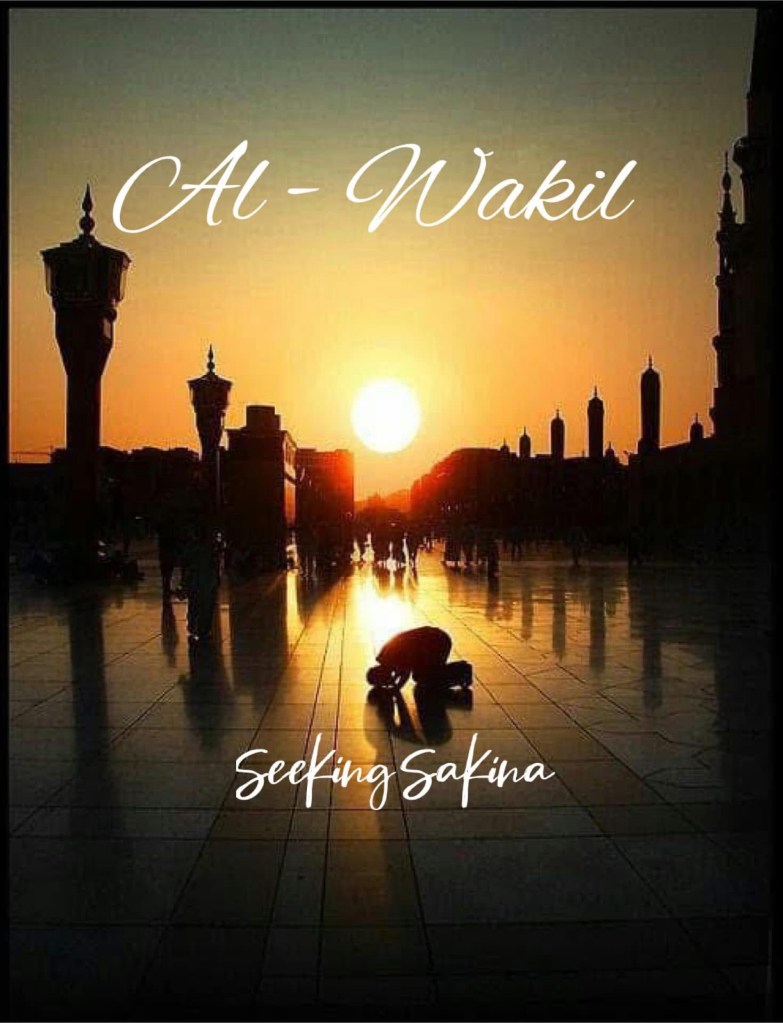
But when we remember this, when we take our belief in Qadr deep into our hearts, something shifts. There is a peace that comes with truly believing that Al-Wakīl (The Best Disposer of Affairs) is always in control. The knowledge of this strengthens our relationship with Allah, because we no longer carry the weight of the past with regret. Instead, we embrace it with understanding.

Laylatul Qadr, the Night of Decree, is the most blessed night of Ramadan. It is the night when destinies are written, and yet, its exact date remains hidden from us. Why? Because billions of Muslims around the world strive to witness it, pouring their hearts into worship, praying, and seeking Allah’s mercy. This night teaches us something profound: we don’t always need to know everything. We just need to trust.

And that brings us back to Al-Wakīl.

How often do we yearn for something, pray for it, only for Allah in His infinite wisdom to give us what we need instead? He knows what is best, even when we do not.

“… But perhaps you hate a thing and it is good for you, and perhaps you love a thing and it is bad for you. And Allah knows, while you know not.” (Quran 2:216)

Our role is not to control everything. Our role is to strive, trust, and submit—to tie our camel and then leave the rest to Allah. This does not mean we sit back and do nothing. Islam teaches us to be proactive, responsible, and to take the means available to us. But it also teaches us to accept that our plan may not always be the best plan.

So as we reflect on our past this Ramadan, perhaps we can begin to see it differently. Maybe everything we’ve been through has been preparing us for where we stand today. Maybe the struggles that once broke us were actually shaping us into who we were always meant to be.

And maybe—just maybe—when we truly entrust our affairs to Al-Wakīl, we’ll finally find the peace we’ve been searching for all along.

Romanticising and reality

In many Muslim communities, there is often an over-romanticized view of marriage. This can be largely due to the fact that many people, especially men, enter into marriage with little to no prior experience in relationships, as premarital relationships are not allowed in Islam. Consequently, they often step into marriage with unrealistic expectations, viewing it as a fairy tale rather than a partnership built on effort, responsibility, and mutual respect.

Marriage in Islam, while beautiful, is not without its challenges. It’s not enough to simply rely on romantic gestures or dua. In reality, marriage involves hard work—managing finances, handling responsibilities, supporting each other’s growth, and addressing the pressures of daily life. You cannot live solely on ideals; practical efforts like earning a living, maintaining respect, and nurturing dignity are what truly sustain a relationship.

Let’s face it, it’s beautiful to receive long romantic messages but in reality if you cannot walk your talk it’s just words you’ve cut copied and pasted to win someone’s heart with no ability to fulfill them.

When these idealized expectations collide with the realities of life—the need to work, provide, and manage household pressures—it can lead to disappointment and frustration. Many relationships struggle because partners fail to maintain a balanced understanding of what marriage truly requires. A successful marriage requires patience, mutual effort, and a clear understanding that love and commitment are built on more than just romantic notions—it’s about facing life together with resilience, respect, and shared responsibility.

In the end, true fulfillment in marriage comes when both partners acknowledge the realities of life and continue to work together, beyond the fleeting romantic moments, to build a stable and respectful relationship grounded in faith and responsibility.

May Allah bless us with balanced, compassionate, and understanding spouses, and grant us the strength to navigate the challenges of life with patience, love, and mutual respect.

When Ramadan Doesn’t Go as Planned: A Test of Trust and Surrender

In the lead-up to Ramadan, I was filled with so much anticipation. This year, I was finally going to fast. I couldn’t wait to experience the long, quiet hours of devotion, the stillness before dawn, and the sweet relief of Iftar at sunset. I stood outside my back door, searching the night sky, waiting for the crescent moon. And when I saw it, a soft silver arc against the darkness, tears welled in my eyes. It was a moment of relief, of hope—Ramadan had arrived.

The first few days were beautiful. I set up a small space in my kitchen, just for Suhoor and Iftar. I woke early, journaled in the morning, reflected, and immersed myself in the peace of it all. There was ease, joy, and an overwhelming sense of closeness to Allah.

And then, in the middle of it, Allah sent me a test.

A hospital visit. My consultants telling me I couldn’t fast. That it was harming my body. And just like that, the thing I had been longing for was taken away. It felt like such a loss, like something had been stolen from me.

At first, I struggled to make sense of it. Was I failing my Ramadan? Was I missing out on its blessings? Did Allah really want me to pass this test?

For many, fasting is difficult. The long hours, the hunger, the fatigue—it pushes you, but it also pulls you closer to Allah. But for those of us who cannot fast, for whatever reason—illness, pregnancy, breastfeeding, mental health—this is the real test. Not fasting can feel like you’re standing outside the gates of Ramadan, looking in, watching everyone else experience it while you’re left behind.

But this test, like all tests, is not a punishment—it’s an opportunity. When you can’t fast, you have to search harder for ways to draw close to Allah. You have to be intentional in your worship, in your dhikr, in your charity, in your prayer. You have to deepen your relationship with Him in other ways.

Not fasting isn’t a relief—it’s not an easier Ramadan. It’s a test that requires patience, faith, and trust. It’s easy to struggle through fasting, but it’s even easier to feel overwhelmed when you cannot. To feel weak. To question whether you’re doing enough. To wonder if you are still making the most of Ramadan.

And it’s okay to feel that way. It’s okay to feel overwhelmed, to feel physically and mentally weaker than usual, to have moments of doubt. It’s okay to sit with those emotions and be human with them. Because that’s exactly what Allah wants from us—to be human with Him.

He is Al-Qarīb, The One Who Is Near. He is with us through every trial, every frustration, every tear. He does not test us to break us, but to bring us closer.

“And when My servants ask you concerning Me, indeed I am near. I respond to the call of the supplicant when he calls upon Me…” (Quran 2:186)

Allah wants us to pass this test. He does not leave us alone with it. And when we begin to accept that—not just with our minds, but with our hearts—that’s when the peace comes.

It comes from knowing that Allah is with us, not just in our worship, but in our weakness. It comes from knowing that this, too, is part of our journey, part of our Qadr, part of the path He has chosen for us.

Maybe this test was never about fasting. Maybe it was about surrender. About trusting that Al-Wakīl, The Best Disposer of Affairs, sees what I cannot, knows what I do not, and that His plan is always greater than mine. Maybe it was about teaching me that Ramadan is not just about fasting—it’s about coming closer to Him, however that may look.

So if you are someone who cannot fast this Ramadan, know that you are not alone. Your test is real, and your struggle is seen. But also know this: you are still in Ramadan, and Allah is still near.

Ramadan Reflections 2025

{“data”:{“product”:”tiktok”}}

Alhamdulillah, as I step into this Ramadan. To be honest it was one I wasnt sure I was going to actually reach what with my health and surgery over the last year but by the will of Allah I am here and by his grace I am Healing, healing beyond the belief of even my own consultants.

Over the last year my faith has been tested beyond measure, not only with my health but also with other people who came into my life albeit briefly. It made me question everything I knew about islam and why I became muslim. Even 5 years into my journey I still get that revert identity crisis, i am not sure that goes away as a revert.

The ability to reflect has been my greatest asset this year since last ramadan. I have struggled with so much and often silently but I have also grown in so many ways and it is all thanks to Allah and his Guidance.

Over the last 6 months my views on islam have changed in as so far as the path I follow but my reasons for staying have remained the same.

For me, Islam has always been about seeking the truth—not just the truth about who God truly is, but also the truth about myself. It is a journey of self-discovery, one where I learn to see myself through His eyes, both in my strengths and my shortcomings. It is about embracing every part of who I am with honesty and acceptance, knowing that my worth is not defined by worldly standards but by the sincerity of my heart.

How can we stand before our Creator every day and not be truthful about who we are? In a world where appearances are often valued more than integrity, Islam has taught me that what resides within my heart carries far greater weight. It is not the image I present to the world but the sincerity, purity, and intention behind my actions that truly matter.

Islam has also opened my heart in ways I never imagined. It has allowed long-buried emotions to surface—feelings I once suppressed out of fear or self-doubt. Through faith, I have learned to embrace warmth, compassion, and love in their purest forms, untainted by expectation or pretense. My heart no longer feels the need to harden itself against the world, because I have found strength in vulnerability and peace in surrendering to God’s will.

And only when I stand firmly in my truth—acknowledging both my flaws and my strengths—can I truly advocate for those more in need than I am. When I embrace who I am with sincerity, I can serve others with integrity, free from ego or self-interest. Islam teaches me that true advocacy is not about seeking recognition, but about standing for justice with a heart that is pure, humble, and aligned with God’s guidance.

Only Allah should reside in our hearts

This needed to end so I could be alone with only Allah, to understand his mercy and how it is only him that can fill any void.

When we put more importance on this dunya and we fill our hearts with people and things of this world we set ourselves up to feel pain.

To be stuck in an endless loop of heartache and sadness.

Nothing or no-one else can be relied upon as they are temporary in this dunya, only Allah is the everlasting, flawless and absolute.

The heart is his rightful place. Nothing else has the right to reside there except him. When we empty our hearts of everything from this dunya and fill it with Allah, only then can we escape this prison this dunya tries to keep us in.

In this place of freedom we can no longer be broken, our hearts can no longer be weak. we will no longer suffer for Allah is there

When I wrote this I had just decided to stop speaking to someone for the sake of Allah, to someone I felt very deeply I would also walk with in Jannah, so strong were my feelings for him. Sadly it became messy and his past interactions all came back to feast and I dont want to eat at that kind of table.

Its ending didn’t affect my decision to travel, in fact it confirmed for me that it was indeed by the will of Allah that this person came back to disrupt the situation, as it caused me to turn back to Allah and away from temporary things. It brought a realisation that I had put this person in the wrong place in my body.

“Only Allah should reside in our hearts”

Despite the situation leaving me to feel like I was stranded in the middle of the ocean I now ‎saw this as a blessing from Allah, for out of his mercy I turned to only him in full acceptance of his will and he placed in my heart something better, something everlasting and perfect

HIMSELF

And when adversity touches you at sea, lost are all these you invoke except for him “[17:67]

Allahu Akbar