To My Dearest Sisters,

To that sister in the abaya.

To that sister who’s trying.

To the one who left behind everything she knew, and still sometimes wonders where she belongs — I see you.

But more importantly, Allah sees you.

You weren’t always like this. Maybe you were the hoodie and jeans type, the one who never imagined herself wrapped in an abaya. Maybe dressing modestly doesn’t feel natural yet — maybe it even feels like a costume some days. But still, you put it on. Still, you showed up. Not for people. Not for praise. But for Him.

That alone speaks volumes about your heart.

You’re a revert. You left behind a life, a mindset, a world — and now you’re walking a new one, brick by brick, often alone. And some days, it hits you hard: the loneliness, the confusion, the weight of not quite fitting in anywhere. Your īmān dips. You question whether you’re doing enough, whether you even belong here. You wonder: Who am I now?

Let me tell you, from one sister who knows that feeling too well — you are not lost. You are not an imposter. You are in the middle of becoming.

We don’t talk enough about this part of the revert journey. The quiet grief of leaving behind your old life. The silent tug-of-war between who you were and who you’re trying to be. The courage it takes to obey when everything inside you is still catching up.

And yet, even in that chaos, you chose Allah.

“Allah chooses for Himself whom He wills, and guides to Himself whoever turns to Him.”

(Qur’an 42:13)

He saw something in you — even when you didn’t see it in yourself. You didn’t stumble into Islam. You were chosen, handpicked by the Most Merciful. And if He brought you here, He will carry you through.

But here’s the reminder we all need:

This journey isn’t about how others see you — it’s about how deeply you turn to Allah.

It’s not about being perfect. It’s not about looking the part. It’s about seeking Him with a sincere heart.

So when it gets too loud, when the dunya pulls you back, when the whispers say you’re not good enough — quiet them with dhikr. Drown them in sujood. Let your heart fall in love with your Lord again and again.

“So flee to Allah.”

(Qur’an 51:50)

Turn to Him not just when you’re strong, but especially when you’re weak. That’s when He is closest.

You don’t have to be graceful. You don’t have to have it all figured out. You just have to keep going.

You in your abaya, unsure but sincere.

You in your prayer, dry-eyed but trying.

You, choosing obedience over comfort.

You, learning to let go of this dunya, piece by piece.

That is strength. That is beauty. That is īmān.

So focus your gaze, your heart, your everything — on Him. Not on the world. Not on your past. Not even on the version of you that you haven’t met yet.

Because in the end, it was always about Allah.

And He is always enough.

With love, understanding, and du‘ā’ from a sister who truly sees you,

Your sister,

U.A. Noor
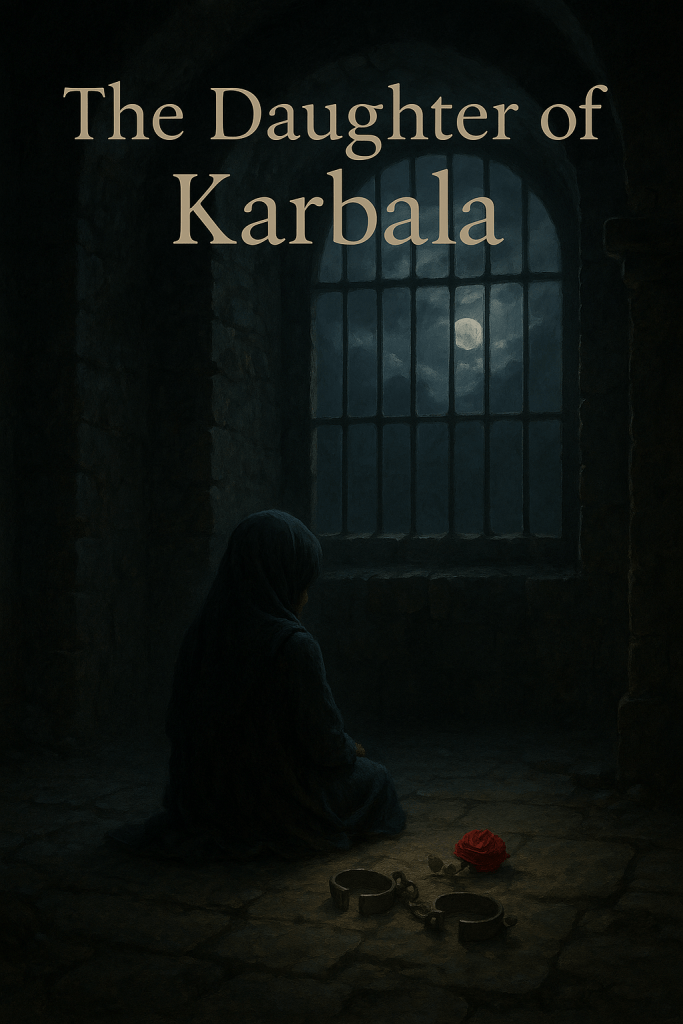
🌸 The Silent Cry of Sayyida Ruqayyah (as) — A Reflection

As the anniversary approaches to honour this little girl I’m struck by the core similarities between her and the children of Gaza like them She was only a child — just four years old, some say even younger — yet her name echoes through the centuries with the weight of grief and sanctity.

Sayyida Ruqayyah bint Husayn (as), daughter of the Master of Martyrs, walked a path that no child should ever walk — the path from Karbala to Kufa, and then to Damascus, shackled not by her own sins, but by the cruelty of those who tried to extinguish the light of the Prophet’s family.

She was born into light, into love — the cherished daughter of Imam Husayn (as) and a grandchild of Fatima al-Zahra (as). Her small world was filled with the fragrance of worship, truth, and purity. But the love of Ahl al-Bayt came with a price in a world intoxicated by power and tyranny.

On the 10th of Muharram, she witnessed what no soul should bear: her father standing alone in the desert, bleeding yet radiant, calling for help that never came. The cries of “al-‘atash!” — “I am thirsty!” — from children like herself, still echo. And when her beloved father fell, she no longer had anyone to shield her from the storm.

Dragged in chains through the streets of Kufa and Shaam, Sayyida Ruqayyah was not only a prisoner of Yazid — she became a witness. Her small voice, her cries for her father in the dark prison cell, pierced the hearts of even the cruel. And when they brought her the severed head of Imam Husayn (as) in a cold box, her tiny heart could bear no more. That night, she left this world, reuniting with her father in the Hereafter, where there are no chains, no pain, no parting.

💔 Her Story, Our Mirror

Ruqayyah’s story teaches us that innocence is not always protected in this world, but it is always honored by God. She reminds us that even the smallest among us can bear witness to great truths, and that grief itself can be a form of resistance.

In her cries, we hear the voice of every oppressed child. In her shackles, we see the cost of speaking the truth in a world ruled by falsehood. And in her martyrdom, we are reminded that Allah sees the brokenhearted, and that the oppressed will rise again — with dignity, with divine reward, and with their names forever engraved in the hearts of the faithful.

🌹 What Can We Learn?

Love for the Ahl al-Bayt must be active — it must move us to speak out against injustice, to comfort the vulnerable, and to uphold truth no matter the cost. Spiritual strength does not depend on age. Even a child, nurtured in faith, can bear immense trials with patience and purity. Grief is not weakness — Ruqayyah’s tears became a testimony that outlived empires. Our pain, too, can be a form of worship when it is rooted in love for Allah and His chosen ones. Martyrdom is not always on the battlefield. Sometimes it is in the prison cell, in the silent suffering, in the dignity of a soul that refuses to bow to tyranny.

May we never forget her.

May we raise our daughters with her name on our tongues and her light in their hearts.

And may we meet her, one day, in a place where no children are ever hurt again — in the gardens of Jannah, under the mercy of Allah, near the ones who were never afraid to stand alone for truth.

Peace be upon you, O Ruqayyah bint Husayn.

You did not die in vain.

Title: In Her Shadow: Reflecting on Hijab and the Legacy of Fatima (as)

There are days when the scarf feels heavier than cloth. When it clings to the back of my neck under the weight of a summer sun, or when the air feels thick with judgment—from within and without. I’ve had my struggles with hijab. I won’t pretend otherwise. I’ve wrestled with questions, with shame, with the feeling of being visibly other. But through it all, there’s one figure who keeps returning to me, like a soft light breaking through my own confusion: Fatima al-Zahra (as).

Fatima. The daughter of the Prophet ﷺ. The woman whose dignity is remembered not just through her words, but through her silence. Through her modesty. Through the way she carried herself even when the world turned its back on her. I think about her a lot—especially on the hard days.

When I wear the hijab, I often feel like I’m stepping into her legacy, one fold at a time. Not perfectly. Not always confidently. But with a kind of quiet love. It’s strange, because the hijab can sometimes feel like a battleground—especially as a revert, especially in the West. But then I remind myself: it was never about performance. It was about presence. Being before Allah in a state of humility, and letting that humility bloom into strength.

What’s more, lately I’ve been walking down the street and seeing sisters in niqab—full black, flowing, unapologetically radiant under the same boiling sun I’m hiding from—and I’m just… in awe.

These women are fierce. Fearless in the most graceful way. Choosing modesty in a culture that constantly ridicules it? That’s strength. That’s freedom. That’s power. And I see you. Every single one of you out there doing it in this heat, choosing haya over ease—you are my inspiration.

Sometimes I feel like I’m dragging myself through this journey—one pin, one fold, one step at a time. But then I remember Fatima. How she walked to the masjid to speak truth to power, covered head to toe, her modesty not muting her, but amplifying her voice. How even in her death she requested privacy. A woman who never needed a stage to shine—her light came from her nearness to Allah. That’s the legacy I want to be part of.

Hijab doesn’t erase us. It refines us. And I’ve come to realise that every time I struggle and still choose to wear it, I’m part of something sacred. Something ancient. Something revolutionary.

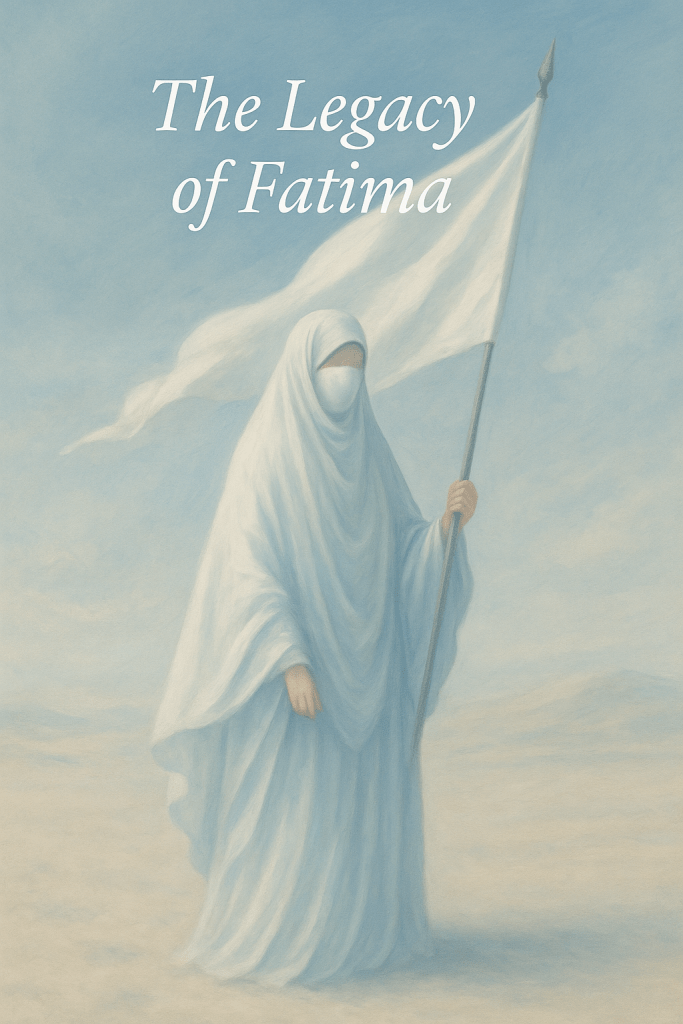
This isn’t just fabric. It’s a flag. It’s a love letter to Fatima.

And on the hardest days, that’s enough to keep me going.

❓How do we get people to see the other side without triggering defensiveness?

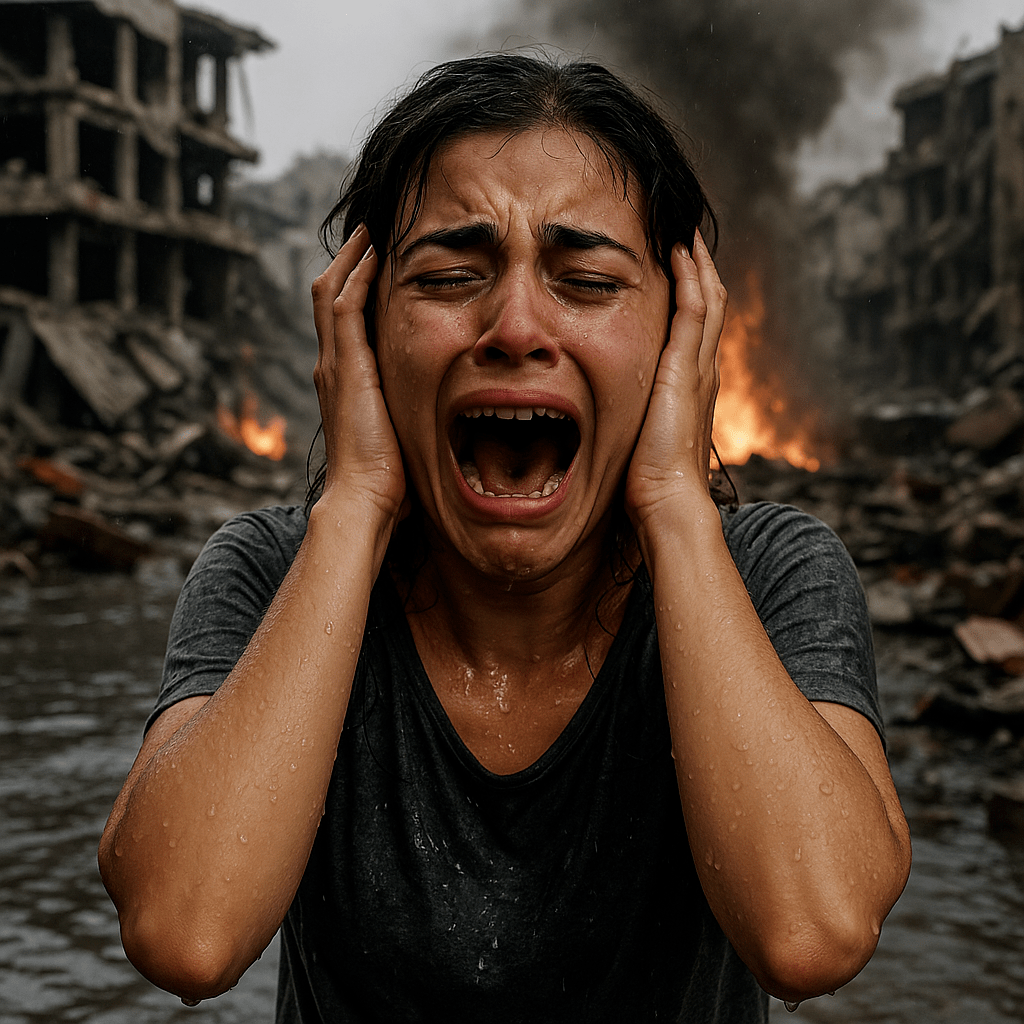
I’ve been thinking about this so much. It’s now been more than 640 days since the genocide began on October 7, 2023—over a year and eight months of devastation now playing out openly. In that time, countless voices—from UNRWA, global healthcare leaders, human rights advocates, legal experts—have stood up and declared: this is genocide. Yet our governments persist in refusing to acknowledge it.

I have to believe that those who deny it are in the minority—because if they were the majority, then humanity is lost, quite frankly. It also means we’re closer than we should be to complete moral collapse.

And yet, what do we see instead? People making effigies, burning boats, sanctioning violence against helpless children at airports—slamming them to the ground into comas—just because of where they’re from. Who is fuelling this hate? Why is it not being challenged openly by our governments? And most shockingly—why is Israel being allowed to commit genocide live on our screens, with no accountability, no consequences, and total impunity?

What is it our governments refuse to see? Do they think these videos and images are fabricated? Or do they simply believe this is “war”—the way war has always been, and they’ve become numb to horror? Do they not realise this is new: the first time we are watching genocide as it happens, in real time.

How many more tragedies must we witness this way before it becomes too late to stop it? This alone is why I don’t soften the language—I refuse to treat genocide like it’s just another conflict. Because to live another day using the word war—when humanity itself is at stake—is beyond forgiveness.

So what’s the Real Reason People Don’t Change – And Why It’s So Dangerous Now

I’ve been thinking a lot about something I just witnessed — and really, something I keep seeing over and over in society. It’s this deep resistance people have to being challenged. Especially when it comes to their beliefs, their politics, their culture — their sense of what’s “right.” The minute you try to correct them or offer another way of seeing things, something switches inside them. It’s like you’re not just disagreeing — you’re insulting them. And suddenly, they become rude, defensive, aggressive.

But I don’t think it’s about rudeness on the surface. I think it comes from a much deeper place — a kind of insecurity. Maybe from childhood, from being told they weren’t smart enough. Maybe from fear. Maybe from a lifetime of tying their worth to being right. And when that’s the case, any challenge to what they believe feels like you’re telling them they’re stupid. That they’ve failed. And that’s when the ego steps in.

Some people live their whole lives not knowing this is what they’re doing. Others do know, but they cover it up with a loud persona — ego, arrogance, even superiority. You see this a lot among the wealthy, among people with power. But honestly? It’s not just them. You see it across all classes. Especially in people who lack self-awareness, who can’t sit with being wrong.

And I genuinely believe — hand on heart — that half of society’s problems today come from this.

This inability to say, “You might be right. Let me think about that.”

This unwillingness to be uncomfortable.

This fear of having your worldview shaken — even when your worldview is harming people.

We see it most painfully right now with this genocide happening in Gaza. People who are wide open, deeply informed, and morally awake are screaming: This is ethnic cleansing. This is mass murder. This is apartheid. And yet we are met — again and again — with blank stares, with arguments, with people saying “No, it’s complicated. We support Israel.”

It’s like watching two different realities play out.

And the question I keep asking is:

How do we get these people to open their eyes — without triggering their defensiveness?

How do we speak truth without it sounding like an attack?

It’s hard. It’s exhausting. And sometimes it feels impossible.

But I’ve learned a few things.

You don’t change minds by force. You plant seeds. You speak clearly, but not with cruelty. You ask questions instead of throwing accusations — not because they don’t deserve confrontation, but because if the goal is change, shame doesn’t always get you there. And most of all, you speak not just for them — but for the ones who are listening quietly. The ones who are still open.

Because maybe they’re the ones who will carry the truth forward when others refuse to hear it.

💔 A Reminder for the Heart That Still Feels

“Surely, in this is a reminder for whoever has a heart, or who listens while he is present [in mind].”

— Qur’an, Surah Qaf (50:37)

There are verses in the Qur’an that don’t just speak—they pierce. This is one of them.

It doesn’t ask if we’ve memorised the words.

It doesn’t ask if we’ve debated the meanings.

It simply asks: do you have a heart that still feels?

Because sometimes, we move through life numb—alive in the body, but asleep in the soul. The Qur’an calls out, not just to be read, but to be witnessed. It speaks of nations destroyed, of death and return, of the unseen and the inevitable. But none of it will matter unless something inside us stirs.

This verse draws a line between those who remember and those who are too distracted to see what’s right in front of them. Between those whose hearts are soft enough to tremble, and those whose ears are deafened by noise. Between those who are truly present, and those who are just… passing time.

“He who has a heart”—not just one that beats, but one that breaks, hopes, longs.

“Or gives ear”—not just listens, but yearns to understand.

“And is a witness”—not just looks, but sees with insight.

Some of us don’t need more signs. We need to slow down long enough to feel the ones already around us.

The sunrise you rushed past.

The ache in your chest when the Qur’an mentions death.

The moment you knew Allah was calling—but didn’t answer.

That was a reminder.

Maybe this verse is a mercy. A final knock on the heart’s door before it hardens completely.

If you’re still moved by these words, still stirred by a verse, still able to cry in secret when no one sees… then your heart is still alive. And that, my friend, is a gift.

Don’t waste it.

Trying to Hold It All Together in a World That Was Never Meant to Hold Us

There are days — many days — when it feels like I’m juggling fifteen things at once. Appointments. Forms. Operations. Children. Responsibilities. Bills. Tasks that never seem to end. And all the while, trying to hold on. Trying to hold it all together.

But the truth is… it’s already out of my hands.

We often move through life with this illusion of control. We plan, we push, we organise, we chase. But the outcomes? They were never ours to begin with. Yes, we do our part. Islam teaches us to act — to take the means — but the results belong only to Allah. QaddarAllahu wa maa shaa’a fa’al — Allah has already measured it, and whatever He wills, happens.

And yet, despite knowing that, we struggle. We feel overwhelmed. Disconnected. Like we’re running a race in a world that was never designed to be the destination.

Sometimes I wake up and feel like I’m carrying more than one person should. I’ve even been told by my own medical professionals that I’m doing the equivalent of two of their professional roles, stress-wise. And still, somehow, I carry on. But it’s not without cost. I’ve worked in high-pressure jobs — I was once a PA to four directors, I even ran a nightclub abroad — but somehow, this life, this stage I’m in now, feels even heavier. And I wonder why.

Maybe it’s because the burdens of dunya aren’t just physical. They’re spiritual. They weigh on our hearts. They pull at our souls. They distract us from the One we’re meant to be turning to — and preparing to return to.

And that’s the test, isn’t it? That’s the real fitnah of this life. Not just the big tragedies, but the daily demands. The mundanity. The relentlessness. The endless cycle of doing, and fixing, and managing, and coping. The tension between what must be done to survive here — and what we yearn to do to thrive in the next life.

I often find myself longing for a different rhythm. One where I could just be — immersed in dhikr, in salah, in stillness. Where my days revolve around prayer, reflection, maybe even sacred places. Medina, Makkah, Al-Aqsa… not school runs, hospital corridors, and urgent deadlines.

But for most of us, that isn’t our reality. Our test is here. Our worship is in the struggle.

When I reach that state of overwhelm — when everything feels too heavy and nothing makes sense — I often whisper to myself: Inna ma’iya Rabbi sayahdeen — Indeed, my Lord is with me, and He will guide me. It’s not just a verse. It’s an anchor. A reminder that I’m not alone in this.

And that, right there, is tawakkul.

It’s trust. Not a passive giving up, but an active surrender. Trusting that Allah sees, knows, and cares. Trusting that even when everything feels like chaos, He is still in control. Tawakkul means doing what I can, with the strength He’s given me, and then handing the rest back to Him — completely.

Because if I try to carry it all alone, I fall. But when I remember that He’s already holding it for me — that’s when the burden starts to lighten.

This dunya can feel like a trap. Constraining. Demanding. Loud. We live lives where we are constantly switched on, constantly responsible — for ourselves, for others, for tasks we didn’t choose. But maybe this is why we feel so disconnected. Because we were never meant to live for this world. We were meant to live through it — for Allah.

That’s the real challenge, I think. That’s what I woke up with on my heart this morning. Balancing the life we’ve been given to live, with the life we are preparing for after this one ends. Walking that line between surviving here and striving for what comes next.

I don’t have the answers. I’m just a soul trying to breathe beneath the weight of too many things. But maybe that’s the whole point: not to carry everything alone, but to keep returning it to the One who never asked us to do this life without Him.

So if you’re in that place too — tired, overwhelmed, aching — remember this:

Your Lord is with you. And He will guide you.

Inna ma’iya Rabbi sayahdeen.

This Muharram, I Choose Truth — Even Here

It’s the first few days of Muharram,

and already I find myself at war —

not with anyone else,

but with the voice inside me that says, “You’re fine. Just hold it together.”

Yesterday, I was sitting in the dental waiting room, waiting.

The smell hung in the air — sharp, sterile, suffocating.

My chest tightened. I felt sick.

My instinct was to run, or pretend I was okay.

They told me fourteen teeth must be removed.

That the infections in my jaw —

years in the making from Crohn’s and chronic illness —

are serious enough to need partial dentures.

That some of the work might have to be done in hospital.

That because of my past sepsis,

and how likely it is to return,

the risk of dental sepsis is high —

and if it happens, survival is only fifty-fifty.

My world cracked open.

And still, I was expected to nod. To cope.

To thank the dentist and walk out strong.

But inside, I was breaking —

quietly, invisibly, again.

The sharp clinical tang still lingers in my memory, fueling panic. I’m unraveling inside, still on the outside.

Like a girl with her sock slipping halfway off in her shoe —unseen, uncomfortable, fidgeting for peace.

And yet, I remind myself:

I’ve walked through fire with steady steps.

So why does this feel like too much?

People see me as strong —the one who holds it together, no matter what.

Do I tell them I’m spiraling?

Or do I keep the mask in place, again?

This “strong one” persona —

it’s a trauma response, I know.I learned early that needing no one was the safest way to exist.

But this Muharram, I promised myself something different: to live with more honesty. To let go of performance. To stop hiding behind strength that costs my peace.

This is one of my first tests.

To sit in my discomfort. To name it. To not shrink away from it —not even here, in this small, anxious moment with slipping socks, shaky breath, and quiet vulnerability.

Because this, too, is a battlefield.

And this, too, is where authenticity begins.

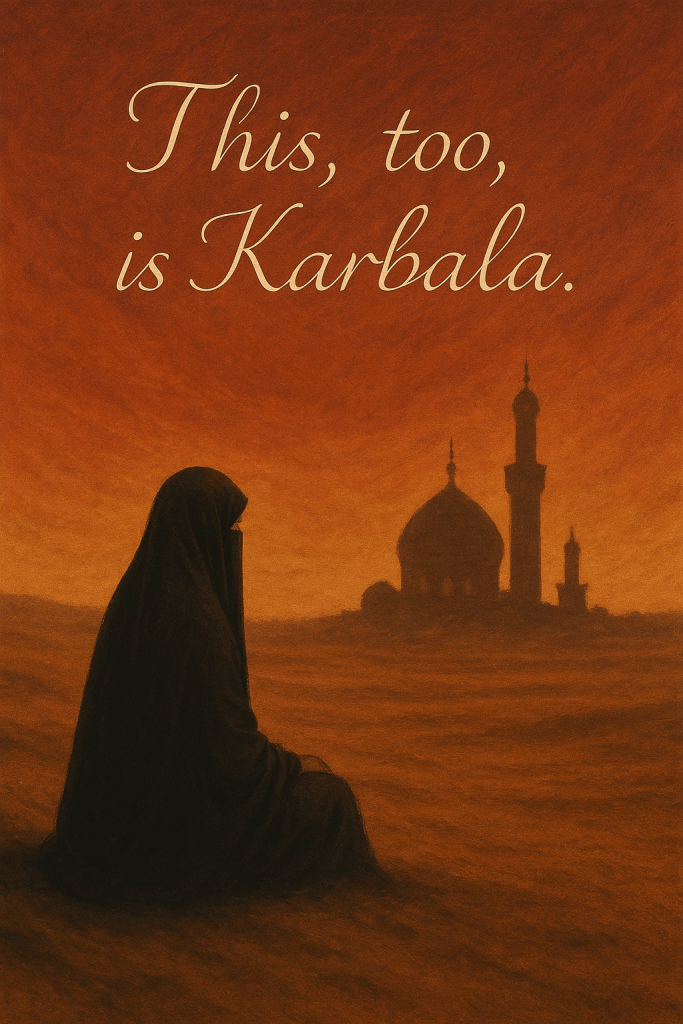
Karbala is not only a place.

It’s every moment I choose truth over silence,

faith over fear,

softness over survival mode.

This, too, is a battlefield.

And this Muharram, Karbala lives in me.

Reflections on Peace, Presence, and the Weight of Masculinity

There’s something I’ve been sitting with lately — a quiet shift in how I understand the role of men, especially within the home. It came from a tafsir I listened to recently. Not a dramatic revelation, just one of those verses you’ve heard a dozen times before… until it suddenly lands differently.

The verse was about Adam عليه السلام in Jannah.

But what struck me wasn’t the story — it was the structure.

Allah addresses Adam directly. He tells him to reside in Paradise, with his wife.

Not the two of them together.

Not a joint command.

The instruction is to him alone.

And the word used — uskun — isn’t just about living.

It’s rooted in stillness. In serenity. In sukoon.

It made me pause.

Because even in a place like Paradise — where peace is already a given — Allah still places the emotional tone of the home on the man.

It’s subtle, but it’s massive.

Before leadership, before provision, before family or tests or legacy — the first responsibility given to the man was to bring calm. Not to rule. Not to fix. Not to control. Just to be a presence of peace.

I keep coming back to that.

Because in this world we live in — full of noise, demands, overstimulation, emotional exhaustion — that responsibility becomes even more sacred.

But somewhere along the way, the definition of manhood shifted.

Now it’s often about dominance, performance, withholding.

Presence is rare. Peace, even more so.

And what I’m realising is: emotional maturity in a man isn’t something you “build together.”

It’s something you either witness in him — or you don’t.

He either brings sukoon into the space… or he brings disturbance.

There is no in-between.

And when he brings chaos? When you find yourself constantly managing, soothing, shrinking just to keep things together — that’s not your role. It was never meant to be.

We, as women, weren’t created to carry the emotional climate of the home alone.

We shift, we soften, we unravel and rebuild. That’s how Allah made us — in cycles.

But peace in the home? That isn’t our burden to bear.

Not entirely. Not always.

I’ve seen too many women asked to become the stillness and the structure — while the men around them remain emotionally unavailable, unaware, or even volatile.

And that tafsir reminded me:

That’s not how it’s supposed to be.

Peace is a man’s responsibility too — from the very beginning.

And if he hasn’t cultivated it within himself first, he has no business expecting partnership.

Because the kind of peace I want in my life isn’t performative. It isn’t external.

It’s something a man carries.

Something that shows in how he speaks. How he listens. How he responds in silence.

Something that cannot be faked.

And if he doesn’t bring sukoon, he doesn’t belong in that role.

It’s really as Simple as that.

This Muharram, I Choose to Live Authentically on the Haqq

This Muharram, I am not just making a promise — I am taking a stand.

A stand to live more authentically.

To walk with integrity.

To align my life with the Haqq — the Truth of Allah.

Authenticity, in its truest form, is not self-indulgence or rebellion. It’s submission. It’s aligning your soul with Divine truth, even when it hurts. Even when it costs you people, comfort, or belonging.

I’ve never really “fit in.” I’ve always stood out — but more importantly, I’ve always stood up.

I don’t turn a blind eye, not even to those closest to me.

Right is right. Wrong is wrong.

That’s something my parents instilled in me — a clear moral compass, no sugar-coating, no excuses, no loyalty to wrongdoing.

Just truth. Just justice.

And yes, it’s cost me friendships. People don’t always want truth — they want allegiance.

But you can’t be loyal to people and to truth when those two paths divide.

You have to choose.

This Muharram, I am choosing.

I am choosing to live like the Prophet’s family — the Ahl al-Bayt — who stood for truth even when they stood alone.

Who were not afraid to confront injustice, even when it came from within the ummah.

Who bore the weight of truth with grace and unshakeable resolve.

There’s a quote I carry in my heart:

“Stand for what is right, even if you’re standing alone.”

It has defined me for as long as I can remember.

And this year, it defines my path forward.

I no longer want to be around gossip, or people who thrive on low-vibrational energy.

If someone is comfortable gossiping to you, don’t think for a second they won’t gossip about you.

Authenticity requires discernment. And discipline.

So this Muharram, I walk forward.

Toward Allah.

Toward truth.

Toward a version of myself that fears no one but Him, and seeks no validation but His.

This Muharram, I am choosing to live upon the Haqq.

And I pray, by the end of this sacred month, I come out of it closer to Allah,

closer to Ahl al-Bayt,

and closer to who I was always meant to be:

authentic.

Unapologetically, faithfully, sincerely — for Him alone.

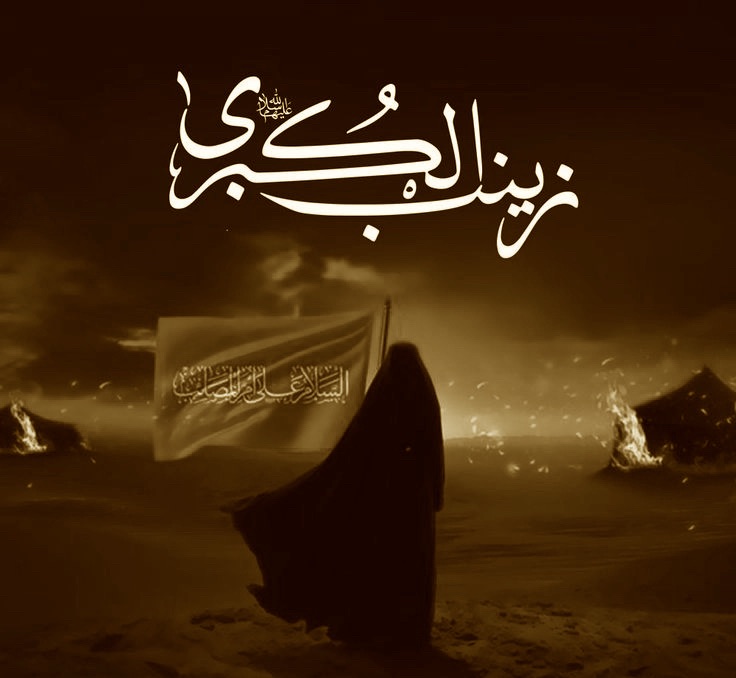
This Muharram, I remember her…

This Muharram, I remember her…

Zaynab, the daughter of Ali,

the echo of Fatimah,

the flame that did not flicker

even when the tents were burning.

She did not weep in defeat.

She wept as a witness.

She stood in the court of tyrants

not with fear,

but with fire.

And when asked what she saw that day,

what remained after Karbala,

she said:

“I saw nothing but beauty.”

So this month,

when my grief rises,

when the world feels heavy with injustice,

when loneliness settles on my skin—

I will think of her.

I will speak like her.

And I will remember:

Truth walks even when trembling.

Dignity survives even in chains.

And loyalty to Allah

is never lost.