Learning to Rest in What Is Written

This week has felt like a series of quiet but decisive curveballs, the kind that don’t arrive loudly but still manage to change the shape of things. My perception of certain people shifted almost overnight. It wasn’t dramatic, and it wasn’t fuelled by anger or hurt; it was simply clarity. I started to see people as they are, not as I hoped they might be, not as I had framed them through patience or loyalty or benefit of the doubt. And once that shift happened, there was no struggle in stepping back. It only took one moment of seeing clearly for something I had been holding to loosen its grip entirely.

People talk about 2025 as a year of shedding, of veils lifting, of cycles closing—the year of the snake, the year of truth surfacing. I remember reading those things with disbelief, dismissing them as pattern-seeking or spiritual trend language. There was one line in particular about relationships being revealed for what they truly were, about a long cycle ending, and I remember thinking, no, not this one, not now. But clarity doesn’t ask for permission. It arrives when it arrives, and once it does, there is no unseeing it. At the same time, there was another situation I had written off entirely, assuming it belonged to some distant “next year,” only to realise that timing, like everything else, has never belonged to me.

What surprises me most is not the events themselves, but where I am internally despite them. In the midst of disappointments, reversals, and uncomfortable truths, I have reached a place I used to dream about but never quite believed I’d inhabit. It isn’t enlightenment, and it isn’t numbness. It’s peace. A deep, anchored peace where what happens around me no longer disturbs my inner core. Not because I don’t care, but because I trust. Trust not in fate as randomness, not in “what will be, will be,” but in God—Allah—being fully in control. Trust that the outcome was never mine to orchestrate, only mine to walk through.

I may want things to unfold a certain way. I may believe an ending should look different, or that someone should choose differently. But everything happens for a reason, and more often than not, that reason is hidden from us. And that is where the beauty lies—not in knowing, but in trusting without knowing. In Islam, the word that comes close to this state is taqwa—not fear in the simplistic sense, but a deep God-consciousness, a reverent awareness that shapes how you move through the world. When you reach that state of trust, something else happens quietly alongside it: you begin to see people clearly. You recognise intentions before they are acted upon. You sense agendas without needing to confront them. And instead of trying to manage, correct, or save anyone, you let them walk their path.

Because it isn’t my role to guide people. The Qur’an is clear about this. “Indeed, you do not guide whom you love, but Allah guides whom He wills” (Surah Al-Qasas, 28:56). And elsewhere: “Allah guides whom He wills and misguides whom He wills” (Surah Ibrahim, 14:4). That truth removes such a heavy burden from the heart. People are not lost or found because of me. Their journeys unfold by divine decree. If someone is guided away from my life, that too is by the will of Allah. Everyone learns in their own time, and no amount of love, logic, or patience can force a lesson that isn’t ready to be received.

There’s a modern saying that people come into your life for a reason, a season, or a lesson—and while it sounds simplistic, it holds truth. Not everyone is meant to stay. Not every ending requires blame. Sometimes nothing “went wrong” at all. Sometimes it simply reached its appointed conclusion. And when you truly accept that, life becomes gentler. Loss no longer feels like failure. Distance no longer feels like rejection. It feels like alignment.

The greatest beauty is not just understanding this, but trusting it. Trusting that whatever enters your life and whatever leaves it was always meant to. Trusting that even when struggle returns—and it will, because struggle is part of being human—you now know how to find your way back to stillness. The lesson is never to avoid hardship, but to learn how not to live inside it.

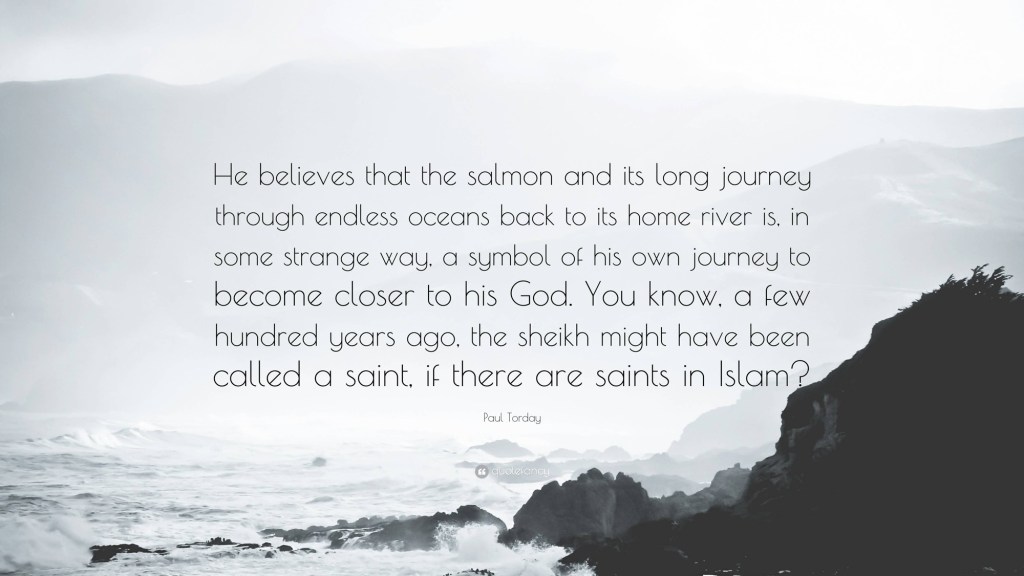
Salmon do not question why they must swim upstream, struggle against the current, fulfil their purpose, and then die. They do not resist their nature or argue with their design. It is written into their very being. And yet humans, gifted with awareness and faith, spend so much time questioning their own journey. Perhaps the question itself is the struggle. Perhaps peace begins when the questioning softens into acceptance.

Acceptance does not mean passivity. It means trust. And trust, I am learning, is the foundation of a peaceful life. A faithful life. A life that moves forward without needing to control every outcome. And I am deeply grateful to be standing in that place now, even knowing I may stumble out of it again, because I finally know the way back.

Rethinking the Sunnah: Qur’anic Guidance vs. Popular Understanding

Today, many Muslims understand the Sunnah as a set of precise rituals and practices reported in Hadith collections. Following it often means replicating specific numbers of rakʿah, performing ablution in exact detail, or imitating minute aspects of the Prophet Muhammad’s ﷺ daily life. For many, failure to observe these practices is feared as deviation or even as risking punishment in the Hereafter. This focus on outward conformity and ritual correctness often overshadows the deeper purpose of worship: sincerity, reflection, and connection with God.

Yet the Qur’an presents a fundamentally different understanding. It frames the Sunnah not as posthumously recorded rituals, but as the Prophet’s example in conveying God’s message and embodying moral and spiritual guidance. In Qur’an 33:21, we are told: “Indeed, in the Messenger of Allah you have a good example for anyone whose hope is in Allah and the Last Day and who remembers Allah often.” The emphasis here is on ethical and spiritual conduct, character, and the remembrance of God, not on replicating actions from centuries-later reports. Similarly, Qur’an 3:164 highlights the Prophet’s role: “Indeed, Allah conferred a favor upon the believers when He sent among them a Messenger from themselves, reciting to them His verses and purifying them and teaching them the Book and wisdom.” His mission was to teach, convey, and embody the Qur’an, not to codify rigid rituals.

The Qur’an also emphasizes reflection and knowledge-seeking. “Do they not reflect upon the Qur’an, or are there locks upon [their] hearts?” (Q 47:24) and “My Lord, increase me in knowledge” (Q 20:114) encourage believers to think critically, engage with scripture, and seek understanding. Applying this principle to ritual practice means questioning inherited customs when they are not clearly grounded in the Qur’an. Reflection and understanding, not blind imitation, are at the heart of true worship.

Prayer itself exemplifies this. The Qur’an specifies times to pray—Fajr at dawn (Q 24:58, 17:78), the middle of the day (Q 2:238), and night prayers (Q 11:114, 17:78)—and describes the actions involved: standing (qiyām, Q 3:39, 73:1–2), bowing (rukūʿ, Q 3:43, 22:26), prostrating (sujūd, Q 96:19), and reciting what is manageable (tilāwah, Q 73:20). Ablution includes washing the face and arms, wiping the head, and wiping the feet (Q 5:6). Nowhere does the Qur’an mandate specific numbers of rakʿah. The Prophet ﷺ, whose mission was to convey this guidance, did not dictate rigid cycles or posthumous rituals. His example shows that heart, intention, and sincerity matter far more than mechanical imitation; when companions attempted to follow him in his private night prayers, he told them to pray at home instead, prioritizing devotion over replication.

Despite this clarity, Hadith collections, compiled 200–300 years after the Prophet, record various numbers of rakʿah and specific procedural details. While historically interesting, these reports are not definitive proof of divine command. Differences in transmission, memory, and regional practices make them unreliable as absolute law. Yet today, many treat them as binding, believing that repeating these numbers guarantees correctness and reward, and that failure to follow them risks punishment in the Hereafter, including burning in Jahannam. This focus on rote performance shifts the essence of worship from sincerity, reflection, and connection with God to fear and ritual compliance.

The contrast is clear: popular understanding equates Sunnah with Hadith-derived rituals and legalistic forms, whereas the Qur’an presents the Sunnah as the Prophet’s ethical, moral, and spiritual guidance. Respecting the Prophet ﷺ, in the Qur’anic sense, means following the guidance he was sent to deliver, embodying his character, and living by the Qur’an, not mechanically imitating centuries-later reports. This approach does not disrespect the Prophet; on the contrary, it honors his mission, aligns with divine instruction, and ensures worship remains living, meaningful, and spiritually grounded.

Ultimately, the Qur’an provides all that is necessary: knowledge of when to pray, how to stand, bow, prostrate, purify, and recite, combined with sincere focus on God. Anything beyond this—fixed numbers of rakʿah, formalized sequences, or strict reliance on Hadith for guidance in matters the Qur’an already addresses—is human interpretation, not divine prescription. True adherence to the Sunnah is found in following the Qur’an fully while embodying the Prophet’s moral and spiritual example, seeking knowledge, reflecting, and maintaining presence in all acts of worship.

People Have Reduced a Living Spiritual Act to a Ritualistic Motion

Oh this seems to be a hot topic of late and a question I’ve found myself asking over the last few months I’ve been absent but with more enquiry as to why as after all Qur’an 47:24 – “Do they not reflect upon the Qur’an, or are there locks upon [their] hearts?”

Therefore I shall begin: Bismillah

Many Muslims today ask, “How many rakʿah should I pray?” This question, repeated so often, points to a deeper issue: a failure to read and understand the Qur’an in its entirety. The Qur’an itself provides guidance on prayer, detailing when to pray, how to pray, and how to purify oneself, without ever specifying a fixed number of rakʿah for any prayer.

The Qur’an clearly identifies prayer times:

   •   Fajr (dawn) – Q 24:58, Q 17:78

   •   The middle of the day – Q 2:238

   •   Night prayer – Q 11:114, Q 17:78

It describes the movements: standing (qiyām, Q 3:39, 73:1–2), bowing (rukūʿ, Q 3:43, 22:26), prostrating (sujūd, Q 96:19), and reciting what is manageable (tilāwah, Q 73:20). Ablution is prescribed: wash the face and arms, wipe the head, and wipe the feet (Q 5:6). Everything necessary for worship is there.

Nowhere does the Qur’an mandate a fixed number of rakʿah. And the Prophet ﷺ, whose role the Qur’an makes clear was to convey and exemplify the message of God, never instructed a specific number of cycles. His purpose was to deliver the Qur’an, to live its ethical guidance, and to show mercy and humility—not to invent or codify rigid ritual forms. Following the Qur’an fully is therefore not contrary to following the Prophet; it is precisely what his mission was about.

Some argue that to disregard hadith is to disrespect the Sunnah of the Prophet. However, the Qur’an itself defines his Sunnah as his example in transmitting the revelation and embodying its moral and spiritual teachings (Q 33:21). Honoring him means following this example, living his teachings, and acting with humility, patience, and sincerity. It does not require uncritical adherence to posthumously compiled reports, particularly when they prescribe details absent from the Qur’an.

The hadith literature, compiled 200–300 years after the Prophet, records various numbers of rakʿah for different prayers. While these narrations reflect historical practices, they are not definitive proof that the Prophet mandated specific ritual units. Differences in transmission, memory, and regional practice make them unreliable as absolute law. Yet today, many treat them as binding, believing that repeating these numbers guarantees correctness and reward, and that failing to follow these prescribed numbers—or ignoring hadith guidance—puts them at risk of punishment in the Hereafter, of burning in Jahannam. In doing so, the focus shifts from sincerity, presence, and reflection—the very essence of prayer according to the Qur’an—to rote performance.

The Prophet’s guidance further illustrates this. When companions tried to follow him in his private night prayer, he told them to pray in their homes, showing that external imitation was not required; sincere, conscious devotion mattered most. This example aligns with the Qur’anic principle that true worship is about the heart and intention, not ritual repetition.

Ultimately, the obsession with counting rakʿah reflects a misunderstanding of worship. The Qur’an provides all the instructions needed: know the times, stand, bow, prostrate, purify, recite what is manageable, and focus your heart. Sincerity, reflection, and presence are the core. Everything beyond this—the fixed numbers, the formalized sequences, the reliance on later narrations—is human interpretation, not divine prescription. Respecting the Prophet means returning to the guidance he was sent to deliver—the Qur’an itself—while embodying his ethical and spiritual example.

Gentle reminder

Just a gentle reminder to those who understand that life is about evolving

It’s okay if you are feeling unsure

You are learning and growing

The Awakening of Hearts and the Returning of Souls

Right now, it feels as if the planet itself is stirring. With the pain of Gaza and Palestine etched into our collective consciousness, humanity is shifting — transforming — and that transformation is neither neat nor easy. It rises and falls like breath: expansion follows contraction, ease follows hardship. Allah Himself tells us, “Indeed, with hardship comes ease.” (Qur’an 94:6). This is His rhythm, built into the fabric of creation.

We, as souls in human form, are part of this unfolding. Awakening is not a straight line; it is a cycle of softening, stretching, and surrendering. Something must end for something else to begin — and surrender is the doorway. For some, it is surrender to the unknown. For us, it is surrender to Allah, the One who created our hearts and wrote their stories long before they beat within our chests.

This surrender is a kind of rebirth — not a return from a previous human body, but the awakening of our souls into a deeper life, the life they were always meant to live. It is what Hasrat Inayat Khan described: “There can be no rebirth without a dark night of the soul, a total annihilation of all that you believed in, the thought that you were.”

In Islam, this annihilation is not destruction but tazkiyah — the purifying of the soul so that it can return to its original clarity.

In Islam, we believe our souls knew Allah before we came here. We stood before Him and bore witness: “Am I not your Lord?” They said, “Yes, we have testified.” (Qur’an 7:172). Deep inside, this covenant lives within us still. This is why returning to faith feels less like learning something new and more like coming home. It is a remembrance, not an introduction.

The “awakening” we feel now — in our minds, hearts, and bodies — is the echo of that primordial knowledge stirring awake.

As our hearts open, stretch, and soften, something remarkable happens: we begin to see the hearts of others more clearly. We feel their pain, their beauty, their longing.

This openness is not always gentle — it can be a cleansing, a falling away of what is not rooted in love, mercy, and truth. Yet through that cleansing, we touch the powerful force that underlies everything: Allah’s mercy, His love, His light.

Some of us will taste moments of peace and bliss in this stage of awakening. Others will feel the “dark night” of the soul — the painful unravelling of old illusions. Both are signs of transformation. Both are invitations to draw nearer to Allah.

We are not merely physical bodies, nor only spiritual ones; we are a weaving of both, designed to awaken. And right now, as the world shakes off an unconscious trance and begins to open its eyes, our task is to remember: this is not a new reality, but the deeper reality our souls already knew.

To awaken is to remember. To transform is to surrender. And to surrender is to return — always — to Allah, the Home our souls have known from the very beginning

Living Miracle

The Living Miracle

“The Qur’an is a living miracle — still challenging hearts and minds today through its timeless ability to awaken faith and conviction.”

Revealed over fourteen centuries ago, the Qur’an remains untouched, unmatched, and undefeated. No word has been altered, no verse replaced, and no human being has ever risen to meet its challenge. Its language is both eternal and near — immutable in perfection, yet accessible to every sincere seeker.

What makes the Qur’an unlike any other text is that it speaks to the soul as much as to the intellect. Its verses move with the rhythm of truth — at once a warning and a healing, a command and a comfort. Its language carries divine precision; every letter placed by the One who knows the depths of the human heart.

And as humanity grows in knowledge, the Qur’an unfolds still deeper layers of meaning. Its verses remain the same, yet their wisdom expands — revealing new signs, softening hearts once hardened by pride, and guiding minds once lost in confusion. It is not bound by time or culture; it meets every generation anew, whispering the same message: Return to your Lord.

The Qur’an transforms those who open themselves to it. Its recitation soothes the restless heart, its reflection humbles the intellect, and its commands illuminate the path of righteousness. It awakens the sleeping soul — reminding us that faith is not inherited but discovered, not memorised but lived.

To hold the Qur’an is to hold a living conversation with Allah — a miracle in sound, meaning, and mercy. It does not age. It does not fade. It continues to breathe life into hearts willing to listen.

For the Qur’an is not merely a book to be read, but a light to be lived by — a divine miracle that still speaks, still challenges, and still transforms.

Taqwa — The Awareness That Awakens the Heart

Taqwa is the essence and purpose of faith — the awareness of Allah in every moment, every thought, and every choice. It is knowing that He sees, hears, and knows everything — even the most hidden corners of our hearts. This awareness is what guides our actions, shapes our character, and anchors our souls.

Taqwa is not merely the avoidance of sin; it is the conscious effort to seek what pleases Allah. It means acting with intention — obeying, worshipping, and striving for His approval — not out of fear of punishment alone, but out of love, reverence, and hope in His mercy.

It is the balance between hope and fear: hope in Allah’s infinite compassion that draws us nearer, and fear of His displeasure that guards us from heedlessness.

Taqwa is the fruit of faith — the proof that belief is real and alive. True faith is not confined to words; it breathes through our actions and transforms our hearts. A person with taqwa aligns their heart, mind, and deeds with divine guidance, walking gently but firmly upon the path of truth.

So how do we develop taqwa?

We begin with knowledge — gaining understanding of Allah, His names, His attributes, and His commands in the Qur’an and Sunnah.

We deepen it through reflection (tafakkur) — observing the signs of Allah in creation and within ourselves, recognising His provision and mercy in every detail of our lives.

We nurture it with worship and patience — through prayer, fasting, charity, and consistent acts of devotion that keep the heart connected to Him. Small and sincere deeds build the strongest foundations.

We sustain it through remembrance (dhikr) — repeating the words SubhanAllah, Alhamdulillah, La ilaha illallah until they soften our hearts and quiet the noise of worldly distractions.

And we purify it through repentance and self-correction — turning away from sin, acknowledging our shortcomings, and returning to Allah with humility and hope.

The signs of taqwa appear in the quiet choices we make: when we choose right over wrong, when we feel peace in obedience, and when we feel unease in the face of sin. It is found in preferring Allah’s pleasure over societal approval, material comfort, or fleeting desires.

Taqwa is God-consciousness in thought, word, and deed.

It is the living pulse of faith — the awareness that keeps the heart awake, humble, and steadfast upon the path to Allah.

The Rhythm of Divine Mercy

Today, while studying the Qur’an, I was reading through Surah Al-Baqarah, 2:25, and I came across something that sparked deeply within me — almost like a divine connection. I realised that Surah Ash-Sharh (94:6) and Surah Al-Baqarah (2:25) are intimately connected.

Surah 94:6 describes the rhythm of Divine Mercy — the ease intertwined with hardship — when Allah says, “Indeed, with hardship comes ease.” And Surah 2:25 shows the fruit of that very rhythm: a heart that becomes like a garden, nourished from within because it trusts in Allah’s promise and continues doing good.

Every time you believe despite fear, every time you act righteously despite pain, you are watering that inner garden Allah has promised you. That is the ease within hardship — the beginning of Paradise already growing in your heart.

This rhythm is how Allah nurtures the heart: hardship humbles, purifies, and turns us toward Him; ease restores, heals, and allows the soul to breathe again. Both movements are part of the same Divine breath — the gentle rhythm through which Allah brings the believer closer to Him