As the days of Ramadan draw to a close, I find myself pausing, reflecting on where I stand in this moment. This sacred month has been a time of peeling back the distractions of life, of drawing nearer to You, of recognizing the depths of my own heart. And now, as the final moments approach, I turn to You—my refuge, my guide, my beloved Allah.
Ya Rab,
I am deeply aware that all I have is today. You alone know whether I will witness another sunrise, whether my soul will be granted another chance to worship You in this world. Grant me the wisdom to cherish each day as it comes, to embrace it with gratitude, to use it in a way that pleases You. If my time should come, take me when my heart is pure, when my deeds are at their best, when my soul is closest to You.
Ya Allah, forgive me. For the times I let my mind drift away from You, for the moments I allowed this temporary world to distract me from what truly matters. Forgive me when I forget, when I falter, when I fall short of the devotion You deserve. When I stray, bring me back. When I hesitate, strengthen me. And when I feel lost and uncertain, wrap me in Your mercy and guide me back with clarity and grace.
I long to be among those dearest to You. To have a heart filled with unwavering trust that You are always near, always watching, always leading me toward what is best. I see so clearly the shifts I need to make, the presence I need to cultivate, the sincerity I must deepen. Ya Wadud, Ya Rahman, Ya Raheem—fill me with a love so pure that my greatest concern is the state of my soul and my closeness to You.
Let my worship be more than routine—let it be the truest expression of my devotion. Let my prayers be more than words—let them be the outpouring of a heart that longs for You. Let me bow before You not out of habit, but out of love, out of recognition that there is no greater purpose in my existence than to seek You. And when I find myself at a loss, unsure of how to move forward, uncertain of what needs to change—show me the way. Open my eyes to what must be refined, to what I must let go of, to what will bring me nearer to You.
I know this path will never be smooth. There will be obstacles, tests, moments of struggle. But in every hardship, in every moment of doubt, remind me that You are always with me. Let me hold onto that truth as my greatest strength.
For as long as I live, as long as I breathe, as long as I am gifted with time—grant me deep, unwavering awareness of You. Let my life be a reflection of my devotion to You, my days a testament to Your presence, my heart a home for Your love.
Ya Rab, let me live for You. Let me return to You in the best of states. Let me belong to You, in this life and the next.
Today, I felt truly honored. A friend of over ten years reached out to me, seeking guidance about her daughter and Islam. It was a deeply humbling moment—one that made me reflect on my own journey, how far I have come, and how much Islam has transformed my life. If you had told me years ago that I would one day be a Muslim, I would have laughed.
The life I once lived—the nightlife, the wild experiences, the world I was immersed in—felt a million miles away from the path I now walk. But Allah chooses His reverts, and I have never felt that truth more deeply than in my own life.
My journey to Islam began in the quiet of my own bedroom, on my knees, in the final months of 2020, as the world was shutting down. I didn’t have a prayer mat; instead, I used a pashmina scarf spread out on the floor. I had no abayas, no proper hijabs—only the guidance of a few sisters in online groups that, sadly, no longer exist. Those sisters were my only source of community in the beginning, and I now understand just how vital support is for new reverts. I was completely alone in my faith, but I was driven by the need to pray, to connect with Allah, to find the peace I had long been searching for.
The journey hasn’t been easy. Every day I step outside in my hijab, I feel the weight of it—not just on my head, but in my identity. As a revert, the struggle with hijab is real. I still battle with it, even now. I’m not a girly girl; I would much rather throw on jeans and a big jumper than wear an abaya. But wearing hijab means owning the identity of being Muslim, and that can be daunting in today’s society. Recent events—the Southport riots, the accusations, the way the world turns to blame Muslims—have made it even harder. When I reverted, I didn’t sign up for that burden, but it became mine to carry, just as it is for every Muslim. We bear it for the sake of Allah, and we bear it together.
For a long time after reverting, I struggled with the complexities of Islam. I had entered the faith thinking it was one unified way of life, only to discover a minefield of opinions, sects, and interpretations. Like many reverts, I initially followed the Sunni path. I studied their scholars, their hadith, their way of praying. But the deeper I delved, the more unsettled I became. Certain hadiths, even those in Sahih Bukhari, did not sit right with me. I kept asking myself: Is this Islam? And if it was, why did parts of it feel so out of place?
Then I started reading about the Ahlul Bayt, the family of the Prophet (peace be upon him). I learned how they were treated after his death, the injustices they suffered at the hands of those who claimed to follow him. That was the moment of certainty for me—the stamp that sealed my heart as Shia. Once you have seen the truth, you cannot unsee it. If someone told you Saturn had no rings, but then you looked through a telescope and saw them with your own eyes, there would be no denying it. That is how I feel about being Shia.
When I read about what happened to the Prophet’s family, I knew I could never hold in high regard those who had oppressed them. There is no justification for it. None. And my iman could never be at peace until I stood firmly on the side of truth.
But Islam is not just about theology—it is about character. A person of true faith does not deceive, oppress, or harm others. The way the Ahlul Bayt were treated was the greatest betrayal of character, and that alone is proof enough for me. Good character does not harm the beloved family of the Prophet. And so, my heart found its home in the path of the Ahlul Bayt.
Now, as an older revert, I see things differently than I did when I first embraced Islam. I no longer feel the pressures that younger reverts do—the rush to marry, the fear of being alone, the overwhelming burden of fitting in. My only focus now is on my Akhira, my connection with Allah, and my personal growth in the faith.
Marriage is not a priority for me. I have seen too many sisters and brothers rush into it, only to find themselves trapped in abusive relationships under the false belief that they cannot leave. Divorce is not shameful in Islam, yet so many women are made to believe they must endure suffering in silence. I will not be one of them. I have been married before, and I know the weight of that commitment. If I ever choose marriage again, it will be because it genuinely benefits my deen and outweighs my peace that I find alone with Allah —not because of societal pressure.
One of the biggest struggles I face as a revert is holding onto my own identity. In many revert communities, there is an expectation that once you revert, your children must revert too—that you must drag them into Islam whether they are ready or not. But there is no compulsion in Islam. Allah chose me, not my children. If they come to Islam, it must be by their own free will, not because I forced it upon them. And so, my life is unconventional. My children still celebrate their own beliefs, and I support them in doing so. From the outside, it may look like I live a dual life, but this is the balance I have chosen. It is a test of my character, a test of my iman, and I pass it every single time.
Ours may not be a traditional Muslim household, but it is built on love, respect, and understanding. I remain steadfast in my faith, my sakina, and my devotion to Allah subhanahu wa ta’ala, while still allowing my children the freedom to walk their own path. And that, for me, is the ultimate testament of faith—not to force, but to lead by example.
This is my journey, my struggle, my truth. And Alhamdulillah, I wouldn’t change a thing.
I have been thinking about sound. Not just the sounds we hear, but the frequencies that exist beyond our perception—the ones that hum beneath the surface of existence, the ones that hold everything together.
If Allah created the heavens and the earth with precision, then surely, He also created the vibrations that move through them.
It is said that everything in creation glorifies Allah, even if we do not understand how.
“The seven heavens and the earth and whatever is in them exalt Him. And there is not a thing except that it exalts Allah by His praise, but you do not understand their [way of] exalting.” (Surah Al-Isra 17:44)
I wonder—could it be that this unseen dhikr is woven into the very fabric of the universe? That the planets, the stars, the waves of the ocean, even the beating of our own hearts, all resonate with the remembrance of their Creator?
That when we feel peace in the presence of certain sounds, it is not mere coincidence, but rather, a moment of realignment with what was always there?
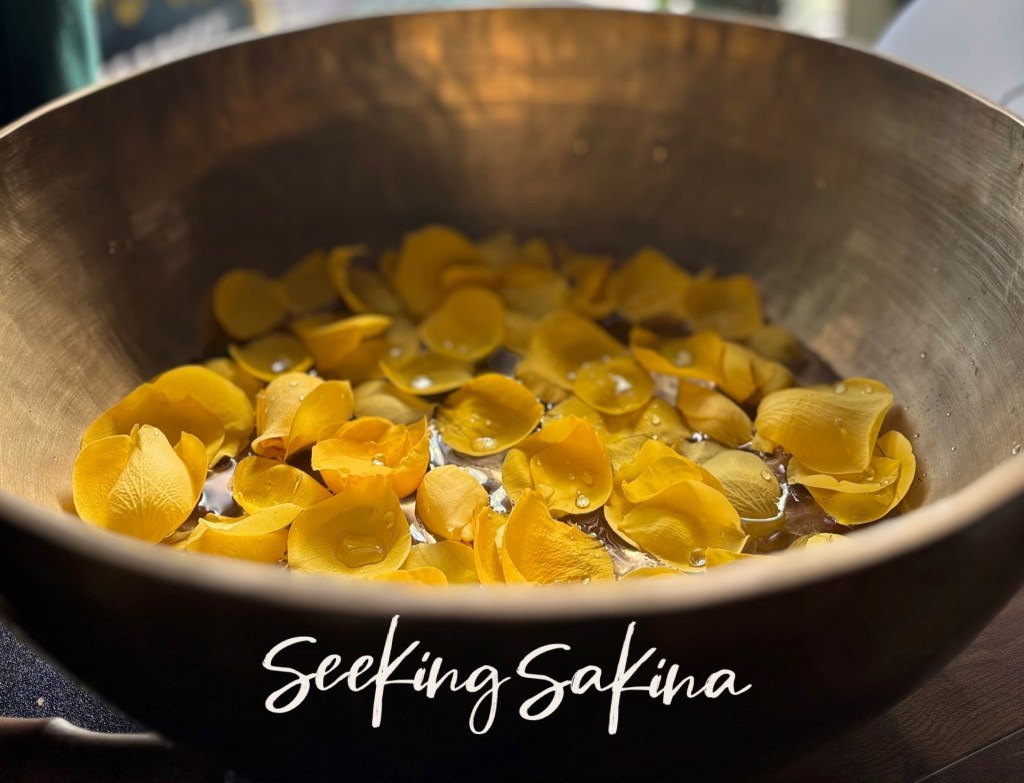
I was a sound therapist. I have witnessed firsthand how vibrations can settle the restless energy inside a person, how a single note from a singing bowl could feel like it was unraveling tension they didn’t even know they were holding.
I never hesitated in my belief that sound had the power to heal—until I came to Islam. Only then did I begin to doubt, wondering if this was something outside of my faith. I put my sound therapy practice to one side, believing it was going against the will of Allah.
But now, I wonder—was that truly the case?
Science tells us that sound is not just something we hear—it is something we feel. Everything in existence vibrates at a frequency, from the smallest atom to the vast expanse of the cosmos. NASA has recorded the “songs” of planets, electromagnetic frequencies emitted by celestial bodies that echo through space. The Earth itself has a natural frequency known as the Schumann Resonance, measuring around 7.83 Hz, which some researchers believe has a calming effect on the human body.
In the study of cymatics, we see that sound has the power to shape matter—when specific frequencies pass through a medium like water or sand, they create intricate geometric patterns, almost as if sound is revealing the hidden design of the universe itself. These same frequencies, in varying forms, are used in sound therapy today, as Tibetan bowls, tuning forks, and even the human voice produce vibrations that bring the body into harmony.
If these frequencies exist throughout creation, if they are found in the pulse of the universe, then surely they are not separate from Allah’s design. Allah created everything. If He fashioned the universe with sound, if He commanded creation with a word
“Kun, fa-yakūn” (Be, and it is) [Surah Yasin 36:82]
then surely, these vibrations are part of us. Part of the divine order He set in motion.
Even the recitation of the Quran carries a frequency. Science has shown its rhythms can regulate the heart, calm the mind, and bring stillness to the soul. This is not separate from what I once felt in sound therapy—it is the highest form of it. Perhaps all the healing I was searching for existed in what was already given.
Now, I see sound differently. I do not see it as something mystical or beyond my faith, but as a thread in the vast, intricate tapestry Allah has woven. A whisper of the unseen dhikr that everything in creation sings.
And perhaps, when we hear a sound that soothes us, when a vibration feels like it is pulling us into stillness, it is not just a sound. It is a reminder. A moment where we unknowingly join in the cosmic dhikr that has been happening since the beginning of time…..
O Fatima (AS), the radiant light in a world of shadows, the purest soul to ever grace this earth. You were the warmth in the Prophet’s (PBUH) home, the solace in his sorrow, the embodiment of love, patience, and grace.
You, whose hands knew only kindness, whose heart held no malice, who gave and gave, even when there was nothing left to give. Your gentleness did not waver, even in the face of cruelty. Your forgiveness knew no bounds, even when wronged. Your strength was unshaken, yet your nature was softer than the morning breeze.
O daughter of the Messenger (PBUH), wife of the Lion of God (AS), mother of the Princes of Paradise (AS), you were justice wrapped in mercy, humility clothed in dignity. The world could not contain your purity, nor could time diminish your light.
And when I remember you, O Fatima (AS), my tears fall—not from sorrow, but from love and awe at the purity of your soul
And when the gates of Jannah open, when the blessed stand in eternal light, the heads will lower in reverence as you walk past, O Mistress of Paradise. Even the angels will step aside, for the daughter of Muhammad (PBUH) has arrived.
O Fatima (AS), my heart finds peace in your name, my soul longs for your nearness. You are the light I follow, the love I hold, the prayer upon my lips.
May I walk in your footsteps, if only by a whisper of your grace.
Du’a is more than just asking Allah for things—it’s a conversation, a connection, a sign that we know He is near. It is an act of faith, trust, and love. Across different beliefs, people call it different things—prayer, manifesting—but for us, it is du’a. And it is everything.
How we make du’a matters. It’s not about wondering if Allah will respond, but knowing when. It’s about asking with full certainty that He hears us, that He is close. Allah Himself tells us:
“And when My servants ask you about Me, indeed I am near. I respond to the call of the supplicant when he calls upon Me. So let them respond to Me and believe in Me that they may be guided.” (Qur’an 2:186)
He wants us to call upon Him. He is Al-Mujeeb, the One who responds. But do we truly believe that when we make du’a? Or do we hesitate, unsure if we are worthy of an answer? Do we make du’a as though we are speaking into an empty space, or do we call upon Him with the certainty that He is already preparing something for us?
Du’a isn’t just about words—it’s about the heart behind them. If we sit there reciting memorized supplications without feeling them, how can we expect them to change our hearts? Allah doesn’t just listen to our words; He listens to our souls. “He knows what is in every heart.” (Qur’an 67:13) So when you make du’a, be real. Be raw. Tell Allah everything—your hopes, your fears, your struggles, your dreams. Du’a isn’t a ritual; it’s a relationship. And like any relationship, it grows deeper the more you nurture it.
This connection with Allah isn’t just for the “perfect” Muslim. It’s for everyone. For the one who prays five times a day and for the one trying to find their way back. For the one who feels close to Allah and for the one who feels lost. The only thing that matters is sincerity.
In Shia teachings, du’a is described as “the weapon of a believer,” “the best worship,” “the light of the heavens and earth,” and “the key of divine mercy.” It is considered a means for increasing one’s sustenance and repelling afflictions. The Imams of Ahlul Bayt (peace be upon them) have instructed people to constantly pray to Allah and to rely upon Him, emphasizing the power of du’a in transforming one’s life.
Imam Ja’far al-Sadiq (peace be upon him) said: “Dua stops the divine decree (qada’) after it comes down from heaven and is firmly determined.”
He also said: “Continue making du’a, for indeed it is the key to every mercy and the fulfillment of every need.”
Imam Ali al-Ridha (peace be upon him) emphasized the virtue of private supplication, stating: “One du’a in private is better than seventy du’as recited openly.”
And du’a isn’t just for the big moments in life. It’s for the small, ordinary ones too. When we wake up, when we eat, when we step outside, when we’re nervous, when we’re excited. The more we turn to Him, the closer we feel to Him. And the more we call upon Him in the quiet moments, the easier it becomes to rely on Him when life feels overwhelming.
As Ramadan draws to an end, these last ten nights are a reminder to make du’a deeply, sincerely. To ask for everything—big or small—without hesitation. Laylatul Qadr, the Night of Decree, is the night when destinies are written. What better time to pour our hearts out to Allah?
We often worry about whether our du’a will be accepted. But our biggest concern shouldn’t be if Allah will answer—it should be whether we continue making du’a at all. Because the ability to make du’a is a sign that Allah is guiding us back to Him. “Call upon Me; I will respond to you.” (Qur’an 40:60)
So, don’t hold back. Speak to Him. Ask from Him. Come to Him exactly as you are. Because He is always near.
Ramadan is the month where we rediscover the vastness of Allah’s mercy. It is a time when the heart softens, the soul awakens, and we are reminded of what truly matters. Al-Karim—The Most Generous—gives us this blessed month not just as a season of worship, but as a season of hope. He is the One who gives without limit, who provides even when we do not ask, and who opens doors for us when we least expect it. Ramadan itself is a manifestation of His generosity—He grants us this sacred time as an opportunity to return to Him, to seek His mercy, and to renew our hope. Because hope is what brings the sweetness to this dunya. It is what keeps us alive when so much around us, and sometimes within us, feels like it is dying.
Hope in Allah is not passive—it is meant to be lived. The one who has tawakkul (trust in Allah) knows that true reliance is followed by action. “Whoever expects to meet his Lord—let him do righteous work and not associate anyone in the worship of his Lord.” (Qur’an 18:110). This expectation, this longing, is the very essence of hope. To do, to move, to act, believing that one day, insha’Allah, you will have done enough to meet your Beloved.
We hope for our sins to be forgiven. We hope that our salah, our fasting, our du’as—our efforts, however small—will be accepted. We hope for healing when our loved ones are sick, for relief when our hearts are burdened, and for guidance when we feel lost. And we hope for the genocide in Palestine to come to an end, for the suffering of our brothers and sisters to cease, for the oppressed to taste justice, and for the people of Palestine to live in peace. But hope is not just a feeling—it is a call to action. It is boycotting, protesting, speaking out, giving, and refusing to be silent. It is doing what we can with whatever is in our hands while knowing that ultimate victory belongs to Allah.
And yet, we forget. We forget the times when hope carried us through, when Allah answered in ways we never imagined. Time moves so fast—the days feel long, but the years slip away. And quite often, despair creeps in because we fail to remember the hope that once saved us.
This is why hope must be renewed. It must be active, just as our trust in Allah must be active. We say to Him: Ya Allah, I hand over the keys to my life to You. Whatever You will, I know it is best for me. And then, we carry on. Because hope is the other wing of that bird. Ibn al-Qayyim beautifully said that a believer is like a bird flying toward Allah—love is its head, and fear and hope are its two wings. If either wing breaks, the bird cannot reach its destination.
And so, as Ramadan nears its end, we are left with a simple truth: We are all hoping to reach it again, just as we once hoped to reach it this year. But we hope not just because we long for another Ramadan, but because we place our trust in Al-Karim—The Most Generous—who never leaves a sincere effort unrewarded. He is the One who grants us the ability to hope, who reassures our hearts, and who reminds us that as long as we turn to Him, no situation is hopeless.
“When He decrees a matter, He only says to it, ‘Be,’ and it is.” (Qur’an 2:117)
As I reflect on my journey, now in my 50s, I find myself thinking deeply about dreams—those I’ve pursued, those I’ve sacrificed, and those still waiting to unfold. Much of my life has been dedicated to others, to responsibilities that shaped me in ways I never expected. And yet, I wonder: what about the dreams that still stir within me?
Life doesn’t always take us where we imagined. We make plans, we set goals, but Allah’s wisdom often leads us down paths we never anticipated. At times, it’s easy to feel like we’ve missed opportunities, that we lack the confidence or motivation to chase something new. But Allah is Al-Kabir, The Greatest—greater than our fears, greater than our self-doubt, greater than the obstacles we perceive. If He wills something for us, no force can stand in its way.
I’ve come to realize that every experience, every skill, every hardship has been a lesson. Perhaps the direction we seek has been unfolding all along, through the knowledge and strengths we’ve gained. Rather than lamenting what didn’t happen, we should embrace what we have been given and channel it into something meaningful. New dreams are always possible, so long as we trust in the One who shapes our destinies.
So I remind myself: turn to Him. Seek His guidance. If a dream is meant to be, He will bring it to life in the right time and in the right way. And if not, then He will redirect us to something even greater—something we may not yet understand, but something that is undoubtedly written for us with His infinite wisdom.
On what could have been one of the nights of Laylatul Qadr, I had my own intentions set. I had planned to immerse myself in du’a, dhikr, and the recitation of the Quran, hoping to make the most of a night where every moment carries the weight of a thousand months. But before the evening even arrived, I was struck—suddenly and mercilessly—by chronic pain, dizziness, and a migraine so intense that it left me unable to do anything but lie there in the dark, eyes shut, body heavy with exhaustion.
It feels as though this Ramadan has tested me at every turn, challenging not just my physical endurance but my faith itself. And yet, each test has forced me—driven me—to seek out new ways to connect with Allah. Even as I lay there, unable to stand in prayer or hold the Quran in my hands, I found solace in the quiet whisper of dhikr. My lips moved in remembrance. My heart reached out in du’a. And in that moment, I realized: He was still there.
“And We have already created man and know what his soul whispers to him, and We are closer to him than his jugular vein.” (Quran 50:16)
I finally understood this verse—not just with my mind, but with my entire being. Even in my weakness, even when I could do nothing but endure, He is near. Not just when I am bowed in sujood or standing in prayer, but in my suffering, in my stillness, in my silence. Just as He was there in 2022, when I lay in intensive care, He is still here now.
And maybe, just maybe, one of His angels has been watching over me all along. Perhaps one of those Mu’aqqibat, the angels who guard by Allah’s decree, was also present today—just as they were before, just as they always have been.
On these sacred nights of Laylatul Qadr, I turn to You with a heart full of gratitude and longing. You have shaped my journey with experiences that have left an imprint on my soul, and You have blessed me with skills and abilities that I know are not by chance—they are Your trust upon me.
Ya Allah, I ask You to guide me toward a life of purpose, to align my will with Yours, and to use everything You have given me—my talents, my struggles, my dreams—for the service of those who need it most. The street children whose eyes have spoken to my heart, whose pain I have witnessed, and whose lives have forever changed me—Ya Allah, let me be a means of comfort, hope, and love for them.
Make this dream of mine a reality, not for my sake, but for Your sake. Grant me sincerity, steadfastness, and the ability to serve without ego or hesitation. Provide me with the resources, the strength, and the wisdom to build something lasting—a charity, a home, a sanctuary—whatever form You will it to take.
Ya Rabb, just as You placed this love for these children in my heart, allow me to act on it in the best way. Remove all barriers, open doors of opportunity, and surround me with people who will help fulfill this mission. Make this work a sadaqah jariyah that continues to benefit others long after I am gone.
And Ya Allah, if ever I waver, if ever I doubt, remind me why You placed this calling in my heart. Let me walk this path with full trust in You, knowing that every effort, every hardship, and every sacrifice is seen by You and rewarded by You.
As I turn the last few pages of the Qur’an, I can’t help but feel the weight of time slipping away. The crisp, delicate pages that once seemed endless are now few, a quiet reflection of how little remains of Ramadan. Each night, each prayer, each whispered supplication has brought me closer to this moment—the nearing of both an end and a beginning.
Ramadan has always been a time of reflection for me, a sacred pause in the year where distractions fade and my heart finds its way back to Allah with renewed sincerity. Every sujood, every verse, every moment of stillness has deepened my awareness of Him, anchoring me in a sense of purpose that often gets lost in the rush of everyday life. And just as I reach the end of the Qur’an, as I always do during this blessed month, I also find myself approaching the end of Ramadan itself.
Many feel sadness at this time—the thought of leaving behind these days of mercy, discipline, and closeness to Allah can be overwhelming. But for me, there is something else. Rather than sadness, I feel rejuvenated. I feel strengthened. Ramadan does not simply come and go; it leaves its imprint on my soul, reshaping my heart in ways that last long after the month has passed.
As I close the Qur’an, I do not see it as an ending, but as a continuation. The lessons of this month, the stillness, the sincerity, the nearness to Allah—they are not meant to fade as soon as the crescent moon of Eid appears. They are meant to be carried forward, to shape the months ahead, to deepen my relationship with Him in ways that stretch beyond these thirty days.
And so, as Ramadan draws to a close, I step into the next year not with sorrow, but with gratitude. With a heart that is fuller, a soul that is lighter, and a commitment to keep this closeness to Allah alive in all the days to come.





 Seeking Sakina