My Hijab, My Niqab My Choice – Not Yours

It is delusional to think that as a woman, I’m only free if I strip down, show off, and serve a society obsessed with my body.

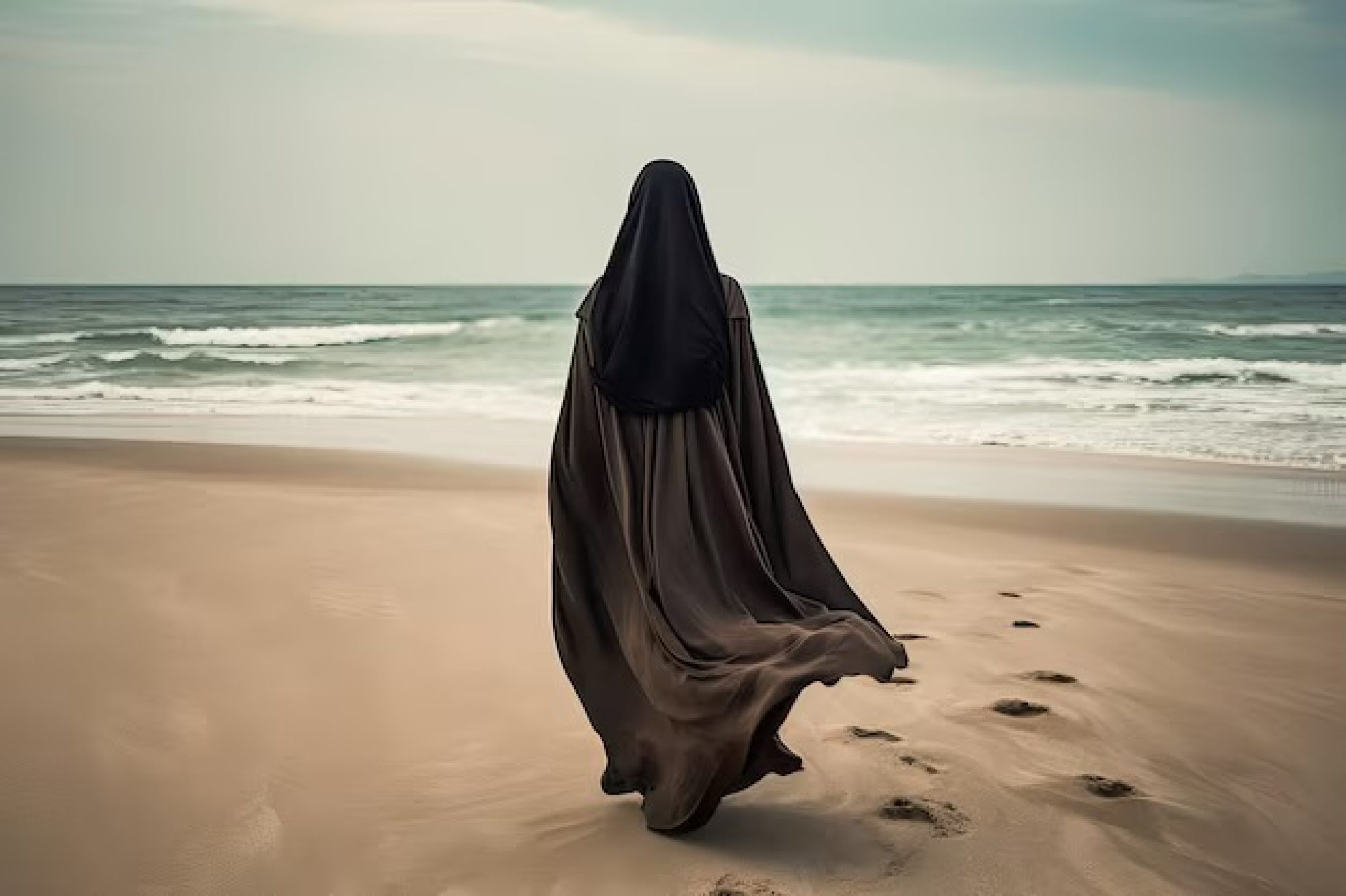
I chose the hijab—and sometimes the niqab—not out of fear, not because a man told me to, and certainly not because I was forced. No one told me to put it on, and no one gets to tell me to take it off. Like the majority of women who wear it—especially reverts like me—I made that choice with full awareness and full agency. And I’m not alone.

You say we’re oppressed?

Either we’re oppressed because we hide our bodies from the sick and perverse male world, or we’re ‘free’ because we expose ourselves to it? That’s not freedom. That’s a narrative. And it’s one I no longer serve.

What is actually delusional is believing that Western society has freed women. Let’s talk about real oppression:

Let’s talk about eating disorders bred by impossible beauty standards.

Let’s talk about women having to sexualize their bodies just to sell products, win attention, or feel validated.

Let’s talk about wage gaps, objectification, and being told our worth lies in how desirable we are to men.

Let’s talk about a society where girls are groomed by screens to believe they are never enough unless they perform.

You want to talk about freedom? That’s not it.

Covering isn’t about shame. It’s not about erasing myself. It’s about reclaiming my autonomy, my space, my peace. It’s not freedom to serve the perversions of the white European man—nor anyone else. That’s just a new kind of slavery.

Even within Islam, there are women who say I shouldn’t cover my face. And just as I accept their journey, they must accept mine. Islam doesn’t erase individuality. It embraces choice—with accountability.

So no—I’m not oppressed. I’m empowered. And the real tragedy is that the people shouting the loudest about saving me are the ones who can’t see the chains around their own necks.

This isn’t submission. This is strength.

This isn’t silence. This is resistance.

And this cloth on my head? It’s mine.

Not yours to question.

Not yours to remove.

Not yours to define.

The Barakah of Gratitude

Across all religions, there’s a common thread: when we’re in need, we turn to God. We’re taught to make dua, to pray, to call on Him when life feels heavy or uncertain. And it’s true—those moments of surrender, when we realise how little control we really have, often bring us closest to the Divine.

But how often do we turn to Allah just to say thank You?

Gratitude is more than a feeling—it’s a way of being. It’s not just about saying “Alhamdulillah” when something good happens. It’s about living in a state of awareness and appreciation, even when things feel ordinary. Because the truth is, nothing is really ordinary. Waking up each morning is a gift. Having food on the table is a blessing. Feeling the warmth of a loved one’s voice, the safety of a roof over your head, the ability to move through your day—these are things we can so easily overlook.

And yet, they’re everything.

For me, living a life of gratitude means living a life of openness. When we express thanks for what we already have, we open the door to receive more. It’s a cycle—giving thanks softens the heart, and a soft heart is a heart that receives. Gratitude is one of the most powerful acts of worship, because it doesn’t come from a place of lack, but from fullness. It says, “I see what You’ve given me. I acknowledge it. I honour it.”

So when we make dua for something we desire, we should also take time to make dua for something we’ve already been given. Before we ask, we must remember to thank. And not just in hard times, or in those moments of desperation—but in the quiet times too. In the everyday moments where everything feels okay.

Because that’s when true gratitude lives.

Personally, every morning when I wake up, the first thing I say is Alhamdulillah. Not out of habit, but from a place of real knowing—He allowed me to wake. That alone is reason to be grateful. Whether it’s unexpected good news, a moment of peace in a noisy day, or simply the blessing of still being here, breathing, witnessing—it all deserves thanks.

Alhamdulillah for everything I have.

Before I ask for more, I remember what already fills my hands.

And that is where barakah begins.

Divine Disconnection: The Selling of Women’s Mysteries and Islamic Empowerment

There’s a rise of women in these spaces calling themselves fierce, calling themselves warriors—but what I’m seeing isn’t strength.
It’s ego.
It’s being dismissive, controlling, unwilling to hear any view but their own.

That’s not power. That’s not maturity. That’s not sacred.

When you shut down conversation, when you bulldoze anyone who doesn’t mirror your beliefs—you’ve narrowed your mind. That’s the very definition of being closed off. And that kind of self-righteousness? It kills growth.

When you’re unwilling to be questioned, you can’t evolve.
When you attack others publicly because they dared to disagree, you’re not holding space—you’re holding a megaphone.
It’s not compassion. It’s not truth.
It’s a performance.

I’ve watched this for years. I didn’t just dip my toes in—I was in it.
I held red tents when they were first beginning. I trained women to hold space before it became trendy.
I used to run full festivals where genuine embodiment was the heartbeat of the work. We had deep trainings that prepared us for this path—how to recognise ego dynamics in circles, how to stay anchored, how to listen.

And now? I’m watching women pass through, cherry-pick bits of what they’ve seen at those festivals or trainings, glue them together into a “program,” run it for a while—and it fizzles. Because it’s not rooted. It’s not real.

It wasn’t born from the heart. It was born from the desire to make money.
And when something comes from ego—it will collapse. Every time.

I stepped away from all of this over a decade ago.
I saw it imploding even back then.
I saw the packaging, the rebranding, the endless cycle of women copying each other’s work, selling it on again with a new name. It lost its heart. And I couldn’t be part of that.

But now I’m watching it burn down—and I need to speak.

This isn’t a callout post. This is a warning to younger sisters:
Be discerning. Don’t confuse volume with truth. Don’t confuse polished branding with integrity.
There’s a poison leaking into what were once sacred spaces.
And if we stay silent, that poison spreads.

These spaces were always meant to be safe.
They were meant to be nurturing.
They were meant to promote growth, to support free thinking.
Because while there may be a common goal in the collective, each individual’s journey is sacred and unique.
There’s no one-size-fits-all model to empowerment.
This push of “either you agree with me or you’re wrong” has to end.
Two truths can coexist.
Multiple truths can coexist.
And that’s what so many women locked in this warrior-blindsided mindset need to remember.

But amidst all of this—there are women I deeply respect.
And I can count them on one hand. I’m actually wearing a scared shawl by one of these very women in my picture, one of many I own as I respect the heart in her work.

So who are these women? They’re not the loudest.
They’re gentle. They’re rooted. They’ve done the work.
They’ve moved through the fire and come out the other side softened, not hardened.

They don’t even realise what they carry is wisdom—because to them, it’s just life. Just love. Just truth.
They glow differently. Their words feel safe. Their work moves differently.

They took time. They let the teachings settle in their bones before they passed anything on.
They bloomed in private before ever teaching in public.
And to those women—I tip my hat.
You’re the ones carrying the medicine.

So no—I’m not angry. I’m not bitter. I’m just deeply sad.
Sad that what was once sacred is now a stage.
Sad that rage is mistaken for empowerment.
Sad that performance has replaced presence.

And no, we don’t need to go back to dancing around the fire.
We need to move with the times, but stay anchored in our bodies.
Rooted in humility.
Grounded in love.

That’s what this work was always meant to be.

And this isn’t just happening in the spaces of feminine mysteries or red tents or embodiment circles.
It’s happening in Islamic spaces too.

There’s a growing wave of Muslim women calling themselves coaches, mentors, guides—selling empowerment from an Islamic lens. And yet so many of these offerings are neither rooted in real feminine work nor grounded in actual Islamic knowledge.

They pull from hadith that may not even be sahih.
They draw loosely from teachings that have been molded to support a personal narrative, not a divine one.
And while they call it Islamic life coaching or Islamic mentoring, what you’re often getting is a confused blend of empowerment language and selective religious references.

It’s not empowerment.
It’s not scholarship.
And it’s certainly not sacred.

And I say this with love—but also with clarity—because I’ve walked both paths.
I’ve trained in the feminine mysteries. I’ve held sacred space long before it became fashionable.
And now I walk the path of Islam, too.

So I see it. The gap.

You can’t sell female empowerment in the ummah if you’ve never truly walked that path.
Because that path isn’t born in textbooks or on Canva slides. It’s born in the body. In blood. In grief. In rites of passage that tore you open and rebuilt you from the inside out.

And in the world of Islamic female empowerment—most of that is missing.

You’re trying to empower women through a patriarchal framework—and yes, Islam grants women rights Western feminism still doesn’t—but the spiritual empowerment people are trying to create here doesn’t quite have a place in the tradition as it stands. Not in the way it’s being packaged.

Because the divine feminine? The goddess current? The womb as a spiritual portal?
That’s not part of Islamic theology.
And if you haven’t lived and understood that current deeply, you can’t pretend to translate it into a sharia-compliant package.

It doesn’t work.
It confuses.
And it quietly disempowers while selling the illusion of growth.

So this is me speaking—not from bitterness, but from deep, heartbroken experience.
From the trenches of real sacred work.
From the path of witnessing what happens when ego tries to masquerade as spirit.

It’s time we remembered the difference.
And honoured it.

Healing Before Love: An Islamic Reflection

Today, a tear slipped down my cheek for a woman I care about deeply.

Not because she hurt me. Not because we argued.

But because she stepped into a new relationship carrying a heart still bleeding from the past.

She hasn’t healed yet—but she’s seeking love as if it will fix what only Allah can.

I see this often, especially with women. The ache of loneliness can become so heavy that silence feels unbearable. The quiet moments turn into whispers of sadness. And in those moments, the idea of being held, seen, loved—it becomes a lifeline. But sometimes, we mistake comfort for connection, and longing for love.

In Islam, we are taught that healing is a mercy, and that even our pain is a reminder to turn inward—to turn toward Allah. “Verily, in the remembrance of Allah do hearts find rest.” (Qur’an 13:28)

Yet many rush into relationships hoping they will fill the void. But if that void is spiritual, no human can fill it. And if our soul is unsettled, we will carry that unrest wherever we go—even into the arms of someone else.

And what happens then?

When you enter a relationship without tending to your own wounds, the risk is great. If your partner lacks emotional depth, compassion, or spiritual grounding, it’s not just mismatched love—it can become a recipe for pain. At best, it leads to heartbreak. At worst, to harm.

Our Prophet Muhammad (peace be upon him) said: “No one should be harmed, nor should harm be reciprocated.” Relationships rooted in pain often end in both.

So I say this not in judgment, but in sorrow. In hope. In dua.

My sister, take time to heal not so you can earn a good partner, but so you can become a whole one. So that when love comes—real, God-sent love—it finds you standing tall, not searching for someone to complete you, but walking beside you in faith.

Heal, not to avoid loneliness, but to discover the sweetness of solitude with your Lord. Heal so that you are not swayed by fleeting affection, but anchored in divine love.

And trust, whatever is meant for you will never pass you by.

Allah Heard, and the Sky Wept

It began raining this afternoon—soft at first, then steadier, almost as if the sky had been holding something in and finally let go. I stood by the window and just watched. I’d been making du’a all day—some of it quietly on my tongue, and some of it just sitting there in my chest, like a knot that needed untangling. I didn’t even realise how constantly I’d been calling out until the rain came and something in me softened.

You know, in Islam, these are not mere coincidences or empty sounds from the sky. Thunder and rain are seen not just as weather, but as signs—ayat—from Allah. Subtle and mighty. They speak in a language deeper than words, and sometimes they say exactly what the heart needs to hear.

The Qur’an says that thunder glorifies Allah. That verse always moves me. The idea that thunder isn’t just noise—it’s dhikr. Worship. It’s glorifying the One who controls everything. That roaring sound that shakes the air? It’s not chaos. It’s praise. Even the angels, we’re told, follow it in awe of Him. That changes everything for me. It makes the storm feel like a prayer in motion.

And rain… rain is mercy. It’s a reminder that something soft and life-giving can fall from the heights of the unseen. Surah An-Nur tells us how Allah gathers the clouds, layers them, and brings forth rain. It’s not a random process—it’s orchestrated. Carefully, lovingly. And it’s said that when it rains, du’as are more likely to be accepted. So when the drops began to fall this afternoon, I couldn’t help but wonder: is this Your way of answering me? Of letting me know You heard me?

I think sometimes Allah responds in ways only our hearts can translate. A feather. A verse. A breeze. A conversation that hits the right chord. Or rain—quietly soaking the earth and something within me at the same time.

Imam Ja’far as-Sadiq (peace be upon him) said that nothing is without meaning. And so I choose to see the signs. Not because I’m desperate for proof, but because I believe in a God who sees me in my stillness. In my longing. In my quiet, constant prayers.

Maybe the rain today was just rain.

But maybe it wasn’t.

And maybe that’s enough.

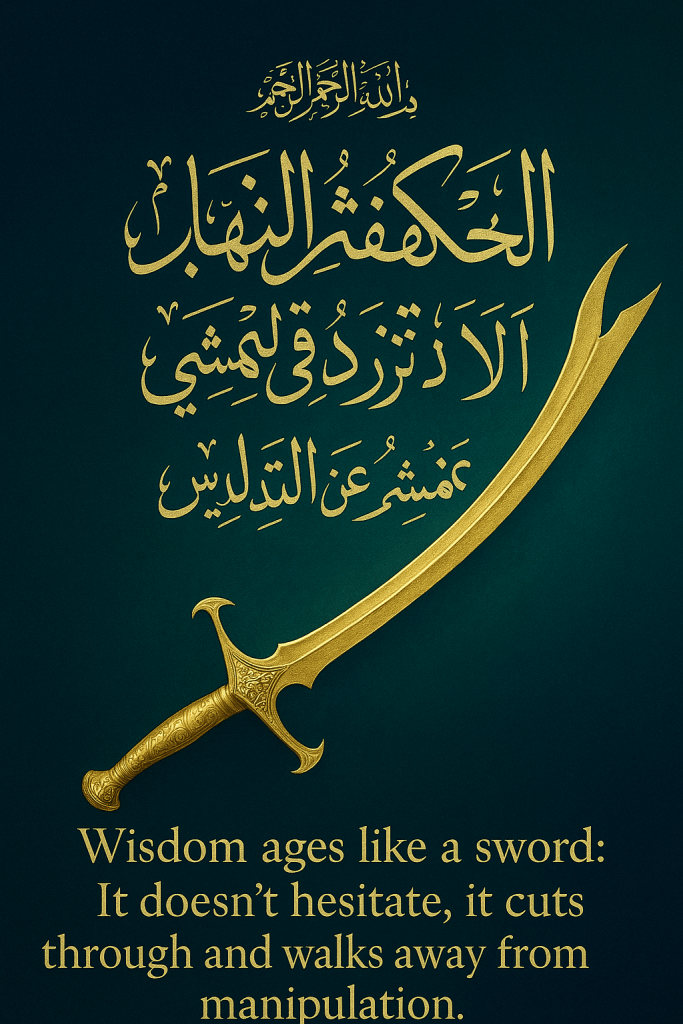
The Zulfiqar of Wisdom: When Time Carves Clarity

With time, Allah grants more than years—He grants basirah, vision that slices through falsehood.And in this sacred vision, the heart becomes sharpened, refined.

What once tolerated chaos now recognizes its scent from a distance.What once made excuses now sees clearly:

This is not naivety.

This is not kindness.

This is dhulm—injustice.

And I will not be part of it.

Allahumma aj‘alni minal mutawakkileen,wa la taj‘alni minal maghrooreen—

O Allah, make me of those who trust in You,and not of those deceived by their own delusions.

In youth, I extended my hand repeatedly.I wept over people who played games,who twisted truth,who wore masks and spoke in half-sincerity.

I thought I could love them into awakening.I mistook endurance for duty.I mistook pain for purification.

But wisdom came.

And with it—Zulfiqar.

Not a weapon of blood.But of furqan—discernment.

A sword that belongs not just to Imam Ali (as),but to every seeker who asks for truth without veil.

Rabbi zidni baseerah.

Grant me insight, O my Lord.Show me what is haqq, and give me the strength to walk toward it—Even if it means walking away.

Zulfiqar does not argue.It does not plead.It does not second-guess what it already knows.

When you reach a certain age—Not in numbers, but in soul—You stop trying to resurrect dead gardens.

You stop watering the same thorn, hoping for a rose.

You see the pattern.

You hear the script.

And you know exactly what will come next—because you’ve lived it before.And this time, you choose you.

Not from pride.

Not from ego.

But because Allah did not place you on this Earth to be a stage for someone else’s ego trip.

Because your time is an amanah—a trust.

And your energy is sacred.

“Ya Allah, protect me from those who drain my spirit,and grant me the strength to walk away with dignity.”

You are still merciful.But your mercy now has boundaries.

You still forgive.But your forgiveness does not come with a return ticket.

You still love.But you no longer let love be a leash.

Because Zulfiqar taught you this:

When the soul matures, it doesn’t just feel deeply.

It sees clearly.

And sometimes the most loving thing you can do—is to walk away with your head held high,while whispering:

“HasbunAllahu wa ni’mal wakeel—Allah is enough for me, and He is the best of protectors.”

And behind you, you leave the chaos,the noise,the manipulation—cut cleanly.

Because wisdom, when it matures,does not shout.

It simply slices,and keeps walking toward light.

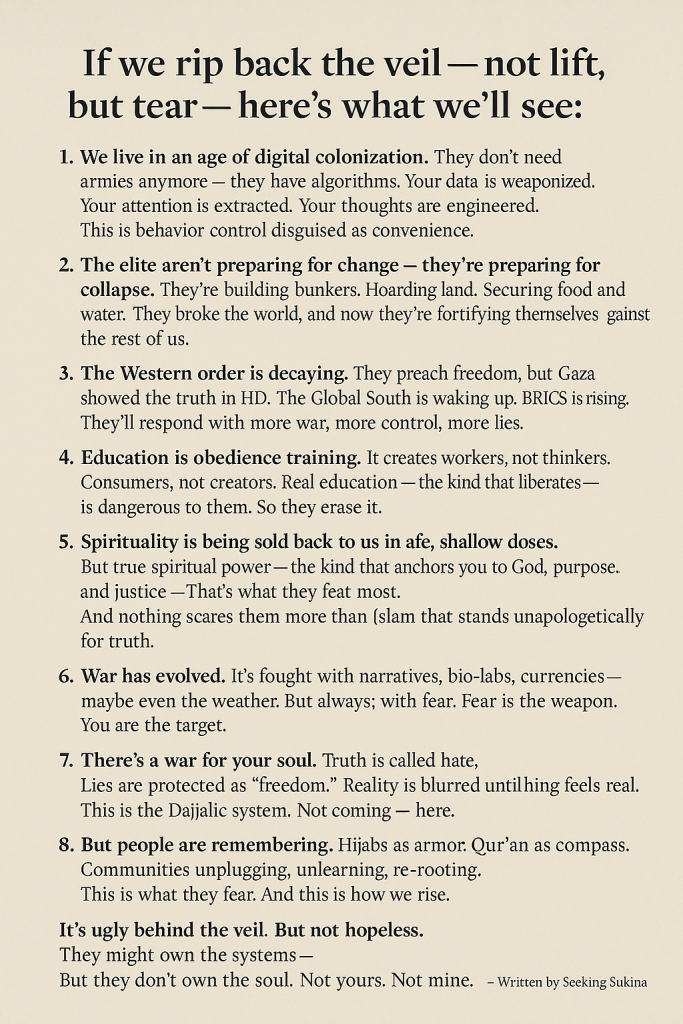
Let’s rip back the veil: The world has changed

Do you really want to know what’s going on ??? Do you really want to see ??

If we really pull back the veil — not gently, but tear it down — here’s what I would tell you:

1. We are living in the age of digital colonization.

The colonizers no longer need ships or soldiers. They’ve replaced them with algorithms, screens, and psychological warfare.

   •   Your data isn’t just tracked — it’s weaponized.

   •   Your attention is mined more ruthlessly than oil.

   •   Your desires, fears, and beliefs are shaped by a few corporations who profit from your distraction and despair.

This isn’t poetic language. This is calculated, AI-driven behavior engineering. The battlefield is your mind — and most people don’t even know they’re in a war.

2. The global elite are not preparing for change — they’re preparing for collapse.

While the world scrambles to survive, the ultra-wealthy are buying bunkers, remote land, and private food and water systems.

Why?

Because they know the truth: the system is broken beyond repair. And they’re not planning to save it.

They’re just making sure they survive without us.

3. The Western liberal order is rotting from the inside.

They preach freedom, democracy, and human rights — but the masks are slipping.

   •   Gaza revealed their hypocrisy in high definition.

   •   The Global South is awakening, and the old empires are shaking.

   •   BRICS is rising, and Western hegemony is desperate to hold on.

Expect more censorship, more surveillance, more wars dressed up as “security.”

4. The education system isn’t about truth — it’s about training obedience.

It doesn’t raise thinkers. It produces compliant workers and consumers.

   •   Children are taught to memorize, not question.

   •   Creativity is suffocated. History is rewritten. Nationalism is normalized.

Real education is dangerous because it liberates the mind — and a liberated mind can’t be controlled.

5. Spirituality is being sanitized and sold.

Pop-astrology. Fake healing. Watered-down “manifestation.”

They give you spirituality without depth, without danger, without real power.

Because real spirituality — the kind that roots you in God, ancestry, and purpose — terrifies the system.

And Islam? Pure, unapologetic Islam? That’s the one they fear most.

Why? Because it demands justice. Truth. Accountability to God — not the state.

6. Wars aren’t just fought with weapons anymore.

They’re fought with:

   •   Narratives — controlled media, propaganda, silence.

   •   Viruses — real and engineered.

   •   Currency — sanctions, digital tracking, economic warfare.

   •   Weather — yes, geoengineering is real.

But the most powerful weapon? Fear. It disables resistance before it even begins.

7. There is a war for your soul.

This isn’t metaphorical. The Dajjal system is here.

   •   Truth is labeled hate.

   •   Lies are protected as “freedom.”

   •   Reality is distorted until nothing feels true.

When nothing feels real, people become spiritually numb, emotionally addicted, and politically passive.

It’s not an accident. It’s designed.

8. But something ancient is waking up.

Even amidst the chaos, people are remembering.

   •   Women are wearing hijab like armor.

   •   Youth are learning Arabic to connect to divine words.

   •   Mothers are raising children outside the matrix.

   •   Communities are growing food, turning off the noise, reclaiming sacred traditions.

This is what they fear.

The silent, rising wave of those who refuse to forget who they are.

So yes — the view behind the veil is raw and terrifying.

But it’s not hopeless. Never has been.

Because they might control the systems — but they do not own the soul.

Not yours. Not mine. Not anyone’s who remembers their truth.

This world?

It’s not home.

It’s the test. The battlefield. The stage.

And the most important thing now is not how dark it gets —

…but who you choose to become while the shadows grow.

So I’ll ask you — do you feel it too?

We’re not just watching history.

We’re part of the turning.

Wrapped in the Whisper of the Cloak: A Mother’s Love, A Son’s Struggle, and the Purification of the Ahl al-Bayt

Today shook me in a way I wasn’t prepared for. I sat beside my son, as he was put under anaesthetic, and it was like time stopped. His eyes were open, but he wasn’t there. It felt like life had been snatched away in an instant. I don’t think I’ll ever forget that moment—how fragile he looked, how helpless I felt. It was a stark reminder of how temporary everything really is. One breath, one heartbeat… and then silence.

As I watched him struggle to wake up, there was a moment where I thought as did the medical team that he wouldn’t and as I was rushed into recovery gowned I remember thinking ——I don’t think I could cope if he was ever in a coma. The thought alone was enough to shatter something inside of me—and it did. As I stood talking to him trying to get him to respond that very thought cracked through that quiet place where I keep my strength stored. It was suddenly hard to breathe. Like grief had settled itself in my chest without asking and I cried as I stood helplessly watching them trying to wake him.

And now that we are home, I know I just need to cry. I need to let it all out—the fear, the helplessness, the ache of being a mother holding everything together when inside, I’m breaking a little.

And yet know there’s so much love in these tears. So much of me pours out with them. It’s not weakness—it’s devotion. It’s the kind of love that hurts because it runs so deep.

And just when I felt like I was holding on by threads, something beautiful had arrived when I was at the hospital —unexpected and perfectly timed. A green pashmina shawl from Karbala gifted quietly, like a whisper from the unseen. I held it in my hands and felt something shift.

Green—the color of the Ahlul Bayt. The color of paradise. A symbol of sacred lineage, of faith, of mourning turned into strength. In Shia tradition, it’s worn with love, loyalty, and remembrance. It carries the legacy of Karbala, of Lady Zainab’s steadfastness, of Imam Hussain’s sacrifice. It represents resilience, truth, and hope—all the things I felt I had run out of today.

Receiving it on a day like this felt like more than coincidence. It felt like a sign. A message. A soft reminder that I am not alone in this. That even in my grief and exhaustion, I am being held by something far greater.

And although I was so tired tonight—bone-tired, soul-tired—I felt a desperate need to get up, to remake my wudu, and to pray. Just two raka’at. Just to thank Allah for being there with me today. And something clicked. For the first time, I truly understood: it’s not about feeling close to Allah. It’s about trusting that He is already close to us. We don’t have to chase the feeling—only hold onto the knowing.

As I prayed with that green scarf wrapped around me, I felt something profound. When I went into sujood, it was like my heart opened. I understood the Ayah of Purification—the moment in the Qur’an when the Prophet Muhammad placed his family beneath a cloak, his nearest and dearest, and Allah declared them purified. I saw it clearly tonight. Why it was them, specifically—the ones known as the Ahlul Bayt. Not the wives, but those souls closest in purity, in truth, in spirit.

And maybe… just maybe… this green cloak that came into my life today was a reminder of that purity. A reminder of that closeness. Of why family is so important. A thread that connects me—us—to something vast and sacred. A bond that runs so deep it carries no words for it needs none.

This scarf isn’t just fabric. It’s a balm. A covering for the heart. A quiet companion on the days I feel like falling apart. And tonight, I’ll keep it close—not just around my shoulders, but wrapped around my spirit too.

Because even on the hardest days… beauty finds a way in. And so does Allah.

To the Sister Who’s Carried Too Much

You’ve been carrying so much for so long. The quiet weight. The unspoken burdens. The roles you stepped into without being asked. Trying to offer comfort to others while your own wounds remained open.

You made it look easy—graceful even—but Allah witnessed the price you paid. He saw the tears you held back so your children could sleep in peace. He saw the prayers you couldn’t utter, frozen by shame. The tired smile you wore after being forgotten, pushed aside, or misunderstood—again.

You believed everything would fall apart if you let go, even for a moment. But Allah never placed all that on your shoulders. He never expected you to repair what others broke. He never told you to harden yourself just to survive. He never demanded you erase your own needs in order to be “worthy.” That wasn’t Him.

That was the noise of the world.

Allah created you luminous. Not to impress, but to be. Not to shrink for others, but to breathe in peace.

Even now, in your exhaustion, confusion, and sorrow—He’s still here. Not waiting for you to “pull it together.” Not disappointed by your storms or silences. Not keeping score of your efforts. Just waiting. For you to release. To return. To remember.

You’ve never been hidden from His gaze.

Not in the depths of despair.

Not in your numbness or your fury.

Not when you couldn’t find yourself in the mirror anymore.

He saw it all.And still, He calls you beloved.

You are not required to perform to be cherished. You do not need to “heal right” to be protected. You only need to come back to your essence.

Because;

your tenderness is power.

Your tears are a form of prayer. And your yearning for peace? That’s not weakness—it’s your soul remembering its origin.

And your hope—that quiet ember you’ve never let burn out—is the light that shines through your face as nūr. It’s the glow that tells the truth of your spirit, even when your voice cannot.

Maybe today is the day you stop tucking away the truth of who you are. Because Allah has never stopped loving you—not even when you forgot how to love yourself. And it’s okay to rest now.

Let Him hold what you no longer can. Let Him restore what’s been frayed inside.

Raise Your Hands, Then Rise to Your Feet .. A call to action

Last night, I couldn’t sleep.

My head was buzzing probably too much caffeine before bed and half from a heaviness I couldn’t name. And just as I drifted off, I woke up with a thought so clear it sat upright in my chest like a stone:

“We treat du’a like it’s a quick fix.”

Earlier that evening, I’d been listening in on a live discussion about Palestine. Someone was saying, “Just keep making du’a. That’s all we can do.” And I get it — truly, I do. I believe in the power of du’a. I believe that the tongue of a believer can move mountains if Allah wills.

But that kind of passive “just make du’a” approach — without action, without strategy, without sacrifice — doesn’t sit right with me.

Because du’a is not the end of the story.

It’s the very beginning.

I wrote something similar during Ramadan when I was reflecting on istikhara — how we often think it’s just about handing over our decisions to Allah and waiting for a sign. But the truth is, even with istikhara, action is needed. You make the prayer and then you move. You take a step and see if it opens up for you or closes off. That’s the test. That’s the trust.

And it’s the same with du’a.

Du’a is not a replacement for action.

It’s the spark that lights the way.

“Indeed, Allah will not change the condition of a people until they change what is in themselves.”

(Qur’an 13:11)

You want something? You ask for it. But then you get up and work for it. You show Allah that you want it — not just with your voice, but with your effort. Your sacrifice. Your sweat.

If you’re praying for a relationship — did you nurture it? Did you protect it? Did you fight for it with dignity and patience?

If you’re praying for success in a business or an exam — did you plan? Did you persevere? Did you take the boring, hard, slow steps that nobody claps for?

“Do people think that they will be left alone because they say: ‘We believe,’ and will not be tested?”

(Qur’an 29:2)

Sometimes your du’a isn’t answered not because Allah said no — but because you never moved towards it. Or maybe, He took it away to see how much you’d chase it. How much you really meant what you asked for.

“Or do you think you will enter Paradise while Allah has not yet made evident those of you who strive and those who are patient?”

(Qur’an 3:142)

We need to stop romanticising passivity.

We need to stop spiritualising laziness.

Especially now, with what’s happening in Palestine. The genocide. The ethnic cleansing. The dehumanisation. Du’a is vital — but it is not enough.

There’s a fatwa now — one that clearly states:

If you are not boycotting.

If you are supporting the oppressor in any shape or form.

Then you are not aligned with Islam. Full stop. https://iumsonline.org/en/ContentDetails.aspx?ID=38846

It’s harsh, yes — but it’s necessary. Sometimes we need truth that cuts through the noise like a blade. And this is one of those moments.

Du’a must be accompanied by action.

By boycott.

By protest.

By education.

By sacrifice.

By showing up even when it’s hard and inconvenient and costly.

And this extends to every part of our lives. Every dream. Every goal. Every prayer.

If you want something — go for it.

If you don’t — don’t expect it to land in your lap.

Allah doesn’t reward silence or stagnancy.

He rewards sincerity in motion.

So yes — make the du’a. Whisper it through tears. Raise your hands in the stillness of the night.

But then get up.

And walk.

And let your feet prove what your heart is asking for.