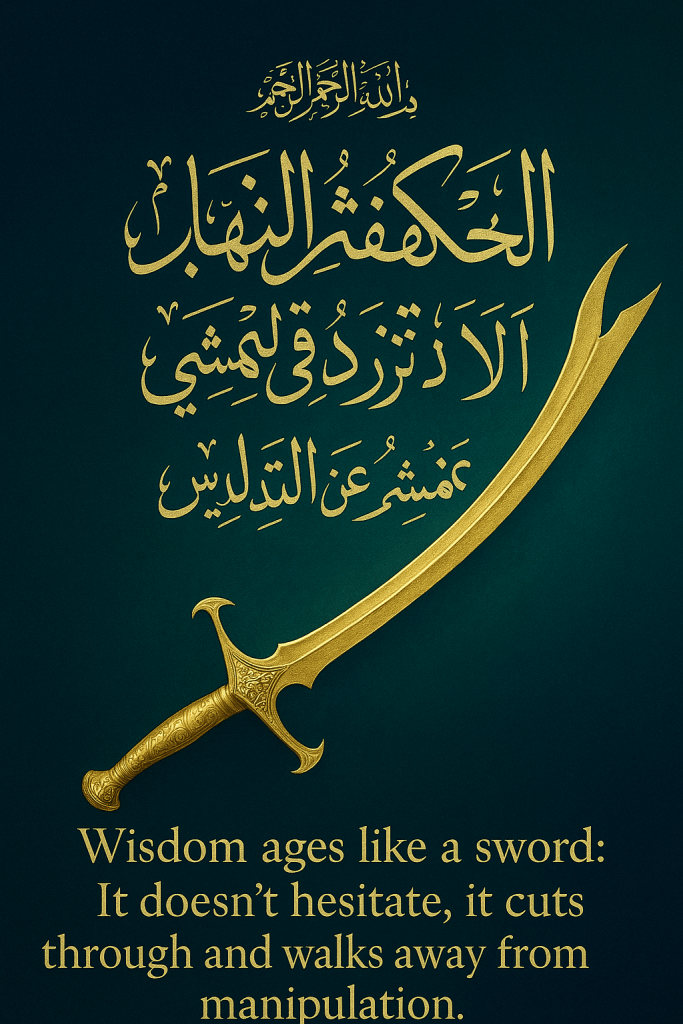
The Zulfiqar of Wisdom: When Time Carves Clarity

With time, Allah grants more than years—He grants basirah, vision that slices through falsehood.And in this sacred vision, the heart becomes sharpened, refined.

What once tolerated chaos now recognizes its scent from a distance.What once made excuses now sees clearly:

This is not naivety.

This is not kindness.

This is dhulm—injustice.

And I will not be part of it.

Allahumma aj‘alni minal mutawakkileen,wa la taj‘alni minal maghrooreen—

O Allah, make me of those who trust in You,and not of those deceived by their own delusions.

In youth, I extended my hand repeatedly.I wept over people who played games,who twisted truth,who wore masks and spoke in half-sincerity.

I thought I could love them into awakening.I mistook endurance for duty.I mistook pain for purification.

But wisdom came.

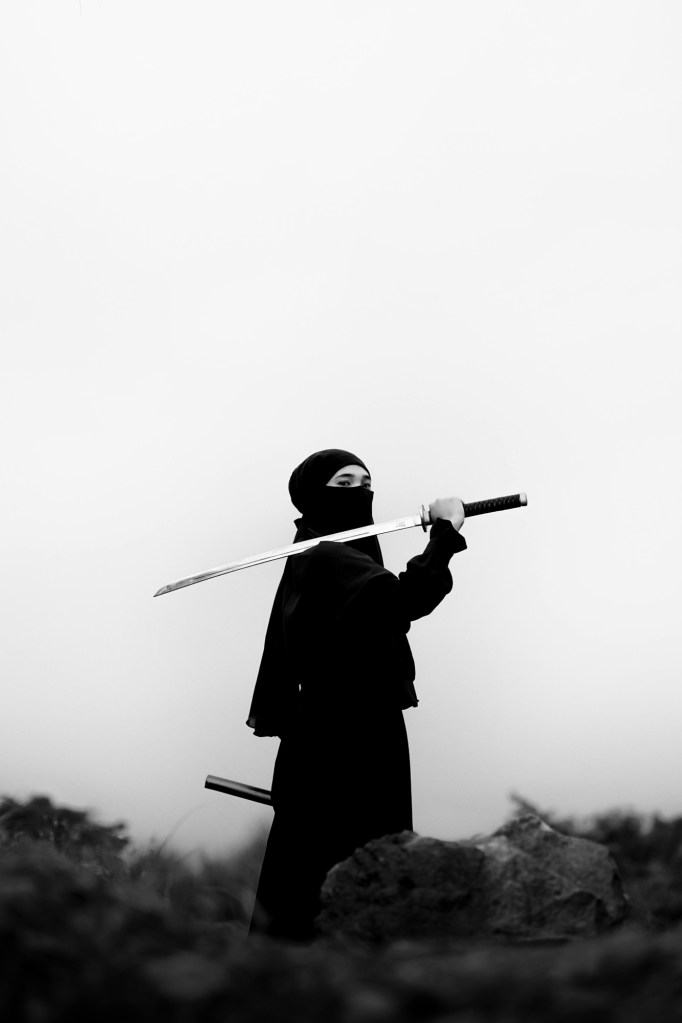
And with it—Zulfiqar.

Not a weapon of blood.But of furqan—discernment.

A sword that belongs not just to Imam Ali (as),but to every seeker who asks for truth without veil.

Rabbi zidni baseerah.

Grant me insight, O my Lord.Show me what is haqq, and give me the strength to walk toward it—Even if it means walking away.

Zulfiqar does not argue.It does not plead.It does not second-guess what it already knows.

When you reach a certain age—Not in numbers, but in soul—You stop trying to resurrect dead gardens.

You stop watering the same thorn, hoping for a rose.

You see the pattern.

You hear the script.

And you know exactly what will come next—because you’ve lived it before.And this time, you choose you.

Not from pride.

Not from ego.

But because Allah did not place you on this Earth to be a stage for someone else’s ego trip.

Because your time is an amanah—a trust.

And your energy is sacred.

“Ya Allah, protect me from those who drain my spirit,and grant me the strength to walk away with dignity.”

You are still merciful.But your mercy now has boundaries.

You still forgive.But your forgiveness does not come with a return ticket.

You still love.But you no longer let love be a leash.

Because Zulfiqar taught you this:

When the soul matures, it doesn’t just feel deeply.

It sees clearly.

And sometimes the most loving thing you can do—is to walk away with your head held high,while whispering:

“HasbunAllahu wa ni’mal wakeel—Allah is enough for me, and He is the best of protectors.”

And behind you, you leave the chaos,the noise,the manipulation—cut cleanly.

Because wisdom, when it matures,does not shout.

It simply slices,and keeps walking toward light.
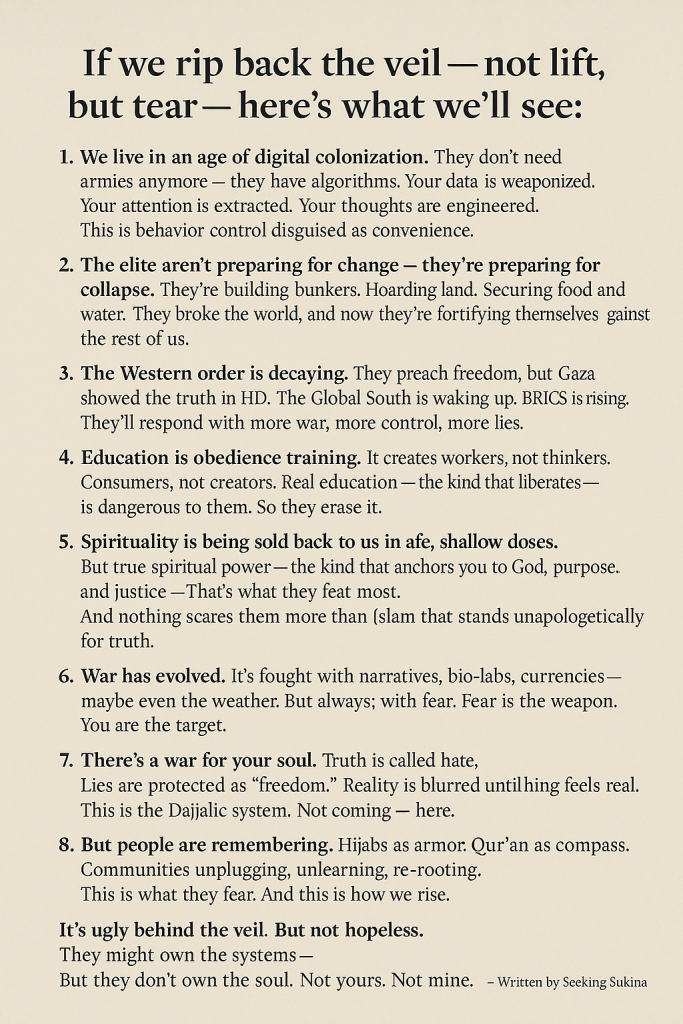
Let’s rip back the veil: The world has changed

Do you really want to know what’s going on ??? Do you really want to see ??

If we really pull back the veil — not gently, but tear it down — here’s what I would tell you:

1. We are living in the age of digital colonization.

The colonizers no longer need ships or soldiers. They’ve replaced them with algorithms, screens, and psychological warfare.

   •   Your data isn’t just tracked — it’s weaponized.

   •   Your attention is mined more ruthlessly than oil.

   •   Your desires, fears, and beliefs are shaped by a few corporations who profit from your distraction and despair.

This isn’t poetic language. This is calculated, AI-driven behavior engineering. The battlefield is your mind — and most people don’t even know they’re in a war.

2. The global elite are not preparing for change — they’re preparing for collapse.

While the world scrambles to survive, the ultra-wealthy are buying bunkers, remote land, and private food and water systems.

Why?

Because they know the truth: the system is broken beyond repair. And they’re not planning to save it.

They’re just making sure they survive without us.

3. The Western liberal order is rotting from the inside.

They preach freedom, democracy, and human rights — but the masks are slipping.

   •   Gaza revealed their hypocrisy in high definition.

   •   The Global South is awakening, and the old empires are shaking.

   •   BRICS is rising, and Western hegemony is desperate to hold on.

Expect more censorship, more surveillance, more wars dressed up as “security.”

4. The education system isn’t about truth — it’s about training obedience.

It doesn’t raise thinkers. It produces compliant workers and consumers.

   •   Children are taught to memorize, not question.

   •   Creativity is suffocated. History is rewritten. Nationalism is normalized.

Real education is dangerous because it liberates the mind — and a liberated mind can’t be controlled.

5. Spirituality is being sanitized and sold.

Pop-astrology. Fake healing. Watered-down “manifestation.”

They give you spirituality without depth, without danger, without real power.

Because real spirituality — the kind that roots you in God, ancestry, and purpose — terrifies the system.

And Islam? Pure, unapologetic Islam? That’s the one they fear most.

Why? Because it demands justice. Truth. Accountability to God — not the state.

6. Wars aren’t just fought with weapons anymore.

They’re fought with:

   •   Narratives — controlled media, propaganda, silence.

   •   Viruses — real and engineered.

   •   Currency — sanctions, digital tracking, economic warfare.

   •   Weather — yes, geoengineering is real.

But the most powerful weapon? Fear. It disables resistance before it even begins.

7. There is a war for your soul.

This isn’t metaphorical. The Dajjal system is here.

   •   Truth is labeled hate.

   •   Lies are protected as “freedom.”

   •   Reality is distorted until nothing feels true.

When nothing feels real, people become spiritually numb, emotionally addicted, and politically passive.

It’s not an accident. It’s designed.

8. But something ancient is waking up.

Even amidst the chaos, people are remembering.

   •   Women are wearing hijab like armor.

   •   Youth are learning Arabic to connect to divine words.

   •   Mothers are raising children outside the matrix.

   •   Communities are growing food, turning off the noise, reclaiming sacred traditions.

This is what they fear.

The silent, rising wave of those who refuse to forget who they are.

So yes — the view behind the veil is raw and terrifying.

But it’s not hopeless. Never has been.

Because they might control the systems — but they do not own the soul.

Not yours. Not mine. Not anyone’s who remembers their truth.

This world?

It’s not home.

It’s the test. The battlefield. The stage.

And the most important thing now is not how dark it gets —

…but who you choose to become while the shadows grow.

So I’ll ask you — do you feel it too?

We’re not just watching history.

We’re part of the turning.

Wrapped in the Whisper of the Cloak: A Mother’s Love, A Son’s Struggle, and the Purification of the Ahl al-Bayt

Today shook me in a way I wasn’t prepared for. I sat beside my son, as he was put under anaesthetic, and it was like time stopped. His eyes were open, but he wasn’t there. It felt like life had been snatched away in an instant. I don’t think I’ll ever forget that moment—how fragile he looked, how helpless I felt. It was a stark reminder of how temporary everything really is. One breath, one heartbeat… and then silence.

As I watched him struggle to wake up, there was a moment where I thought as did the medical team that he wouldn’t and as I was rushed into recovery gowned I remember thinking ——I don’t think I could cope if he was ever in a coma. The thought alone was enough to shatter something inside of me—and it did. As I stood talking to him trying to get him to respond that very thought cracked through that quiet place where I keep my strength stored. It was suddenly hard to breathe. Like grief had settled itself in my chest without asking and I cried as I stood helplessly watching them trying to wake him.

And now that we are home, I know I just need to cry. I need to let it all out—the fear, the helplessness, the ache of being a mother holding everything together when inside, I’m breaking a little.

And yet know there’s so much love in these tears. So much of me pours out with them. It’s not weakness—it’s devotion. It’s the kind of love that hurts because it runs so deep.

And just when I felt like I was holding on by threads, something beautiful had arrived when I was at the hospital —unexpected and perfectly timed. A green pashmina shawl from Karbala gifted quietly, like a whisper from the unseen. I held it in my hands and felt something shift.

Green—the color of the Ahlul Bayt. The color of paradise. A symbol of sacred lineage, of faith, of mourning turned into strength. In Shia tradition, it’s worn with love, loyalty, and remembrance. It carries the legacy of Karbala, of Lady Zainab’s steadfastness, of Imam Hussain’s sacrifice. It represents resilience, truth, and hope—all the things I felt I had run out of today.

Receiving it on a day like this felt like more than coincidence. It felt like a sign. A message. A soft reminder that I am not alone in this. That even in my grief and exhaustion, I am being held by something far greater.

And although I was so tired tonight—bone-tired, soul-tired—I felt a desperate need to get up, to remake my wudu, and to pray. Just two raka’at. Just to thank Allah for being there with me today. And something clicked. For the first time, I truly understood: it’s not about feeling close to Allah. It’s about trusting that He is already close to us. We don’t have to chase the feeling—only hold onto the knowing.

As I prayed with that green scarf wrapped around me, I felt something profound. When I went into sujood, it was like my heart opened. I understood the Ayah of Purification—the moment in the Qur’an when the Prophet Muhammad placed his family beneath a cloak, his nearest and dearest, and Allah declared them purified. I saw it clearly tonight. Why it was them, specifically—the ones known as the Ahlul Bayt. Not the wives, but those souls closest in purity, in truth, in spirit.

And maybe… just maybe… this green cloak that came into my life today was a reminder of that purity. A reminder of that closeness. Of why family is so important. A thread that connects me—us—to something vast and sacred. A bond that runs so deep it carries no words for it needs none.

This scarf isn’t just fabric. It’s a balm. A covering for the heart. A quiet companion on the days I feel like falling apart. And tonight, I’ll keep it close—not just around my shoulders, but wrapped around my spirit too.

Because even on the hardest days… beauty finds a way in. And so does Allah.

To the Sister Who’s Carried Too Much

You’ve been carrying so much for so long. The quiet weight. The unspoken burdens. The roles you stepped into without being asked. Trying to offer comfort to others while your own wounds remained open.

You made it look easy—graceful even—but Allah witnessed the price you paid. He saw the tears you held back so your children could sleep in peace. He saw the prayers you couldn’t utter, frozen by shame. The tired smile you wore after being forgotten, pushed aside, or misunderstood—again.

You believed everything would fall apart if you let go, even for a moment. But Allah never placed all that on your shoulders. He never expected you to repair what others broke. He never told you to harden yourself just to survive. He never demanded you erase your own needs in order to be “worthy.” That wasn’t Him.

That was the noise of the world.

Allah created you luminous. Not to impress, but to be. Not to shrink for others, but to breathe in peace.

Even now, in your exhaustion, confusion, and sorrow—He’s still here. Not waiting for you to “pull it together.” Not disappointed by your storms or silences. Not keeping score of your efforts. Just waiting. For you to release. To return. To remember.

You’ve never been hidden from His gaze.

Not in the depths of despair.

Not in your numbness or your fury.

Not when you couldn’t find yourself in the mirror anymore.

He saw it all.And still, He calls you beloved.

You are not required to perform to be cherished. You do not need to “heal right” to be protected. You only need to come back to your essence.

Because;

your tenderness is power.

Your tears are a form of prayer. And your yearning for peace? That’s not weakness—it’s your soul remembering its origin.

And your hope—that quiet ember you’ve never let burn out—is the light that shines through your face as nūr. It’s the glow that tells the truth of your spirit, even when your voice cannot.

Maybe today is the day you stop tucking away the truth of who you are. Because Allah has never stopped loving you—not even when you forgot how to love yourself. And it’s okay to rest now.

Let Him hold what you no longer can. Let Him restore what’s been frayed inside.

Raise Your Hands, Then Rise to Your Feet .. A call to action

Last night, I couldn’t sleep.

My head was buzzing probably too much caffeine before bed and half from a heaviness I couldn’t name. And just as I drifted off, I woke up with a thought so clear it sat upright in my chest like a stone:

“We treat du’a like it’s a quick fix.”

Earlier that evening, I’d been listening in on a live discussion about Palestine. Someone was saying, “Just keep making du’a. That’s all we can do.” And I get it — truly, I do. I believe in the power of du’a. I believe that the tongue of a believer can move mountains if Allah wills.

But that kind of passive “just make du’a” approach — without action, without strategy, without sacrifice — doesn’t sit right with me.

Because du’a is not the end of the story.

It’s the very beginning.

I wrote something similar during Ramadan when I was reflecting on istikhara — how we often think it’s just about handing over our decisions to Allah and waiting for a sign. But the truth is, even with istikhara, action is needed. You make the prayer and then you move. You take a step and see if it opens up for you or closes off. That’s the test. That’s the trust.

And it’s the same with du’a.

Du’a is not a replacement for action.

It’s the spark that lights the way.

“Indeed, Allah will not change the condition of a people until they change what is in themselves.”

(Qur’an 13:11)

You want something? You ask for it. But then you get up and work for it. You show Allah that you want it — not just with your voice, but with your effort. Your sacrifice. Your sweat.

If you’re praying for a relationship — did you nurture it? Did you protect it? Did you fight for it with dignity and patience?

If you’re praying for success in a business or an exam — did you plan? Did you persevere? Did you take the boring, hard, slow steps that nobody claps for?

“Do people think that they will be left alone because they say: ‘We believe,’ and will not be tested?”

(Qur’an 29:2)

Sometimes your du’a isn’t answered not because Allah said no — but because you never moved towards it. Or maybe, He took it away to see how much you’d chase it. How much you really meant what you asked for.

“Or do you think you will enter Paradise while Allah has not yet made evident those of you who strive and those who are patient?”

(Qur’an 3:142)

We need to stop romanticising passivity.

We need to stop spiritualising laziness.

Especially now, with what’s happening in Palestine. The genocide. The ethnic cleansing. The dehumanisation. Du’a is vital — but it is not enough.

There’s a fatwa now — one that clearly states:

If you are not boycotting.

If you are supporting the oppressor in any shape or form.

Then you are not aligned with Islam. Full stop. https://iumsonline.org/en/ContentDetails.aspx?ID=38846

It’s harsh, yes — but it’s necessary. Sometimes we need truth that cuts through the noise like a blade. And this is one of those moments.

Du’a must be accompanied by action.

By boycott.

By protest.

By education.

By sacrifice.

By showing up even when it’s hard and inconvenient and costly.

And this extends to every part of our lives. Every dream. Every goal. Every prayer.

If you want something — go for it.

If you don’t — don’t expect it to land in your lap.

Allah doesn’t reward silence or stagnancy.

He rewards sincerity in motion.

So yes — make the du’a. Whisper it through tears. Raise your hands in the stillness of the night.

But then get up.

And walk.

And let your feet prove what your heart is asking for.

The Sword and the Veil: A Reflection on Hijab

The hijab is a journey — not a punishment, not a prison, and certainly not a measuring stick for piety. It is not something to be weaponised or used as a yardstick to shame others into submission.

It’s a veil of devotion. A symbol of presence. A sacred marker that each woman must come to in her own time, in her own way, and with her own heart.

And the truth is — the head covering isn’t unique to Islam.

In Judaism, Orthodox women cover their hair with scarves or wigs after marriage. In Christianity, early traditions expected women to cover their heads during prayer and worship. Paul even wrote in 1 Corinthians 11:5–6:

“But every woman who prays or prophesies with her head uncovered dishonors her head—it is the same as having her head shaved. If a woman does not cover her head, she might as well have her hair cut off.”

Modesty has always existed in sacred traditions — but it was never about control. It was about reverence. Humility. Sacred space.

In the Qur’an, the word khimār is used — a cloth that was already being worn by women at the time. The instruction in Surah An-Nur (24:31) is to draw it over the bosom. Why? Because people used to walk around half-naked in that society. The verse was about refining modesty, not inventing it. It was about dignity, not dominance. It was about helping Muslim women be recognised, respected, and protected — not scrutinised and shamed.

But today, that’s what it’s become for many of us — especially online.

Too many brothers — and yes, I say brothers first because it’s mainly them — are calling out sisters for what they call “incomplete hijab.”

They’re focused on makeup.

On lashes.

On colourful scarves.

On strands of hair.

And most of these voices are coming from hardline mindsets — Salafi, Wahhabi-flavoured thinking — using harshness and fear instead of compassion and understanding. They quote Hadith, but they forget adab. They preach Qur’an, but ignore its mercy.

Meanwhile, they are silent on genocide. Silent on Palestine. Silent on corruption, war, and poverty.

Where is your outrage when children are being bombed?

Where is your energy when the Ummah is bleeding?

Why is a sister’s eyeliner more offensive than an orphan’s cry?

On the Day of Judgment, each soul will be accountable for its own actions.

“No bearer of burdens shall bear the burden of another.” (Qur’an 6:164)

You won’t be judged for my scarf.

And I won’t be judged for your beard.

So many people misuse the deen to control others. They wield rules without wisdom. They use Islam as a stick, not a path. And sisters like me — who are trying, stumbling, returning, recommitting — are left feeling judged, excluded, not good enough.

But I believe this, with my whole heart:

We all have our own path to Allah.

We will not be asked if our scarf was pinned tight enough — but we will be asked if our heart was sincere. If we tried. If we showed mercy. If we remembered Him.

I don’t believe that Allah — the Most Merciful — is going to condemn me for a few eyelashes or a slip of hair. I believe He sees the effort, the pain, the intention — the quiet ways I seek Him through the chaos of life.

Hijab is not just a piece of cloth.

It’s a mirror.

A sword.

A shield.

And it must be worn with awareness, yes — but also with love.

Not shame.

Not fear.

Not for others.

But for Him.

So to the sisters still figuring it out: you’re not alone.

To the ones who wear hijab and still feel the pressure: I see you.

To those who are returning after years away: may your journey be soft.

And to those who judge: may Allah soften your hearts and open your eyes.

Let us stop turning the veil into a weapon.

Let us carry the sword with mercy — not to wound, but to protect.

Let the hijab be light.

Let it be love.

Let it be yours.

The Weight of Forgiveness

“Do you need to forgive someone?”

It’s a simple question, yet it carries the weight of our deepest wounds. Forgiveness is often mistaken for excusing what has been done to us, for letting someone escape accountability. But in truth, forgiveness is not about the other person—it is about us. It is about releasing the burden we carry, the pain that still lingers in our hearts, shaping our thoughts, our actions, our ability to move forward.

Allah reminds us in the Qur’an:

“And let them pardon and overlook. Would you not like that Allah should forgive you? And Allah is Forgiving and Merciful.” (Surah An-Nur 24:22)

Forgiveness is not a sign of weakness. It is an act of strength. It is the decision to say, “What you did was wrong, but I will not let it define my life.” By holding on to resentment, we chain ourselves to the past, reliving the hurt over and over. Letting go is not about erasing the past—it is about freeing ourselves from its hold.

But perhaps the hardest person to forgive is ourselves. We carry guilt for staying too long, for giving too many chances, for believing in change that never came. We punish ourselves for the choices we made, even when we did the best we could with what we knew at the time. Yet Allah, in His infinite mercy, does not hold us to an impossible standard. He tells us:

“Say, O My servants who have transgressed against themselves [by sinning], do not despair of the mercy of Allah. Indeed, Allah forgives all sins. Indeed, it is He who is the Forgiving, the Merciful.” (Surah Az-Zumar 39:53)

If Allah, whose justice is perfect, is willing to forgive us, why do we struggle to forgive ourselves?

Forgiveness is not forgetting. It is not pretending that the hurt never happened. It is acknowledging the pain, but choosing not to let it define us. It is saying, “I will no longer be bound by this.” And in that, we find freedom.

So, do you need to forgive someone? Maybe that someone is you.

All I see is beauty…

O Lady Zainab,

In the darkest moments, when cruelty and suffering surrounded you,you saw only beauty.

Amidst the horrors of Karbala,with your brother’s head upon a spear,your family torn apart by the forces of oppression,you stood, shackled and humiliated,yet your heart remained untouched,pure and steadfast.

When the world sought to break you,to extinguish the light of truth,you looked beyond the pain,beyond the bloodshed and loss,and in that moment,you declared,

“All I see is beauty.”

O Lady Zainab,

Your words were not mere words;they were a testament to your divine vision,a vision that saw not the cruelty of the oppressors,but the eternal beauty of your family’s sacrifice.

You saw the beauty in their unwavering faith,in their unyielding commitment to justice,in their sacrifice for the sake of Allah,a beauty that no darkness could eclipse.

You stood not as a victim,but as a beacon of resilience,a reflection of the strength that flows through the veins of the Ahl al-Bayt.

In your eyes, we see the truth of Karbala,a truth that transcends time,a truth that shines brighter than all the suffering,a truth that will never fade.

O Lady Zainab,

You are the embodiment of grace and strength,the woman who, in the face of torment,saw beauty where others saw only destruction.

You remind us that in the darkest of times,there is always light—light in sacrifice, in faith, in truth.Your courage is our inspiration,your words our guide.May we always strive to see the beauty in the struggles we face,to hold onto the divine purpose behind our hardships,and to stand firm in our faith as you did,unshaken by the storms of this world.

O Lady Zainab,

Your legacy is a garden of beauty,nurtured by the tears of sacrifice,and watered by the love of Allah.

May we honor you with every breath and with every step we take toward justice and truth.

Forever and always,

we remember you,

and we are guided by your light.

“Genocide Live: The World Watches, the West Betrays, and Humanity Dies”

Today, I Sat to Write—But I Couldn’t

I opened my laptop, ready to write after a month of Ramadan, a month of seeking closeness to Allah. But I couldn’t. The words wouldn’t come. Not because I had nothing to say, but because there is too much—too much horror, too much betrayal, too much rage.

Instead, I find myself sharing images, videos, anything to get the truth out. The speed of this genocide has shifted into high gear, and the world is still watching, still doing nothing. I see things most will never see, images that burn into my mind, that keep me awake at night. And I have never been so angry. Never felt so helpless.

How did we get here? How did we let it come to this?

And worse—how do we stop it?

This is a time of reckoning, a time of unbearable weight on the conscience of the world. What is unfolding in Gaza is not just another conflict—it is a genocide in real-time, with the slaughter of innocent men, women, and children playing out before our eyes. It is a slow, deliberate extermination of a people, while those in power lie, cover up, and betray not just the Palestinians, but their own citizens, their own so-called democratic values.

The West, with its grand proclamations of human rights and freedom, has been unmasked. The governments that claim to champion justice and democracy are either complicit or cowardly, and the people are left screaming into a void. Protests, once a force of millions, dwindle in numbers. The outrage is still there, but the exhaustion is setting in. And so we ask, again and again—what is the answer?

Were we ever really in control? Did we ever have a say, or were we simply pacified, led to believe that our voices carried weight when in truth, the scales have always been tipped in favor of those who wield power through oppression? Perhaps the real illusion was that we were ever part of the equation at all.

Some say history repeats itself, but maybe it never ended. Maybe World War II wasn’t the end of an era of genocide but the blueprint for what we see now. The very horrors that justified the creation of Israel are now being used to justify its crimes. And yet, the world remains silent or, worse, cheers on the slaughter. The propaganda machine has done its job well—dividing, conquering, twisting reality until truth itself is seen as an act of rebellion.

In the UK, we see this sickness manifest in other ways. Hate-fueled mobs target immigrants, burn buildings, barricade people inside—because anger, when misdirected, becomes a weapon for the powerful. Instead of rising against the true oppressors, people are manipulated into fighting each other. This is by design. It has always been by design.

And so, we return to the question—how do we stop this? Can we? Or has the balance of power tipped so far that resistance is nothing more than an echo in the wind? As an Ummah, as a global community, where do we turn when our voices are drowned out, our efforts dismissed, our people slaughtered without consequence?

If there was ever a test of humanity, of faith, of perseverance—it is now. And yet, the fear remains: What if we fail? What if we already have?

Today, I Planted an Olive Tree

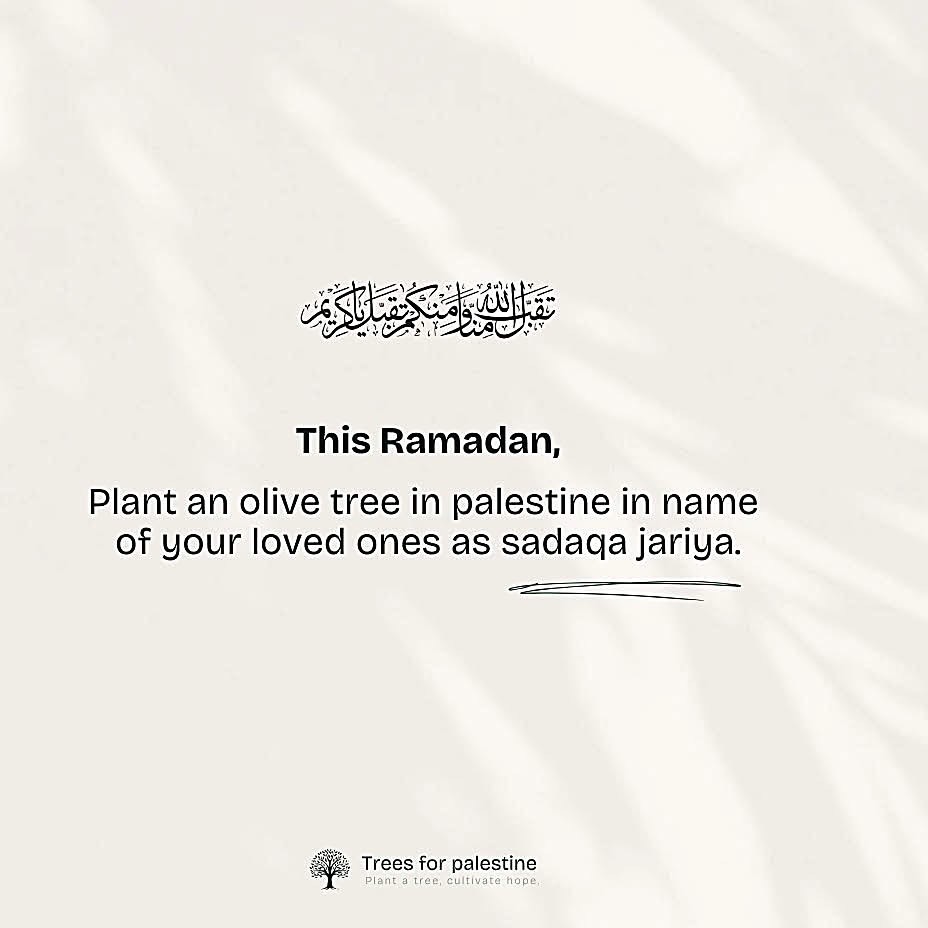
Today, I planted an olive tree.

Its roots curled into the earth, searching,

and as I patted the soil down, it whispered to me.

It told me of the land—

of the golden sun that kissed its ancestors,

of the winds that carried the laughter of children,

of the call to prayer that wove through the hills

like a thread binding hearts to Allah.

It told me of the people—

the hands that had tended its forebears,

calloused but kind, strong but gentle,

their fingers stained with the ink of history

and the scent of jasmine and warm bread.

It told me of the other trees—

the ones who had stood for centuries,

silent witnesses to faith and struggle,

until the axes came,

until the fire rained down,

until the ground drank something deeper than water.

It spoke with tears,

for the earth is drenched in blood now.

And the trees that remain murmur in mourning,

their branches heavy with loss,

their roots tangled with the names of those

who stood and gave their lives to defend them.

And I wonder—

will this little sapling see peace?

Or will it, too, one day whisper of sorrow?

For the Prophet ﷺ said,

“The trees will speak at the end of days.”

And I fear what they might say.

But today, I planted an olive tree.

And one day, it will grow tall.

And one day, it will tell its own tales.

Let us pray they are of love and laughter,

of golden suns and gentle winds,

of a land where no more blood is spilled,

only water, only rain,

only mercy.