There is something subtle happening in our public conversations about hijab, and it deserves reflection.
In the West, hijab is often portrayed as a symbol of oppression. We know this narrative. It is shaped by political imagery, by cultural practices in certain regions, and by a broader misunderstanding of Islam.
But if we are honest, we must also look inward.
Increasingly, hijab is being framed — even by Muslim women — primarily as a tool of protection from men. We say: We wear it to protect ourselves from the male gaze. We say: It shields us. We say: It prevents objectification.
There is truth in these statements. Divine law contains wisdom. Modesty carries dignity.
But wisdom (ḥikmah) is not the same as obligation (farḍ).
The reason we wear hijab is not because men look.
The reason we wear hijab is because Allah commanded it.
If tomorrow there were no men on earth, the obligation would remain.
When protection becomes the primary narrative, the axis shifts. Hijab begins to sound like a reaction to male behavior instead of an act of devotion. It moves from worship to sociology. From obedience to explanation.
And that shift has consequences.
Externally, it reinforces the very critique used against us:
“If women must cover to protect themselves from men, then the burden is on women.”
Hijab becomes framed as defensive — something women must do because men cannot control themselves.
But hijab is not a response to men.
It is a response to Allah.
Internally, this framing creates confusion — especially for reverts and young Muslim women. When hijab is presented primarily as functional — protective, empowering, socially beneficial — it subtly becomes conditional. And anything conditional becomes negotiable.
But obligation is not negotiable.
Hijab is not worn because society is flawed.
Hijab is worn because Allah is worthy of obedience.
That obedience stands whether society understands it or not. Whether it is politically convenient or not. Whether it feels empowering in a given moment or not.
And What of “Hijab Is a Journey”?
Here we must speak carefully.
Struggle is real. Fear is real. Family pressure is real. Workplace discrimination is real. The vulnerability of new Muslims navigating identity shifts is real.
Growth takes time. Implementation can require courage.
But we must distinguish between spiritual growth and redefining obligation.
It is one thing to say:
“I know this is an obligation, and I am striving toward it.”
It is another to say:
“It is not obligatory until I feel ready.”
The first is humility.
The second reshapes theology.
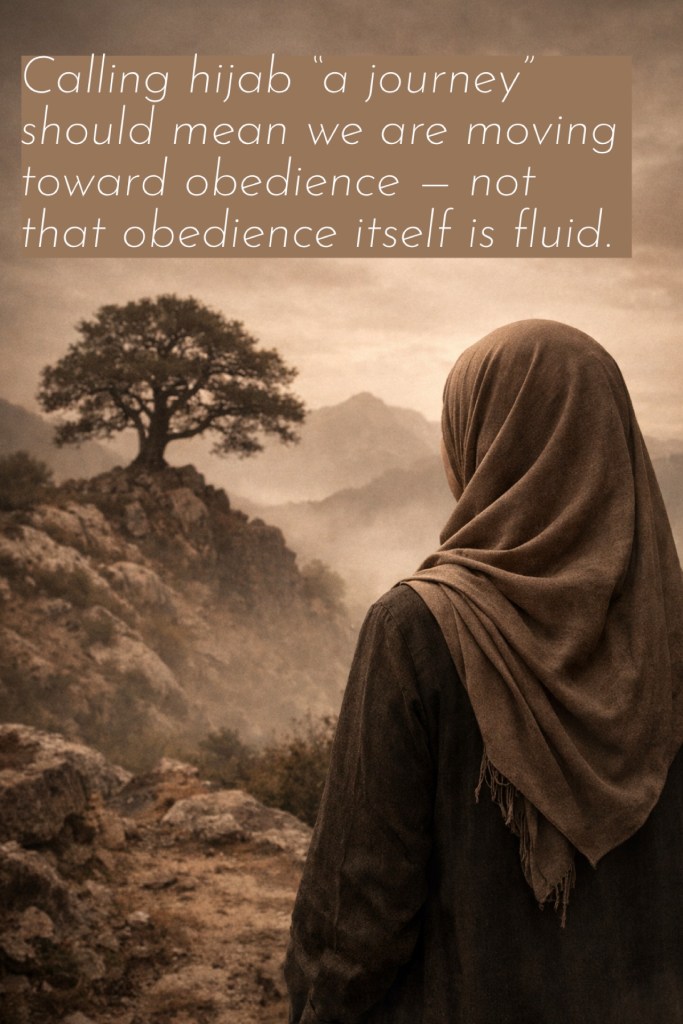
Calling hijab “a journey” should mean we are moving toward obedience — not that obedience itself is fluid.
We all fall short in different ways. Our shortcomings do not change what Allah has commanded.
Compassion must not blur clarity.
The Language We Use Matters
There is a deeper danger here.
When we rush to explain hijab in ways that are palatable to a Western audience, we subtly begin to center their comfort over our creed.
We start saying:
“It’s for protection.”
“It’s empowering.”
“It’s cultural.”
“It’s a personal choice.”
And while pieces of these statements may contain truth, they are not the foundation.
The foundation is obedience.
If our primary explanation avoids saying “because Allah commanded it,” then we have already shifted the center.
Islam does not require sociological justification to stand.
An obligation does not need to be marketed.
We do not soften divine law so that it is easier to defend in interviews or on social media reels.
We do not recalibrate farḍ to survive criticism.
And we certainly do not frame women’s obedience as a response to male weakness.
Hijab is not a negotiation with society.
It is an alignment with revelation.
And revelation does not bend to public opinion.
When we speak publicly, we are not only defending ourselves from critics. We are teaching. We are shaping how Islam is understood by reverts. We are forming the theological instincts of the next generation.
If we center hijab on male behavior, we hand critics a narrative that is easy to weaponize.
If we center hijab on ʿubūdiyyah, the conversation changes entirely.
We are not covering because we are afraid of men.
We are covering because we submit to Allah.
That submission is not weakness.
It is allegiance.
There is dignity in obedience.
There is stability in clarity.
And when the root is firm, the fruits will speak for themselves.
Discover more from Seeking Sakina
Subscribe to get the latest posts sent to your email.
 Seeking Sakina