
Five years ago — maybe slightly longer — I took my Shahada, declaring my faith in Allah, Subḥānahu wa Ta‘ālā. I entered Islam as a revert, and like many of us, I believed that the only way to practice was to follow what I had been shown at the start: the Sunni practices, the hadith collections, the rules everyone seemed to adhere to. I thought this was the path — the one true way — and I clung to it because I was afraid. Afraid of standing out, of being called a Kāfir or a Munāfiq, afraid that to question or to explore would mean rejecting Islam itself.
For years, I followed the herd. I ran with the crowd. I obeyed not always because I understood or felt it in my heart, but because the fear of judgment loomed larger than the call of truth within me. But the Qur’an itself reminds us that we must not simply accept things blindly. Allah Subḥānahu wa Ta‘ālā commands us to seek knowledge — ʿilm — and to reflect, to ask, to question, and to understand:
“Say, ‘Are those who know equal to those who do not know?’ Only they will remember [who are] people of understanding.” (Qur’an 39:9)
It is ḥalāl and encouraged in Islam to seek knowledge, to ponder, and to discover the truth for oneself. And it is this pursuit of ʿilm — this flow of learning, reflection, and honest self-inquiry — that has carried me over the past six months into the depths of my own understanding. It has been a slow, sometimes frightening, but ultimately liberating process of self-discovery.
Through this journey, I realized that it is very easy to follow the crowd. To conform. To accept without questioning. And it can be dangerous for some reverts; some may cling so tightly to a single path that they never stop to wonder if it aligns with their conscience, with their heart, with their understanding of the Qur’an. But I could not stay silent with myself. I could not simply repeat practices that felt hollow or disconnected from my soul. I had to be authentic — honest — in what I believed, in what resonated, in what connected me to Allah.
Even the simplest acts of worship, the things I had always struggled to make sense of, became clearer in this exploration. For years, I could never fully grasp the logic or meaning of some Sunni wudu practices. Repetition felt mechanical, and certain steps seemed confusing or disconnected. But over time, I realized that the ways I naturally performed these acts — guided by my heart, by sincerity, by reflection — had a place. Only today did I discover that these practices align beautifully with the Jaʿfarī school of thought. Everything I had been doing intuitively, from a heartfelt point of view, has a home within this tradition. That realization was profoundly validating: my inner compass, my natural spiritual inclinations, were not random or wrong — they were part of a living, thoughtful, and deeply ethical school of Islamic practice.
Around the year 2024/5, I discovered Shi‘ism and began to follow the Shia path. Everything started to align and fall into place, even my ability to speak my prayers in Arabic. I remember vividly: where previously I had not been able to speak a word of Arabic as a Sunni, suddenly I could recite my prayers in the language of the Qur’an with connection and sincerity. And now, today, to realize that all the natural practices I had been following over the last five years aligned with a school of thought and a marjaʿ — a guiding figure — gave me such an incredible sense of belonging, of anchoring. This anchoring does not rigidly dictate my faith; rather, it strengthens it, giving me confidence, direction, and a home within Islam that resonates with the way my heart and conscience naturally operate.
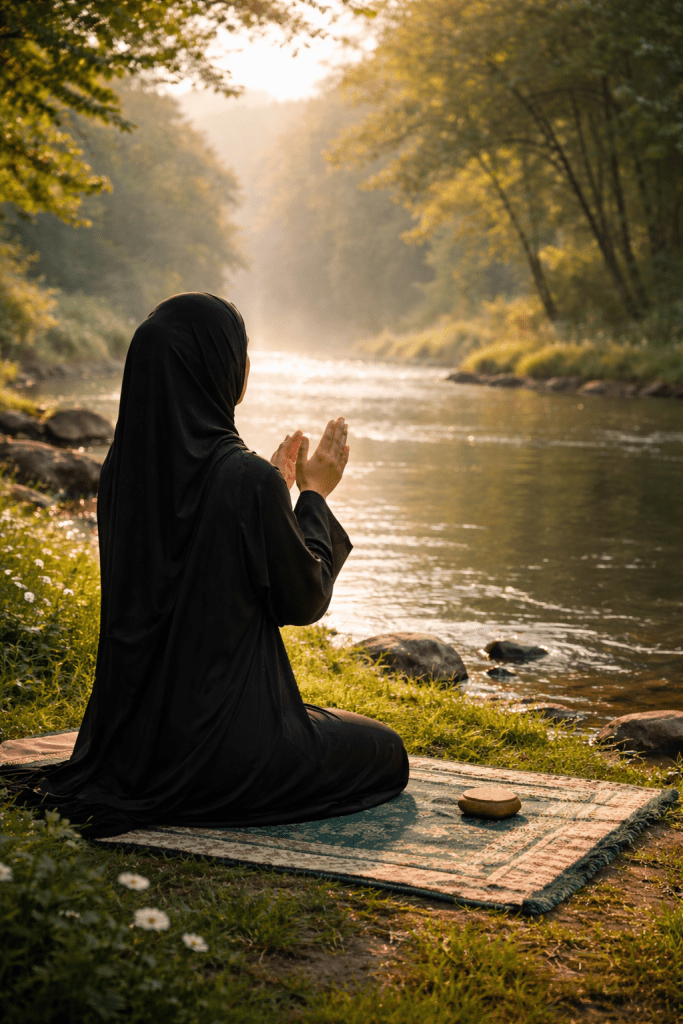
The very name, Jaʿfarī, speaks to me: it means “flowing stream” — a river, always moving, always alive, never stagnant. That is exactly how I have felt on this journey. My faith has not been fixed in one rigid channel; it has moved, it has flowed, it has explored, and now, seeing that it has a home within the Jaʿfarī tradition, it has returned to the Source — Allah, Subḥānahu wa Ta‘ālā.
The Jaʿfarī approach is, in many ways, like myself. It is quieter, inward, reflective. Ethical, intentional, and thoughtful. Less obsessed with surface conformity or performing rituals for the approval of others. It emphasizes understanding, reason (ʿaql), and the teachings of the Ahl al-Bayt, rather than the pressure of habit or inherited cultural expectation. In finding that my practices naturally fit here, I have found a mirror of my own spiritual self: contemplative, seeking, flowing, alive.
And that is the beauty of this journey. Islam is not one river, nor one rigid channel. It is a multiplicity of streams, all flowing back to the One God, Allah Subḥānahu wa Ta‘ālā. And it is a profound gift to be able, as a human being, to explore the variations within Islam, to navigate these streams, to find the channel that nurtures your soul while keeping your heart rooted in the Qur’an, in sincerity, and in love for Allah.
I cannot help but think: if more Muslims were allowed — even encouraged — to seek their own path to Allah, to explore, to question, to reflect, there would be far less struggle, far less fear, and far more connection to the Divine. There would be less worry about fitting in, about performing, about being judged. There would be more peace, more authenticity, more rivers flowing freely toward the Source.
And so here I am, 5/6 years after my Shahada, standing in the stream I have discovered for myself. It is quiet, it is reflective, it is alive. It is my faith — flowing, moving, reaching toward Allah, Subḥānahu wa Ta‘ālā, with sincerity, intention, and ʿilm. And I am learning, every day, to flow with it, to embrace it, and to trust in the mercy and guidance of Allah, the Most High.
Discover more from Seeking Sakina
Subscribe to get the latest posts sent to your email.
 Seeking Sakina
So good and so true. So many people around the world in Islam think that being a Muslim means you have to conform to Arab culture and it’s just not true. More importantly, that kind of thinking takes away our natural curiosity and drive to go deeper, just as you said. Thank you for sharing, I learned something new, about the Jaʿfarī school of thought. I’m going to research now! I feel the same way about the rigidity and sometimes religiosity of sunnah, especially when they say things like you can’t rest your elbows on the mat during prayer, because only a dog would do that. To each their own but I know there is a more simplistic way to connect with Allah beyond the legalism
LikeLike