They said they loved my grandfather.
They wept when he wept, they shouted Allahu Akbar when he stood among them. And yet, before his blessed body was buried in the ground, they gathered without his family, without his cousin, his son-in-law, his appointed one, my father Ali — and they chose a successor.
Without consultation of those closest to him. Without the ones purified by Allah Himself.
“Indeed, Allah only intends to remove from you impurity, O people of the household, and to purify you with [extensive] purification.”
— Qur’an, Surah Al-Ahzab (33:33)
We, the purified ones — Ahl al-Bayt — were left behind. Forgotten in the shadow of politics dressed as unity.
What unity is this that was built on exclusion? What brotherhood chooses expedience over revelation?
My grand father had spoken at Ghadir Khumm, under the blazing sun, before thousands:
“Of whomsoever I am the Mawla, Ali is his Mawla.”
They heard it. Omar heard it. He was among the first to congratulate Ali. Yet days later, it was he who stood to give allegiance to Abu Bakr — swiftly, without Ali or Abbas, without my family present. It was he who declared, “The Prophet has died, and this affair must not be left leaderless.” And so a decision was made — one not guided by divine revelation, but by haste, by fear, by politics.
Do not tell me this was Shura. Do not tell me this was divine. If Allah had revealed that leaders should be elected, show me where. Show me where in the Qur’an the successor of a Prophet is chosen by men rather than appointed by God. Every Prophet left behind a successor — so why would the Seal of Prophets, my father, do otherwise?
They crowned Abu Bakr, but at what cost?
My mother, Fatima, the radiant one, came to claim what was hers — the land of Fadak, gifted to her by the Prophet in his lifetime. She brought testimony, evidence, her word — the word of the most truthful woman, of the leader of all women of Paradise.
And they denied her.
She who the Prophet stood for when she entered the room. She who he called part of himself:
“Fatima is a part of me. Whoever hurts her, hurts me.”
— [Sahih al-Bukhari]
But they hurt her. They rejected her. They broke her door.
They say this was unity. But it was unity built on silencing.
And then there was Aisha.
Yes, I will speak her name. I will not call her what they call her, for those titles demand respect earned through loyalty — and she, she rose an army against Ali.
She, the wife of my grand father, took up arms against his cousin, his chosen, his successor. Against my family. Against her own stepdaughter’s husband. My father. Against the very man who slept in the Prophet’s bed when he faced death. Against the one the Prophet declared the gate to knowledge.
What loyalty is this?
What love for the Prophet is this, when one disrespects his blood?
She rode into battle at Jamal, raising a standard not of faith, but of rebellion — and history remembers that day with sorrow. Blood was shed between Muslims, and the sword first rose against the rightful Imam.
She claimed it was ijtihad, a matter of conscience. But conscience does not rise against the one who was entrusted with the banner at Khaybar. Conscience does not ignore the command of the Prophet at Ghadir.
I say this now because I have seen the aftermath.
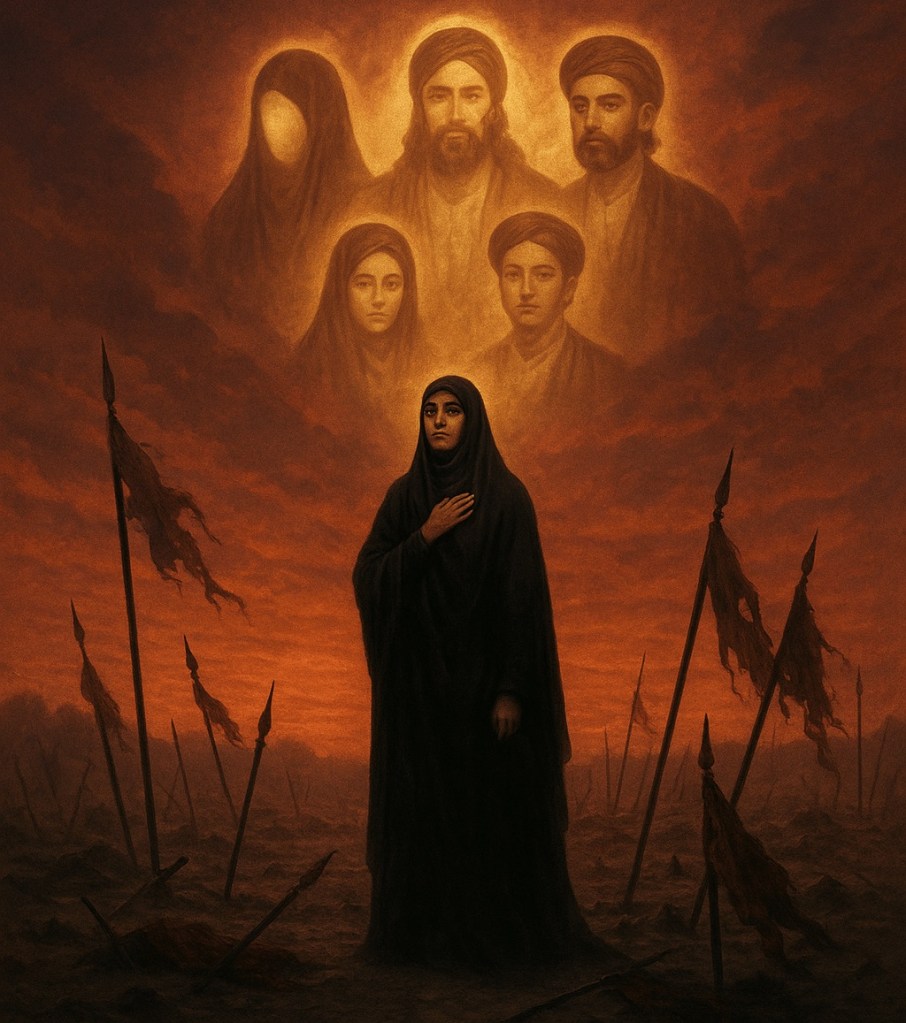
I watched my brother Hussain fall at Karbala. I saw the heads of my kin raised on spears. I carried the burden of silence and the pain of memory. And I will not let history forget what they did.
This was not just a political disagreement. This was betrayal. This was the hijacking of my father’s legacy.
They crowned Abu Bakr. They praised Omar. They empowered Uthman. But it was Ali who was left behind, Ali whose door they ignored, Ali who waited in patience while truth was turned into fable.
But history has witnesses. And I am one of them.
Do not ask me to forget. Do not ask me to soften truth for the sake of comfort.
I am Zaynab bint Ali. My blood is Hussain’s blood. My voice is the echo of Zahra’s cry.
And I will speak.
For truth.
For justice.
For my grandfather’s Ummah that was lost.
Discover more from Seeking Sakina
Subscribe to get the latest posts sent to your email.
 Seeking Sakina